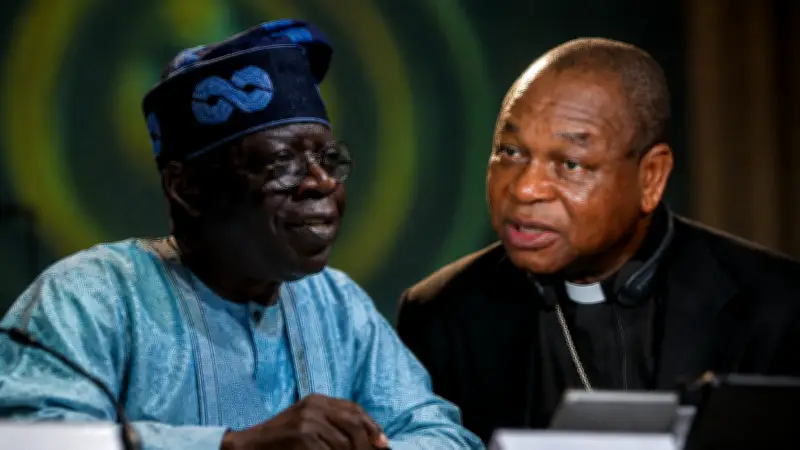
Archbishop Emeritus John Onaiyekan has revealed that President Bola Tinubu argued with delegates of the Catholic Bishops' Conference of Nigeria (CBCN) during a closed-door meeting at the Presidential Villa on Thursday, insisting that the nation's economy was performing well despite the bishops' concerns about worsening hardship. Onaiyekan, who was part of the delegation, said the president's reaction demonstrated that he was being shielded from the true state of affairs in the country.
President's Reaction to Bishops' Assessment
Speaking on Arise Television's Prime Time programme on Friday, Onaiyekan said the president's facial expression showed displeasure with the bishops' appraisal of the economy. "You asked me, how did I see the face of the President in reaction? I was not surprised that he was not looking very happy. Not even his colleagues who were there. We knew that this is different from the kind of statements that our president keeps receiving from all kinds of people," he said.
The retired archbishop explained that one of the delegation's major concerns was that the president was surrounded by aides who fed him a rosy picture of the country. "And that is one of the things that worries us. That there are so many people hanging around Mr President, giving him a rosy picture of what the country is, which it is not. And we felt that we have no duty to do that. Indeed, we have the obligation to help him to appreciate the reality of the situation in which we find ourselves. And that is the reality that we painted, which I know is not the kind of thing that he wanted to hear. And the reply shows very clearly," Onaiyekan said.
Both Sides Stuck to Their Positions
Onaiyekan said the meeting ended with neither side changing its position. The bishops delivered their message, and the president gave his response, making it clear that he did not accept their narrative about the economy.
"And you can see his reply. We left that hall, both sides, knowing that we said what we had to say. He said what he had to say. His reply is that the nation is not bleeding. We told him our economy is not helping our poor people. He told us the economy is doing fine. Practically speaking, he told us quite clearly that he did not agree with us. Again, I said, we're not surprised. We didn't expect him to agree with us. We have done our duty. We have delivered our message," he said.
'When the Nation Is Bleeding, Don't Expect a Polite Meeting'
Asked whether the meeting could be described as frosty, particularly because Nigerians are accustomed to polite interactions between religious leaders and political officeholders, Onaiyekan said the gravity of the country's problems required honest conversations. "When the nation is bleeding, you can't expect a polite meeting with the head of state. We need to let him know," he stated.
Despite the disagreement, Onaiyekan expressed optimism that some of the president's aides would eventually bring the bishops' concerns to his attention. "And we have a feeling that somehow along the line, somebody will show him a few of the things we said," he said.
CBCN's Agenda: Security, Education, Democracy, Poverty
The delegation, led by the President of the CBCN, Archbishop Matthew Ndagoso of Kaduna, raised several critical issues during the meeting, including security, the quality of tertiary education and limited spaces, sustaining the gains of democracy, credible elections, and poverty.
Archbishop Ndagoso also called on President Tinubu to consider returning mission schools to their owners and to ensure fair treatment for all worshippers, including the provision of worship places in every part of the country without bias.
"As a man who risked so much in the struggle for the return of democratic rule in the dark days of the military dictatorship, your greatest legacy would be the strengthening of our democratic institutions," Ndagoso said.
Delegation of 15 Bishops
The delegation comprised 15 bishops from across Nigeria, along with several priests and a lay official. Among them were Most Rev. Alfred Martins, Archbishop of Lagos and CBCN Vice President; Most Rev. Peter Odetoyinbo, Bishop of Abeokuta and CBCN Secretary; Most Rev. Moses Chikwe, Auxiliary Bishop of Owerri and CBCN Assistant Secretary; Peter Cardinal Okpaleke, Bishop of Ekwulobia; Most Rev. Ignatius Kiagama, Archbishop of Abuja; Most Rev. Gabriel Abegunrin, Archbishop of Ibadan; Most Rev. Valerian Okeke, Archbishop of Onitsha; Most Rev. Emmanuel Badejo, Bishop of Oyo; Most Rev. Gerald Musa, Bishop of Katsina; Most Rev. Matthew Kukah, Bishop of Sokoto; and Archbishop John Onaiyekan.
Others were Most Rev. Callistus Onaga, Bishop of Enugu; Most Rev. Godfrey Onah, Bishop of Nsukka; Most Rev. Augustine Echema, Bishop of Aba; Most Rev. Christopher Naseri, Auxiliary Bishop of Calabar; Rev. Fr. Michael Banjo, CBCN Secretary General; Rev. Fr. Peter Audu, Director of the Church and Society Department; Rev. Fr. Michael Imhadowinyi; and Dickson Adeyanju.
Economic Reforms and Criticism
Since President Tinubu assumed office in May 2023, he has introduced major economic reforms, including the removal of the petrol subsidy and the unification of the foreign exchange market. The federal government has defended these policies as essential for economic stability and attracting investment.
However, the reforms have resulted in a sharp rise in fuel prices, transportation costs, food inflation, and the general cost of living. These outcomes have drawn criticism from labour unions, civil society organisations, and religious leaders, including the Catholic bishops who met with the president.