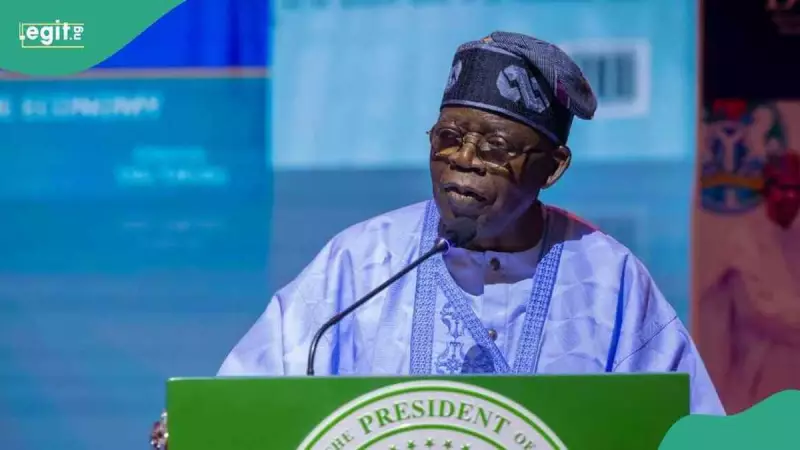
The year 2025 proved to be a defining period for Nigeria under the leadership of President Bola Ahmed Tinubu. His administration implemented a series of bold and often controversial policies that reshaped the nation's political landscape, security architecture, and socio-economic policies. These decisions sparked intense nationwide debate, drawing mixed reactions from citizens and analysts alike.
From declaring states of emergency to overhauling the education system and enacting sweeping tax laws, the government's actions left a lasting imprint on governance and daily life. Below is a detailed look at the ten major decisions that shaped Nigeria throughout the year.
Governance and Political Decisions
In a dramatic move to address a protracted political crisis, the federal government declared a state of emergency in Rivers State in March 2025. This decision led to the suspension of Governor Siminalayi Fubara, his deputy, and the state's House of Assembly for a period of six months. The crisis was rooted in a fierce power struggle involving the incumbent governor and the former governor, now FCT Minister Nyesom Wike.
To manage the state's affairs, retired Navy Vice-Admiral Ibok-Ete Ekwe was appointed as the sole administrator. This intervention highlighted the federal government's willingness to take direct control in situations of severe political instability.
In a separate act of executive power, President Tinubu exercised his constitutional prerogative of mercy in October 2025. He granted pardons and sentence commutations to 175 individuals. The list included symbolic, posthumous pardons for historical figures like Herbert Macaulay, Mamman Vatsa, and the executed Ogoni Nine, including Ken Saro-Wiwa.
However, this move was not without controversy. The initial inclusion of Maryam Sanda, convicted for the 2017 killing of her husband Bilyaminu Bello, on the pardon list ignited national outrage. Following severe backlash, the presidency reviewed the list, commuting her death sentence to 12 years imprisonment and removing her from the outright pardon category.
Economic and Administrative Reforms
June 2025 saw a landmark shift in Nigeria's fiscal policy as President Tinubu signed four major tax reform Bills into law. The new legislation, including the Nigeria Tax Act 2025 and the Nigeria Revenue Service (Establishment) Act 2025, repealed outdated statutes, consolidated overlapping taxes, and established a centralized revenue authority aimed at improving efficiency.
In a decision that directly impacted citizens, the Nigeria Immigration Service announced a sharp increase in passport fees in August 2025. Effective from September 1, 2025, the cost of a five-year passport doubled from ₦50,000 to ₦100,000, while the ten-year passport rose to ₦200,000. Interior Minister Olubunmi Tunji-Ojo defended the hike, stating it would fund automation, reduce processing delays, and enhance document security, promising delivery within one week.
After a delay of over two years, the President also took steps to address a diplomatic vacuum by submitting the names of three non-career ambassador nominees—Kayode Are, Aminu Dalhatu, and Ayodele Oke—to the Senate in November 2025.
Security and Education Overhauls
Responding to escalating security challenges, President Tinubu declared a nationwide security emergency in November 2025. The emergency measures authorized the immediate recruitment of 20,000 new police officers and the deployment of forest guards to dislodge armed groups from remote areas. The President emphasized the urgent need to protect lives, secure schools, and safeguard communities.
Complementing this, a major reshuffle of the nation's top military leadership occurred in October 2025. New service chiefs were appointed, including General Olufemi Oluyede as Chief of Defence Staff and General Waidi Shaibu as Chief of Army Staff, signaling a renewed strategy to combat insecurity.
In the education sector, the Federal Government unveiled a revised national curriculum for primary and secondary schools ahead of the 2025/2026 academic session. The new curriculum placed a stronger emphasis on vocational training, technical skills, and digital literacy, while also bolstering national history and civic education. Officials stated the goal was to better align educational outcomes with labour market demands.
Furthermore, the Nigerian Education Loan Fund (NELFUND) significantly expanded its operations in 2025. By May, it had disbursed ₦56.85 billion in loans, benefiting nearly 300,000 students across 198 tertiary institutions. The loans covered tuition fees and provided living allowances, offering relief to many families despite ongoing concerns about the scheme's long-term transparency and repayment structures.
Impact and National Discourse
The cumulative effect of these ten decisions defined the year 2025 for Nigeria. They demonstrated an administration willing to take assertive, and at times unilateral, action across multiple spheres of national life. While some moves, like the education reforms and student loan expansion, were met with cautious optimism, others, such as the passport fee hike and the Maryam Sanda clemency controversy, sparked significant public discontent.
The declaration of emergency rule in Rivers State set a precedent for federal intervention in state-level political crises. Simultaneously, the nationwide security emergency and military reshuffle reflected the government's acknowledgment of the persistent threat posed by kidnappings, banditry, and insurgency, though their long-term efficacy remains to be seen.
Ultimately, these decisions shaped not only policy but also the national conversation, highlighting the tensions between decisive governance, economic pressures, public trust, and the quest for stability in Africa's most populous nation.