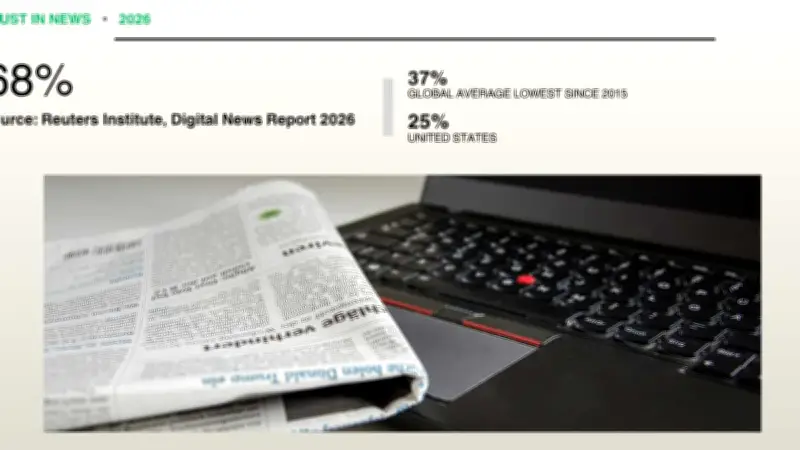
The Reuters Institute's Digital News Report 2026 has revealed that trust in news media has fallen to its lowest level since tracking began in 2015, with the global average now at 37%. However, Kenya and Nigeria stand out as exceptions, recording overall trust of 68%—the joint highest among all 48 markets surveyed. In contrast, the United States has an overall trust score of just 25%.
African Markets Defy Global Decline in Media Trust
The report, based on responses across 48 markets, found trust dropping in 29 of them. Kenya and Nigeria's 68% trust scores place them well ahead of other nations, marking a significant shift in the global media landscape. South Africa, which was second in 2022, has fallen to ninth place this year, with its trust score dropping 5 percentage points to 50%.
The decline in trust correlates with newsroom economics. The report notes that South Africa's Mail & Guardian reduced its staff by 12 people from an already small newsroom of 25 permanent staff, following the Media24 print shutdowns that began in 2024. This pattern of shrinking newsrooms and falling trust contrasts sharply with the growth seen in Kenya and Nigeria.
Digital Natives Lead Trust in Kenya and Nigeria
In Kenya's online news category, TUKO.co.ke leads with a weekly reach of 62%, ahead of Citizen TV online, Kenyans.co.ke, and Daily Nation online. In Nigeria, the Reuters Institute's country page names Legit.ng as the second Nigerian digital-born brand that continues to grow, particularly among younger audiences, despite challenges including press freedom rankings, advertising economics, and cybercrime laws.
These trusted newsrooms are not state broadcasters or century-old newspapers. They are commercial, digital-first operations competing for the same distracted, platform-hopping audience as other media, but winning its trust rather than assuming it.
Building Trust Through AI-Assisted Editorial Practices
At TUKO.co.ke, editorial judgement is supported by EditorialEye, an in-house AI assistant trained on the newsroom's editorial guides, SEO standards, and ethical frameworks. The tool checks, flags, and recommends, but never writes, with every final decision resting with a human editor. This distinction matters as the Media Council of Kenya's State of the Media 2025 report indicates that 63% of Kenyan media consumers cannot tell AI-generated content from traditional reporting.
At Legit.ng, the approach is reflected in specific stories. When a claim spread that South Africa had denied BUA Group chairman Abdul Samad Rabiu a visa, FactCheckAfrica rated the claim misleading. Rabiu had been refused entry due to an expired visa the day before, not a rejected application. The verification named Legit.ng among outlets that had reported it accurately from the outset.
In September, a Facebook post mangled the name and numbers behind a pledge by SDP presidential candidate Adewole Adebayo. FactCheckAfrica confirmed the pledge was genuine—an 11 to 15 kilowatt solar commitment for every Nigerian roof within 11 months—and listed Legit.ng's reporting alongside PUNCH, Vanguard, and Pulse Nigeria as accounts that captured it correctly.
Trust as a Daily Practice, Not an Entitlement
Briefly News and YEN.com.gh are addressing similar issues in their own markets, highlighting the value of a pan-African perspective on this data. The Reuters Institute notes a caveat on both Kenya and Nigeria's country pages: samples skew toward younger, urban, English-speaking respondents, so figures should not be read as nationally representative. However, this caveat supports the argument that the audience most exposed to AI-generated content and information disorder is the one reporting high trust in news.
Legacy newsrooms elsewhere are still treating trust as something they are entitled to defend. The newsrooms actually gaining trust have stopped defending and started earning it through verified stories, disclosed AI use, and open corrections. This approach is harder to maintain but, according to the evidence, is the only one still working.