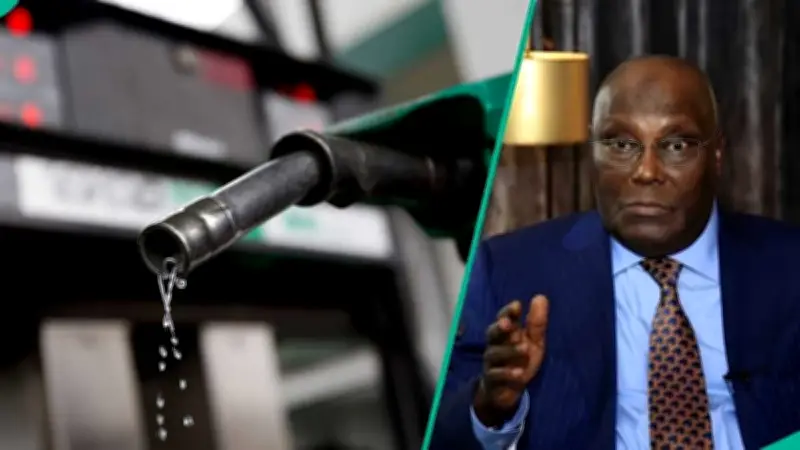
Paul Ibe, media adviser to former Vice President Atiku Abubakar, has rejected the Federal Government's assertion that petrol is cheaper in Nigeria than in the United States, arguing that the comparison fails to account for the significant income gap between workers in both countries.
Ibe's reaction follows comments made by Heineken Lokpobiri, the Minister of State for Petroleum Resources (Oil), during an appearance on Channels Television's Politics Today programme on Tuesday, September 22. Lokpobiri had claimed that petrol sold for an average of about N1,430 per litre in Nigeria, compared with roughly N1,633 in the US, and that Nigeria's prices were also lower than those in Cameroon, Ghana, and South Africa.
Income and Purchasing Power Matter More Than Nominal Prices
Ibe argued that any price comparison that strips out purchasing power and cost of living is economically incomplete. He stressed that what a worker can afford to buy with a month's wages matters far more than the raw price at the pump.
"At about N1,400 per litre, Nigeria's N70,000 minimum wage buys only 50 litres of petrol," Ibe said. He added that a worker earning the US federal minimum wage for four weeks could purchase roughly 981 litres of petrol at prevailing American pump prices.
Ibe called on the government to publish data showing petrol costs as a share of wages, alongside figures on real household income, food inflation, transport costs, unemployment, poverty levels, and purchasing power. He argued that these numbers would give Nigerians a clearer picture of where the burden actually falls.
Fuel Costs and the Wider Economy
Ibe also highlighted the knock-on effects of high petrol prices in Nigeria, where road transport dominates the movement of goods and petrol-powered generators remain common in homes and businesses, as reported by Tribune.
He said rising fuel costs tend to push up prices for food, transportation, and production, squeezing household budgets beyond just what families spend at the filling station.
"Affordability is measured against income, purchasing power and cost of living. Any comparison that leaves those out is economically incomplete," Ibe said.
Minister Defends Deregulation Amidst Rising Prices
For his part, Lokpobiri maintained that the Federal Government had no direct control over petrol prices under a deregulated market, since crude oil and refined products are traded globally. He also said the pressure on consumers from higher energy prices was not a problem unique to Nigeria, noting that households in the US and Europe faced similar strain.
Petrol was selling for about N1,400 per litre in Lagos and Abuja at the time of the debate, with prices reaching around N1,500 in some northern parts of the country, according to Reuters.
Earlier, Legit.ng reported that the Independent Petroleum Marketers Association of Nigeria (IPMAN) said petrol prices in the country are likely to drop further in the days and weeks ahead as a result of the recent dip in international crude oil prices. Chinedu Ukadike, IPMAN's Public Relations Officer, explained that the drop in crude oil prices is already being reflected at the pump at the Dangote Refinery and depots, but immediate price cuts could lead to losses for marketers still holding expensive inventory.