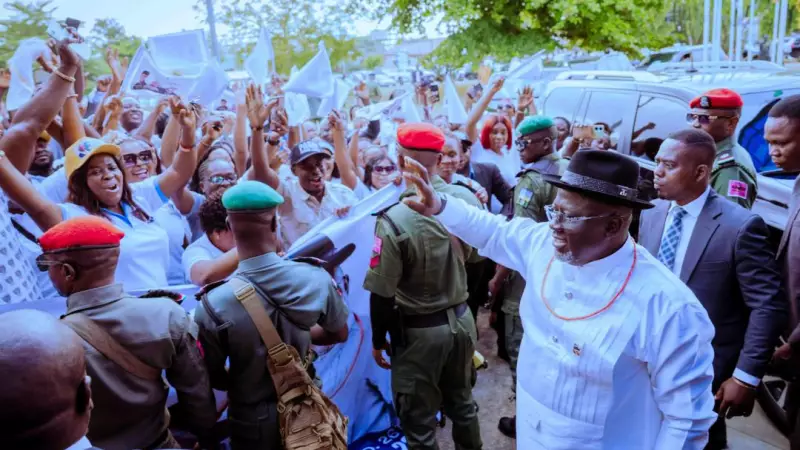
Governor Sheriff Oborevwori of Delta State has presented a compelling account of his administration's financial stewardship and aggressive infrastructure development, marking a significant shift in the state's governance trajectory.
A New Culture of Fiscal Prudence
Addressing the Delta State House of Assembly in Asaba on December 20, 2025, Governor Oborevwori placed a strong emphasis on fiscal responsibility as the cornerstone of his government. He detailed systemic reforms that have instilled a new culture of discipline in public finance management.
The administration has implemented rigorous processes including competitive bidding, strict contract monitoring, price verification, and enhanced procurement systems. These measures have led to more efficient project execution, timely delivery, and a significant reduction in the cost overruns that previously hampered development.
The most tangible result of this fiscal tightening is a dramatic increase in Internally Generated Revenue (IGR). In just 18 months, from May 2023 to December 2024, Delta State's IGR surged by over 90%, climbing from N83 billion to N158 billion. The state is projected to cross the N200 billion mark by the end of 2025, representing a 140% leap from the 2023 baseline.
Governor Oborevwori stressed that this revenue mobilization was achieved without imposing new taxes on citizens. Instead, the government focused on blocking financial leakages, expanding the tax net to capture more informal sector players, and simplifying compliance through automation.
Zero Borrowing Amid Major Infrastructure Push
Despite embarking on some of its most ambitious capital projects in years, the Oborevwori administration has maintained a strict no-borrowing policy. The Governor emphasized that the state has not borrowed a single dime to fund its initiatives.
Instead, resources have been directed towards aggressively repaying existing debts. A notable example is the recent release of N8.4 billion to the Delta State Oil Producing Areas Development Commission (DESOPADEC) to clear liabilities dating back to 2010.
The government has also prioritized the welfare of its workforce. Salaries are consistently paid before the 25th of each month, despite a monthly wage bill of N16 billion. Furthermore, the administration approved N10 billion to offset pension arrears, in addition to regular monthly pension releases of N2.03 billion.
Transforming Delta's Physical Landscape
If fiscal reforms define the administration's discipline, its sprawling infrastructure projects illustrate its vision. Governor Oborevwori outlined a comprehensive network of roads, flyovers, bridges, and urban developments transforming both rural and urban areas.
Key projects highlighted include:
- The completed dualisation of the Ughelli-Asaba Road.
- The ongoing reconstruction of a section of the Warri–Sapele–Benin Dual Carriageway, a federal road intervention by the state.
- Multiple flyovers at PTI Junction, DSC Roundabout, Enerhen Junction, and newly awarded structures at Otovwodo Junction in Ughelli and Uromi Junction in Agbor.
A landmark achievement is the Trans Warri–Ode-Itsekiri Road, a mega project featuring 15 bridges and connecting 10 riverine communities. Conceived in 2006, the project languished for years until the current administration cleared outstanding liabilities and provided the capital to push it to completion. The road is now finished after 19 years and is scheduled for commissioning in the first quarter of 2026.
Other significant developments are the evolving Waterfront City Project in Asaba and the steadily progressing Warri Township Stadium. Massive stormwater drainage works in Warri and Asaba are also addressing critical long-standing issues for residents.
The administration's commitment to equitable development is evident in over 50 major road and bridge projects spread across all 25 local government areas. Examples span from the Isele-Azagba/Otulu Road in Aniocha North to the Okerenkoko–Pepeama–Kokodiagbene Road in Warri South-West, and the Kwale–Beneku Bridge in Ndokwa.
Future-Proofing the Economy
To sustain this development momentum, Governor Oborevwori pointed to strategic revenue initiatives beyond oil. The Koko/Kwale Free Trade Zone, now hosting 11 anchor tenants, is emerging as a growing industrial corridor. The groundbreaking of a new facility within the zone is expected to attract further investment.
Another forward-looking venture is the Delta Azure Carbon Mosaic Project, a nature-based carbon initiative that has garnered strong interest from the Federal Government due to its potential for long-term revenue generation.
Governor Oborevwori's budget presentation transcended a mere fiscal ritual. It painted a portrait of a state rebuilding public trust, driving inclusive development, and governing with transparency. With soaring IGR, a debt-free project financing model, and an expansive infrastructure footprint, Delta State under Sheriff Oborevwori is charting a new course where financial prudence directly powers tangible physical transformation.