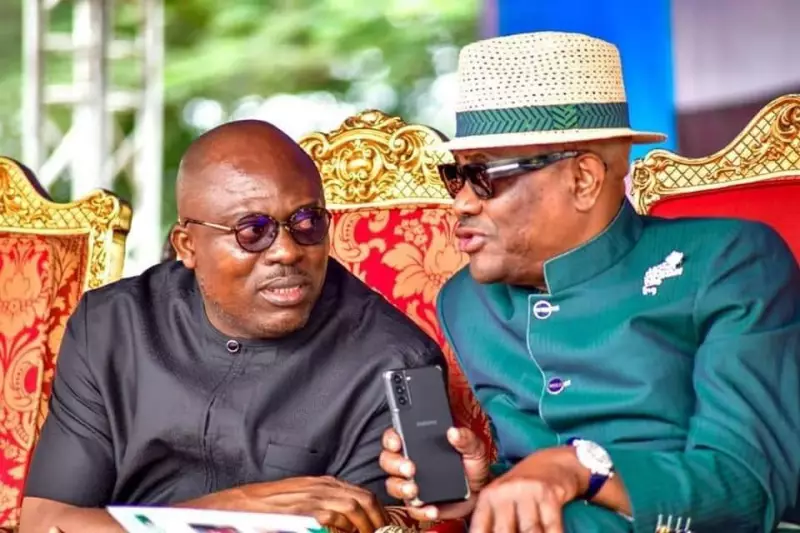
The turbulent political landscape of Rivers State has taken another dramatic turn, with Governor Siminalayi Fubara's strategic defection to the All Progressives Congress (APC) potentially altering the balance of power ahead of the 2027 general elections. This move has left his erstwhile godfather and current Minister of the Federal Capital Territory (FCT), Nyesom Wike, in a precarious position, echoing a recurring cycle of political rebellion in the oil-rich state.
The Unending Cycle of Godfather Dethronement
Rivers State has a well-documented history of political proteges overthrowing their mentors. The pattern began with former governor Peter Odili, who elevated his protege, Rotimi Amaechi, first as Speaker of the State Assembly and later as his successor. Once in power, Amaechi turned against Odili, effectively sending him into political exile in Abuja.
Amaechi then repeated the cycle by promoting his former Chief of Staff, Nyesom Wike, to a junior ministerial position under President Goodluck Jonathan. Wike, leveraging federal connections, ascended to the governorship in 2015 despite Amaechi's opposition. As governor, Wike systematically dismantled Amaechi's influence in the state, securing his own political dominance.
Wike's own political strength was bolstered by his access to resources from the Federal Accounts Allocation Committee (FAAC) and a crucial alliance with Bola Ahmed Tinubu, then the strongman of Lagos politics. This linkage with Tinubu helped Wike secure an unopposed second term in 2019, as Tinubu calculated that a Wike-controlled Rivers was less of a threat to his own presidential ambitions than an Amaechi-controlled one.
Fubara's Rebellion and the State of Emergency
As Wike's second term ended, he meticulously positioned his former Accountant-General, Siminalayi Fubara, to succeed him. Mindful of the fate that befell previous godfathers, Wike imposed strict conditions on Fubara, including requiring his approval for any contract above N50 million and restricting the governor's travel for political meetings.
Fubara's eventual rebellion against these constraints led to a severe political crisis, including an attempt to impeach him by Wike's loyalists in the State Assembly. The situation escalated to the point where President Bola Tinubu declared a six-month state of emergency in Rivers State to restore order.
Following the state of emergency, the political tide shifted decisively in Fubara's favour. The pro-Wike assembly members, known as the House of 27, defected to the APC. In a masterstroke, Fubara himself also joined the ruling party, automatically becoming its leader in the state by virtue of his position as governor. This move effectively placed Wike's loyalists under the authority of their principal adversary.
Strategic Realignments and the 2027 Calculus
President Tinubu's recent meeting with Governor Fubara and Ebonyi State Governor Francis Nwifuru sent a powerful message. Insiders revealed that Tinubu assured the governors that their executive powers were not subject to the whims of his ministers, a clear reference to Wike and Dave Umahi. Emboldened, Fubara publicly declared his APC membership, stating, "I'm not just a member of the All Progressives Congress; I am the number one. I have collected my card, and the form is 001."
Fubara framed his defection as essential for ensuring Tinubu's smooth re-election in 2027, vowing to make the president's campaign "a smooth drive in Rivers." This direct access to the presidency has significantly weakened Wike's leverage.
Wike now finds himself politically isolated, described as being stuck at a political Ojuelegba—a reference to Fela's song about a chaotic Lagos intersection where traffic comes from all directions. With Fubara controlling the state APC and his influence in the PDP waning, Wike is reportedly exploring alternative platforms, including the resuscitation of the comatose National Democratic Party (NDP), to field his loyalists in 2027.
Further complicating Wike's position are revelations from former ally and Oyo State Governor Seyi Makinde. Makinde disclosed that Wike had volunteered to "hold the PDP" for Tinubu against 2027, a claim that has caused significant friction and painted Wike as operating independently of his former G5 group.
The Cost of Power and the Future
The ongoing saga underscores the high cost of godfather politics in Nigeria's prebendal system. President Tinubu, a former governor himself, understands that influence in a state often resides more with the sitting chief executive than with a political godfather. This reality is guiding his strategic alignment with Fubara.
As the 2027 elections approach, the key question is whether Tinubu's electoral fortunes in Rivers are better secured with Fubara in charge, with or without Wike's input. Having survived impeachment and humiliation, Governor Fubara appears strengthened and unwilling to concede ground in any future political spat.
The battle for Rivers State continues, but the latest chapters suggest that the cost of playing godfather has, once again, proven exceedingly high for Nyesom Wike, while Siminalayi Fubara has skillfully navigated the furnace of political adversity to claim his independence and a powerful new alliance.