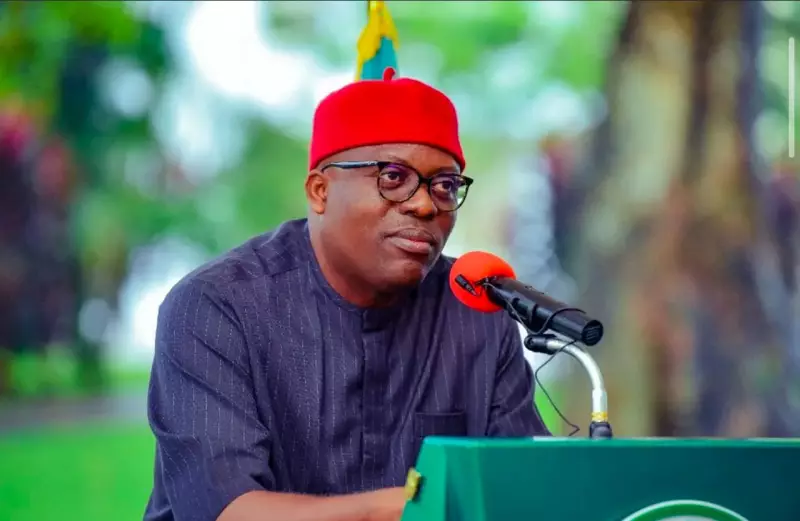
The political landscape of Nigeria's oil-rich Rivers State has undergone a seismic shift following the dramatic defection of Governor Siminalayi Fubara to the ruling All Progressives Congress (APC). This move, which also saw key state and federal lawmakers cross over, has fundamentally altered the power equation in the state, setting the stage for a high-stakes battle ahead of the 2027 general elections.
The Battle for Supremacy: Fubara vs. Wike
At the heart of Rivers State's renewed political turbulence is a fundamental struggle for control. The question is whether true command of the state's political machinery lies with the sitting governor, Siminalayi Fubara, or with his estranged political godfather, Nyesom Wike, the Minister of the Federal Capital Territory. This is not a new conflict, but a long-standing, zero-sum contest for authority, influence, and access to state resources.
Governor Fubara resumed office on September 18, 2025, after President Bola Tinubu lifted a six-month state of emergency. While a fragile public peace was declared, insiders observe that this détente is largely cosmetic. Beneath the surface, deep mistrust and unresolved grievances fuel an ongoing battle for supremacy.
The governance of the state continues to reflect this struggle, with a prolonged delay in appointing commissioners and other administrative bottlenecks. A key point of contention remains Wike's continued grip on the local government structure, a reality that reportedly makes Governor Fubara uncomfortable.
The Defection That Changed Everything
The political calculus was dramatically reset on December 9, 2025, when Governor Fubara formally defected to the APC. He was joined by influential groups like Rivers Women Unite for Sim and several lawmakers. This move shattered the long-standing dominance of the Peoples Democratic Party (PDP) in Rivers State and, more crucially, repositioned Fubara as the leader of the ruling party in the state.
By party convention, governors are automatic leaders of the APC in their states, a point reinforced at the party's national caucus meeting on December 18, 2025. This new status directly challenges Wike's once-unassailable influence. Furthermore, Fubara's growing closeness to President Tinubu has strengthened his position. He recently claimed Rivers State had secured "70 per cent support" for Tinubu's 2027 re-election bid.
Analysts like Dr. Christian Onyegbule of Abia State University argue the tide has turned. "The governor no longer needs intermediaries to access the President. He now goes directly to him, and that alone makes him relevant," Onyegbule stated, describing the defection as a decisive victory.
Wike's Waning Influence and the Road to 2027
Faced with this new reality, Nyesom Wike is not standing idle. Reports indicate he is positioning trusted loyalists like George Kelly Alabo and Boma Iyaye as potential governorship contenders in 2027. However, his political options are narrowing. He is isolated in the PDP, having been expelled by a faction, yet remains unrecognized as a member of the APC.
Legal practitioner Dr. Chukwuma Chinwo notes that reconciliation is a gradual process. "Normally, peace does not return as quickly as it is destroyed. It is easier to break a relationship than to rebuild it," he commented, referring to the fragile peace in the state.
Civil society voices echo this caution. Sunny Dada, Chairman of the Civil Liberties Organisation, describes the current calm as "peace enforcement" imposed by external forces, not genuine reconciliation. He warns that the pre-election year could reopen old wounds, stating, "The final year before elections is always the hottest phase."
For the APC, the mood is upbeat. State Publicity Secretary Chibuike Ikenga said Fubara's entry expands the party's grip on Rivers and aligns with President Tinubu's inclusive governance. "It will breed peace, unity and development, and reduce tension and crisis," Ikenga asserted.
As 2027 approaches, Rivers State is once again a theatre of high-stakes political drama. Whether Fubara's federal backing and party control can finally eclipse Wike's entrenched machinery remains the defining question, one that will shape not only Rivers' future but also the wider national political equation.