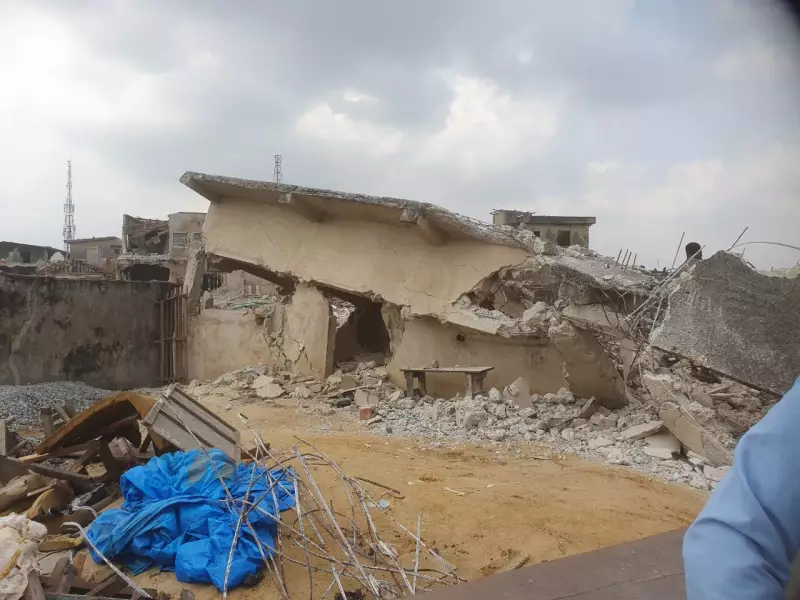
The bustling community of Mile 12 in Lagos State was united in grief this week as the roar of government bulldozers reduced homes, a hospital, and a school to rubble. The massive demolition exercise has left thousands of residents, including long-standing families and business owners, suddenly homeless, casting a shadow over the area known as one of Nigeria's largest food markets.
A Life's Work Destroyed in Minutes
For Inusa Baba Saara, whose name means "free giver" in Hausa, the morning of December 16, 2025, brought catastrophe. Having emigrated from Sokoto in 1973 and built a successful onion business, Baba Saara had spent decades constructing a four-plot family home that also served as a refuge for homeless children. His world collapsed as excavators tore through his life's work.
"My home ever since I migrated from Sokoto," he told reporters, tears streaming down his face. "We celebrated Sallah here, and the children were able to go to school, but everything is gone now." His story mirrors that of nearly 50,000 Yoruba and Hausa families whose decades-old community was erased in hours.
Critical Community Infrastructure Lost
The demolition spared no essential services. Al-Sadiq Hospital, a healthcare pillar for the community for almost two decades, was demolished by the Lagos Ministry of Physical Planning and Urban Development (LMPPUD). Dr. Sadiq, who reportedly built the two-storey facility from savings or a loan, was given just one hour to evacuate.
"This is injustice," Dr. Sadiq stated. "I thought my building would be spared, being a hospital." A school adjacent to the hospital was also destroyed, compounding the community's loss. Meanwhile, residents like Mrs. Serifat Abdulahi were seen picking through the ruins of her rented wooden home, left with nothing but fragments of wood after seven years of residence.
Conflicting Claims and a Wider Trend
While residents insist they received no warning, an anonymous LMPPUD official claimed the ministry had issued all necessary quit and demolition notices, which were ignored. The state government defends the action, labeling the area an "environmental nuisance, security risk, and an impediment" to Lagos's megacity status, which is preparing for a predicted population of 40 million.
This event is not isolated. It follows a pattern of mass evictions targeting the urban poor in Lagos. Reports indicate that over the past few months, more than 3,000 homes across 23 settlements have been demolished, displacing around 30,000 people. Areas like Makoko, Oworonsoki, and Oko-Baba in Ebute-Metta have faced similar fates.
As the dust settles in Mile 12, the Lagos State government has made no provision to relocate the displaced residents, pushing landlords into tenancy and shattering long-standing community networks. With a stated goal to clear every slum cluster within five years, the wave of demolitions shows no sign of abating, leaving a trail of homelessness and heartbreak in the name of urban development.