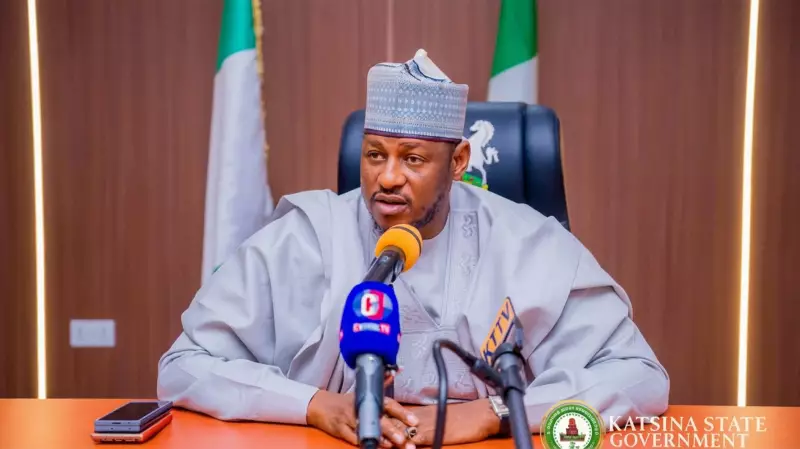
Katsina State Governor, Malam Dikko Umaru Radda, has urged Nigerians to shift their focus from blaming state governors and instead critically examine how the Federal Government spends its larger share of the national revenue. This call was made during an interview with Radio France Internationale (RFI) Hausa service on 23 December 2025.
Federal Government Controls Bulk of National Revenue
Governor Radda highlighted a fundamental imbalance in Nigeria's revenue distribution system. He pointed out that public anger over the worsening economic situation is often directed at state and local governments, while the entity receiving the most funds faces less scrutiny.
The Federal Government gets 52 per cent of the monthly allocations from the Federation Account Allocation Committee (FAAC). The remaining 48 per cent is then shared among all 36 states and the 774 local government areas across the country.
"Whenever there is hardship, people blame governors and local governments," Radda stated. "But when revenue is shared, 52 per cent goes to the Federal Government. It is the remaining 48 per cent that is shared among the 36 states and 774 local governments."
A Call for Accountability on Decades of Federal Dominance
The governor questioned the outcomes of this long-standing arrangement, urging citizens to demand transparency from the centre. He noted that this model of federal dominance in revenue collection has persisted for decades.
"For decades, the Federal Government has been receiving the larger share of federation revenue. So the question Nigerians should be asking is: where has the bulk of that money gone?" he challenged.
His comments come at a time when state governments are facing increased pressure to account for their allocations, especially following the removal of the fuel subsidy. Radda argued that the current revenue-sharing formula leaves subnational governments struggling to meet the growing demands of their people, despite the common assumption that governors control vast resources.
On Corruption and Infrastructure Investment
Addressing the frequent corruption allegations levelled against state governors, Radda cautioned against blanket judgements. He emphasized that leadership is defined by individual character and integrity.
"Leadership is about individual integrity. It is wrong to generalise and label everyone the same way," he said, adding that all public office holders would ultimately answer for their actions.
Defending his administration's ongoing capital projects amidst the economic challenges, Governor Radda insisted that infrastructure development remains a vital tool for stimulating grassroots economic activity.
"When you execute capital projects, you create jobs and bring money down to the people. Labourers earn wages, food vendors make sales and suppliers benefit," he explained.
He claimed the positive impact of such spending is already visible across Katsina's local government areas, where executed projects have spurred local economic circulation.
By redirecting attention to the Federal Government's control and utilisation of revenue, Radda's remarks ignite a crucial conversation about fiscal federalism, accountability, and the equitable distribution of resources in Nigeria, as citizens nationwide grapple with rising costs and uncertainty.