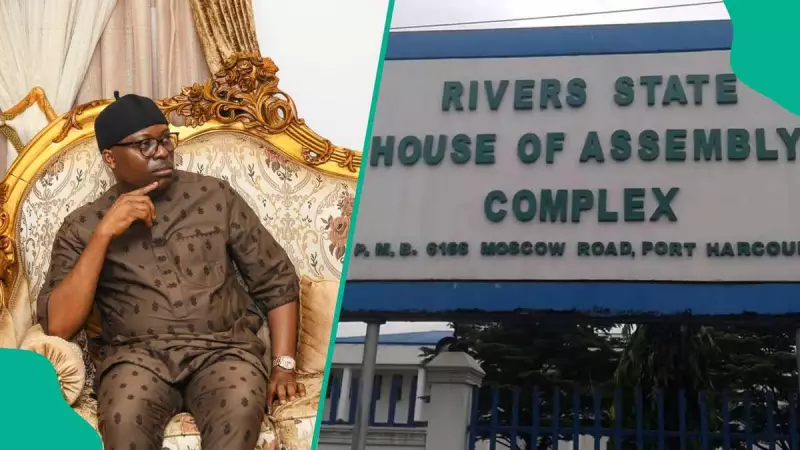
The political landscape in Rivers State has entered a critical phase as the State House of Assembly has formally commenced impeachment proceedings against Governor Siminalayi Fubara and his deputy, Professor Ngozi Odu. This dramatic move, confirmed on Thursday, January 8, 2026, marks a significant escalation in the ongoing political tensions within the oil-rich state.
Notice of Allegation and the Core Accusation
The impeachment process was set in motion when the Speaker of the Assembly, Honourable Martin Amaewhule, signed and served separate notices to both Governor Fubara and Deputy Governor Odu. The primary allegation levelled against the governor is a serious breach of financial governance. The lawmakers accuse him of spending public funds without an approved appropriation bill, a fundamental requirement in Nigeria's budgetary process.
These notices, which began circulating on various social media platforms, constitute the second formal step in the impeachment process as outlined by the Nigerian constitution. The first step, a notice of allegation, must be signed by at least one-third of the assembly members before it is presented to the speaker for service.
The Constitutional Roadmap for Impeachment
The path to removing a state governor in Nigeria is a meticulous constitutional procedure designed to prevent arbitrary actions. Following the service of the notice, the assembly has a strict timeline to follow. Within 14 days of the governor receiving the notice, the House must vote on whether to investigate the allegations. This motion requires the support of a two-thirds majority of all members to proceed.
If the vote passes, the speaker will then request the Chief Judge of Rivers State to constitute a seven-member investigative panel. This panel, mandated to comprise persons of unquestionable integrity who are not politicians or public servants, will have three months to conduct a fair hearing. The governor retains the right to defend himself personally or through legal representation during this investigation.
The panel's findings are decisive. If it finds no misconduct, the process is terminated immediately. However, if gross misconduct is established, the report is sent back to the House. The final and most crucial step is a resolution for removal, which again must be supported by at least two-thirds of all assembly members. Upon the passage of this resolution, the governor is removed from office instantly.
Broader Political Context and Reactions
This impeachment move unfolds against a backdrop of a deepening rift between Governor Fubara and the Minister of the Federal Capital Territory, Nyesom Wike. The political feud, which has dominated headlines, is widely viewed as a precursor to the political alignments expected for the 2027 general elections.
Adding another layer to the crisis, the national secretary of the All Progressives Congress (APC), Ajibola Basiru, has publicly criticised Minister Wike. Basiru urged Wike to focus on the politics of Rivers State and expressed unwavering support for Governor Fubara amidst the tensions. This interjection from a senior APC figure highlights the complex, cross-party dimensions of the Rivers political impasse.
The situation remains fluid and highly charged. The coming days will be critical as the Rivers State House of Assembly decides whether to proceed to a vote for investigation, setting the stage for either a prolonged legal and political battle or a potential de-escalation of the crisis that has gripped one of Nigeria's most strategic states.