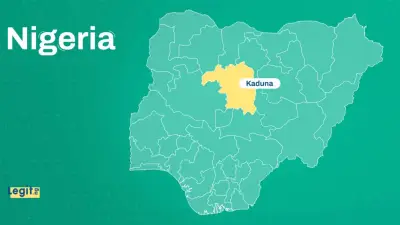
Security experts have urged the Federal Government of Nigeria to make significant investments in geospatial intelligence technology, asserting that the tool is essential for winning the country's battle against terrorism, banditry, and kidnapping. The call was made during a virtual dialogue organised by WeweNetwork Afrique, where experts argued that modern security threats demand intelligence-driven responses rather than an exclusive reliance on military force.
Geospatial technology as a security game changer
Prof. Sunday Adejoh, a Senior Lecturer in Defence and Security Studies at the Nigerian Defence Academy (NDA), Kaduna, stated that Nigeria's deteriorating security situation requires a clear move away from purely kinetic military operations towards technology-driven intelligence gathering. He explained that geospatial intelligence allows security agencies to identify, monitor, and track criminal elements operating in forests and other ungoverned spaces across the country's vast territory.
"Military operations are not just kinetic because the threats we now deal with are non-conventional, requiring non-conventional approaches," Adejoh said. "The insecurity challenge is enormous, and I see a gap in the current approach. One area we need to invest in is geospatial intelligence. With geospatial technology, you can track and locate enemies where they are hiding."
Former minister: Chibok abduction could have been prevented
Dr. Goddy Jedy-Agba, former Minister of State for Power and a doctorate holder in Defence and Security Studies, said human intelligence alone is no longer sufficient and must be complemented by systems capable of delivering real-time data. "We have seen a lot of coordinated attacks by terrorists and bandits. There are certain things human intelligence cannot do. We need real-time data and analysis of areas of concern," he said.
Jedy-Agba was direct in his assessment of what the technology could have prevented, stating that the 2014 Chibok abduction of over 200 schoolgirls would not have occurred with geospatial surveillance in place. "With geospatial intelligence, the Chibok girls wouldn't have happened. It would have tracked them down," he said. He added that the technology could also strengthen border control by tracking the movement of illicit arms into Nigeria, and could be used to predict floods and landslides. "The government should see the importance of this and buy into it. It is the in thing globally. Security threats are not tackled with boots on the ground anymore," he said.
Calls for collaboration and institutional reform
Prof. Dimla Joel Nchinney, Executive Director of the Nigerian Electricity Liability Management Company and also a doctorate holder in Defence and Security Studies, described geospatial intelligence as an early warning system capable of stopping threats before they materialise. He raised concern that some agencies with advanced technological capacity were refusing to share it with others. "Security agencies that have this capacity are hoarding it instead of sharing it with others," he said.
Dr. Otive Igbuzor, Founder of the African Centre for Leadership, Strategy and Development, said security reforms must go beyond the debate over state police and extend to training, manpower development, and the welfare of security personnel. The three experts are co-authors of the book "Geospatial Intelligence In Complex Security Environment."
Participants at the dialogue also called for greater accountability in military budgeting, insisting that any increase in funding must come with measurable improvements in intelligence and operational effectiveness.
Kwankwaso explains method to tackle insecurity
Earlier, Legit.ng reported that Rabiu Musa Kwankwaso, the 2027 vice presidential candidate of the Nigeria Democratic Congress (NDC), said his administration would engage terrorists and criminals in direct dialogue as part of a broader strategy to reduce insecurity across the country. Kwankwaso made the remarks during a one-on-one interview on Channels TV's Politics Today programme.