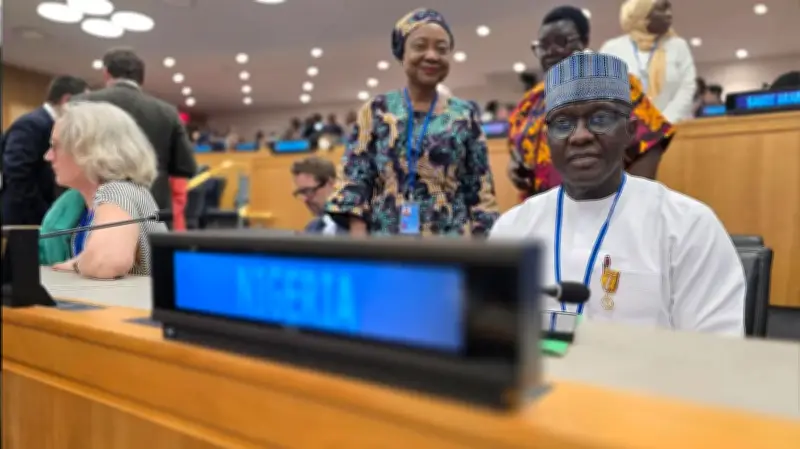
The Federal Government has declared that Nigeria will continue to keep its borders open to asylum seekers and uphold the non-refoulement treaty for Cameroonian and Nigerien refugees.
Federal Commissioner's Statement
The Honourable Federal Commissioner of the National Commission for Refugees, Migrants and Internally Displaced Persons (NCFRMI), Tijani Ahmed, made this known in Abuja during an address ahead of the 2026 World Refugee Day, themed 'Until Everyone is Safe'. This year's event marks the 75th anniversary of the 1951 UN Convention, observed on Monday, 22 June.
Ahmed explained that Nigeria continues to uphold the international principle of non-refoulement, which prevents the forced return of refugees to countries where they face persecution or threats. The country has registered thousands of displaced persons from Cameroon and Niger Republic in frontline states, including Benue, Borno, and Cross River.
The NCFRMI chief insisted that Nigeria remains resolved in opening its borders to persons forcibly displaced due to conflict. He noted that about 3,000 Nigerian refugees were voluntarily repatriated from Cameroon in January 2026. Any Nigerian migrants willing to return home will be repatriated, but only voluntarily and not by force.
Impact of Globalisation on Border Closures
Speaking on the impact of globalisation on border closures, the Executive Director of the Justice, Development and Peace Caritas Initiative (JDPCI), Reverend Father Sebastian Sanni, noted that with modern globalisation, isolating national borders is no longer a viable economic option. He said Nigeria must develop sophisticated, multi-stakeholder internal mechanisms to manage displaced populations.
The cleric emphasised that the scale of the crisis requires a conducive environment that allows non-state actors to provide aid effectively. He stated, 'The government cannot do it alone. This day calls for strategic collaboration between the government and different stakeholders in reaching out to the most displaced in society. The government should also create a conducive atmosphere for other development partners to come in and work with them.'
Interventions by the Catholic Church
Highlighting the interventions of the Catholic Church, Sanni disclosed that JDPCI has been at the forefront of providing sustainable livelihoods and legal aid to displaced persons in the Federal Capital Territory (FCT) for over three decades. 'We have a skill acquisition centre where we train refugees on artificial intelligence, cyber security, fashion, and catering to provide sustainable livelihoods. We are also in partnership with UNHCR and have a legal desk that provides pro bono legal services to rejected asylum seekers,' he explained.
Saluting the resilience of displaced persons globally, the JDPCI boss reminded the public and policymakers that safeguarding refugees is a fundamental obligation under international conventions. 'Refugees must be protected. It is their right, not a privilege,' Sanni said.
UN Warning on Asylum Rights
Meanwhile, the United Nations High Commissioner for Refugees (UNHCR) has warned that the global right to seek asylum is under immense pressure, urging nations to reaffirm their commitment to the 1951 Refugee Convention. UNHCR Representative to Nigeria, Ambassador Arjun Jain, gave the warning, urging global leaders that seeking safety is a non-negotiable human right.
Represented by the UNHCR Deputy Representative, Bernadette Muteshi, Jain said the treaty was established after the Second World War as a universal promise to protect anyone fleeing conflict or persecution. 'Today, that safety net is under immense pressure, but human rights are not negotiable. Safety should not be a privilege. No one is truly safe until the most vulnerable among us are safe,' he stated.
The agency aims to halve the number of refugees trapped in long-term displacement over the next decade by expanding access to jobs, healthcare, education, and voluntary resettlement. 'No one chooses to leave everything they love behind. The right to seek safety is a sacred promise of shared humanity,' Jain concluded.