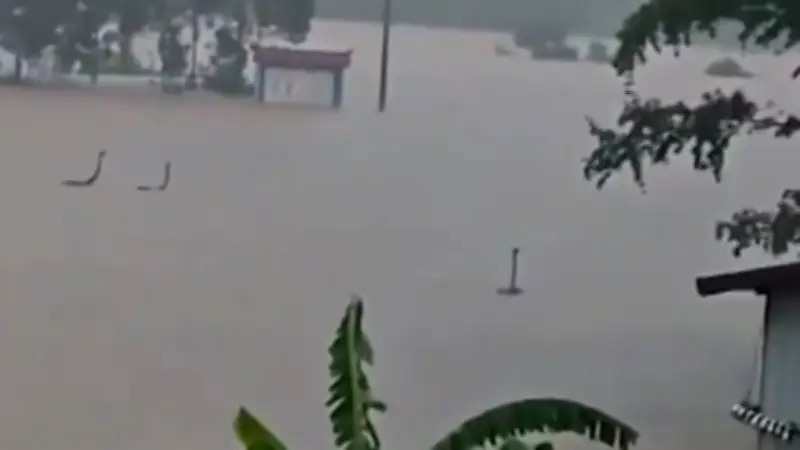
Over 800 snakes, including venomous cobras, escaped from a farm in Dengwei village, Hengzhou, South China's Guangxi Zhuang Autonomous Region, after the farm was damaged by flooding. Local media reported that some residents have suffered snakebites, and rescue workers have been dispatched to handle the situation.
Typhoon Maysak Triggers Flooding and Snake Escape
Affected by Typhoon Maysak, Guangxi experienced continuous heavy rainfall, leading to emergency situations at several reservoirs in Hengzhou, Nanning. On Tuesday, July 7, netizens posted screenshots and video clips claiming that a snake farm in Dengwei village was destroyed by floods, resulting in the escape of a large number of snakes. The posts warned nearby residents to take precautions.
Other netizens commented that some trapped villagers had been bitten by snakes and were facing shortages of medical supplies and treatment, according to CCTV.com.
Official Confirms 800-900 Snakes Escaped
Wu Zhi, head of the Dengwei village committee in Yunbiao township, Hengzhou, told Red Star News on Tuesday afternoon: "It [the escape] happened on the morning of July 6. According to our preliminary estimate, around 800 to 900 snakes escaped after the farm was washed away by floodwaters. So far, one villager has been bitten by a snake and is receiving emergency treatment at a hospital." Wu added that not all escaped snakes were venomous, with a large proportion being non-venomous water snakes.
Local Residents Describe Widespread Escape
A local resident surnamed Shen from Yunbiao township told CCTV.com that snake farms are located in both low-lying areas and on hillsides across the township. Due to breaches at Liulan Reservoir and Yunbiao Reservoir, low-lying areas were inundated, and snakes from small-scale farms escaped into surrounding areas. Shen said some trapped villagers had been bitten by snakes but were unable to seek medical treatment because they remained stranded.
A local snake farmer surnamed Lei told CCTV.com that his farm is on higher ground and unaffected so far. Lei estimated that snakes from scattered small-scale farms in low-lying areas may have escaped in large numbers, but added that most farmed snakes live in mountainous forests and are likely to die after prolonged submersion.
Emergency Response and Civilian Snake-Catching Team
An employee from Hengzhou Emergency Management Bureau told the Global Times on Tuesday afternoon that they were aware of reports and had notified frontline workers. Rescue personnel were dispatched, but no further updates were received. The employee said more details would be released in an official announcement.
Wu Zhi said that after the incident, more than a dozen residents from nearby unaffected villages voluntarily formed a civilian snake-catching team. They entered affected areas and went house to house to capture snakes. "Team members mainly use fishing tools and electric fishing equipment to catch the snakes. Most of the snakes have already been washed away by the floods. At present, only a small number remain on floating garbage and debris on stagnant floodwaters. Most of the snakes captured at the site have been non-venomous water snakes," Wu added.
Wu said they have issued notices urging villagers without professional snake-catching skills not to attempt to capture snakes themselves. "If residents find snakes in their homes, they should immediately report it to the village committee and have professional personnel handle the situation."