On October 7, 1967, Nigerian federal troops killed hundreds of Asaba residents who had marched in white to proclaim their allegiance to 'One Nigeria.' The massacre, which took place during the Nigerian Civil War, remains one of the conflict's goriest episodes. On Tuesday, October 7, 2026, Asaba paused to mark the 59th anniversary of the tragedy, with leaders gathering to remember the victims.
Background: Nigeria Before the Civil War
At independence in 1960, Nigeria was a federation of three regions: the Yoruba-dominated Western Region, the Igbo-dominated Eastern Region, and the Hausa-Fulani-dominated Northern Region. In 1963, the ethnically diverse Midwestern Region was created. Regional politics intensified, with each party fearing domination by others, leading to disputed census counts and electoral irregularities in 1964 and 1965.
On January 15, 1966, a group of military officers, mostly of Igbo descent, overthrew the civilian government. Northerners viewed the coup as an attempt by Igbos to impose dominance, sparking deep-seated animosity. This led to systematic massacres of Igbo people in the North. A countercoup on July 29, 1966, led by northern officers, resulted in the death of Igbo head of state General Johnson Aguiyi-Ironsi and the installation of Colonel Yakubu Gowon, a northerner.
During attacks on easterners in the north, some soldiers defied orders to keep the peace and joined civilian mobs in attacking Igbos. They opened fire on Igbos trying to board planes in Kano to escape to the east, including areas like Asaba in the Midwest.
Asaba During the War
Before the war, Asaba was part of the Mid-Western Region, not Biafra, and had never been under Biafran control. Although the people of Asaba are ethnically Igbo, many identify as Anioma, distinct from Igbo communities in the Eastern Region. The Mid-Western Region officially supported 'One Nigeria,' though many were wary of the federal government due to its perceived role in earlier attacks against Igbos. Onitsha, a core Biafran town, was just across the Niger River.
The war came to Asaba on August 9, 1967, when Biafran soldiers advanced across the Niger Bridge from Onitsha into Asaba, beginning the invasion of the Midwest. Joseph Nwajei, who was fifteen at the time, recounted: "It was very early in the morning. We just heard rumblings, so we knew something was up in the road. So, we all came out. We saw troops and tanks, singing joyously and advancing, going towards Benin. That was all. And after they passed, we continued with school. Nothing happened."
The Biafran forces moved through the Midwest, taking Warri, Sapele, Ughelli, Agbor, Uromi, Ubiaja, and Benin City, and advanced towards Ore, about 100 miles from Lagos. On September 20, 1967, Biafra declared the 'independent and sovereign Republic of Benin.' But a day later, federal troops led by Colonel Murtala Muhammed recaptured Benin City. By October 4, Biafran troops retreated across the Niger Bridge into Onitsha, blowing up two sections of the bridge to prevent federal pursuit.
The Massacre and Its Aftermath
Many Midwestern Igbos were sympathetic to Biafra's independence but believed remaining Nigerian was in their best interest. They trusted the 'Operation Code of Conduct for the Nigerian Army' signed by Gowon in July, which instructed troops to treat civilians humanely, in line with Geneva Conventions. However, reports of treatment of Igbos in Benin City after federal forces 'liberated' it in September 1967 raised fears.
Emmanuel Nwanze, an 18-year-old Asaba indigene living in Benin, described the mood: "I went into the back of the compound knowing that the house was no longer safe because everything had been vandalized… You could hear from around the corners - youths with soldiers… hounding and hunting people out and you could see the people being dragged, even on the streets. Nude. They'd take them out for, uh, slaughter, we'll call it now."
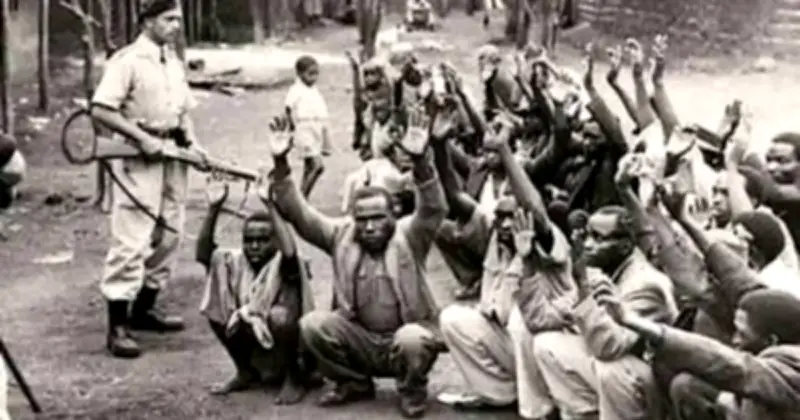
Federal troops reached Asaba's outskirts on October 4 and entered the town on October 5. They began house-to-house raids, looting, raping, and rounding up boys and men accused of Biafran sympathy, killing them or collecting money from those spared. A woman recounted: "My husband and brother, and all those - about 400 people who were following them, were shot in front of the police station at Asaba. That made me hysterical... I held onto the person I saw, the soldier, I said, 'Why did you kill my husband?'.... The man with the butt of the gun hit me on the chest and said, 'Woman, if you're not careful, you'll get killed as well.' Papa - that's my father-in-law - when he heard that his two sons were killed, he went out….They shot him. They killed him in fear that they were going to wipe out everybody in Asaba, especially male children."
Testimonies indicate that the Asagba-in-Council, with the town's chief, resolved to contribute £50 from each of the town's five quarters to impress the troops, and the Omu of Asaba would present a traditional woven cloth to their commander. On the morning of October 6, four men delivering the first quarter's contribution never returned. A second group sent to investigate also vanished. In the evening, leaders announced a gathering to welcome the troops and pledge to 'One Nigeria,' encouraging residents to wear akwa ocha, a ceremonial white clothing signifying peace.
October 7, 1967: The Massacre
On October 7, soldiers flanked the assembled hundreds of men, women, and children. They began picking males at random and killed them in full view of the marchers. With only women left, they had to bury the decomposing bodies. An eyewitness said: "Some were already decomposing, where you can poke somebody, and their head would roll off. And we just put them into one grave, there was no coffin, nothing, nothing shallow graves, and then put them there. We knew it was our duty at that time to bury the dead."
Gertrude Ogunkeye described a young woman abducted by soldiers for a week: "When she came back, she was a different girl… She wouldn't talk to anybody, she was very weepy… You see, we come from a culture where, where talk like rape is taboo, you know, a girl says she's been raped, getting married is like an impossibility." To survive, mothers disguised their boys as women and their daughters as older women. By mid-October, most Asabans had escaped, while others fled to Biafra, not returning until the war ended in 1970.