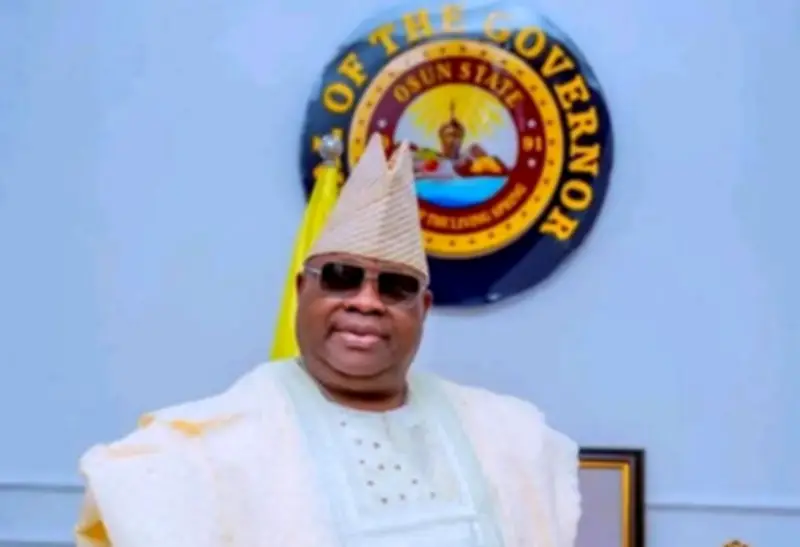
The Federal High Court in Abuja has issued a ruling ordering the Independent National Electoral Commission (INEC) to deregister five political parties for failing to meet constitutional performance requirements. The affected parties include the Accord Party, on whose platform Osun State Governor Ademola Adeleke is seeking re-election, as well as the African Democratic Congress (ADC), the Action Peoples Party (APP), the Action Alliance (AA), and the Zenith Labour Party (ZLP).
Court Ruling and Legal Basis
Justice Peter Lifu delivered the judgment in a suit marked FHC/ABJ/CS/2637/2026, filed by the National Forum of Former Legislators. The court held that the affected parties had not satisfied the constitutional conditions necessary to retain their registration. The plaintiff relied on Section 225(a) of the Nigerian Constitution, which empowers INEC to deregister political parties that fail to meet electoral performance thresholds, including securing a prescribed percentage of votes or winning elective positions at federal, state, or local government levels.
Constitutional Requirements for Party Registration
Under the Constitution, a political party must meet specific criteria to maintain its registration. These include winning at least 25 percent of votes in a state during a presidential election or securing at least one elective seat at the national, state, or local government level. The plaintiff argued that the affected parties performed poorly in the 2023 general elections and subsequent contests, thereby failing to meet these requirements. Justice Lifu agreed and ordered INEC to proceed with the deregistration process.
Political Implications for Osun Governorship Election
The judgment comes at a politically sensitive time in Osun State, where preparations for the off-cycle governorship election scheduled for August 15 are in full swing. Governor Adeleke, who defected from the Peoples Democratic Party (PDP) to the Accord Party in December 2025, now faces uncertainty regarding his candidacy. The window for changing parties ahead of the election has closed, and Nigerian law does not permit independent candidacy, meaning a candidate must belong to a registered political party.
Samakin AbdulJeleel, the Senior Special Assistant to Governor Adeleke on media monitoring, argued that the High Court ruling cannot stand because the case is already at the Court of Appeal, which has adjourned proceedings to September 2026. He stated that the party's activities would continue, including a rally where Adeleke is expected to declare his intention to run for governor. Legal experts note that while the ruling may not immediately alter Adeleke's political future, it introduces fresh uncertainty for the party's participation in the upcoming election.
Historical Context of Party Deregistration
This is not the first legal battle over party deregistration in Nigeria. In August 2020, the Court of Appeal nullified INEC's deregistration of 22 political parties, ruling that the commission failed to follow due process. However, the Supreme Court later overturned that decision and affirmed INEC's constitutional power to deregister parties that fail to meet performance thresholds. That earlier judgment led to the deregistration of parties including the National Unity Party (NUP).
Background of the Accord Party
The Accord Party was founded in 2006 by former Oyo State Governor Rashidi Ladoja, now the Olubadan of Ibadan, following his political disagreements within the PDP. While the party has never won a presidential election or produced a state governor, it has secured legislative seats at both federal and state levels. In the 2015 general election, the party won a House of Representatives seat through Dauda Kako Abayomi, representing Mushin I Federal Constituency in Lagos State.