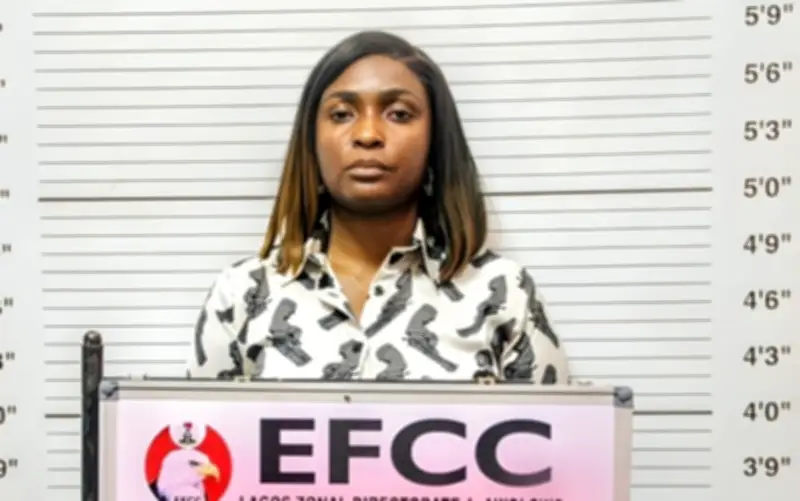
The Federal High Court sitting in Ikoyi, Lagos, has reserved its ruling until 9 June on the bail application filed by social media influencer Blessing Okoro, widely known as Blessing CEO. The self-styled relationship expert is facing trial for an alleged fraud involving N36 million.
Court Proceedings
Justice D.I. Dipeolu fixed the date after hearing arguments from both the prosecution and defence during proceedings on Friday. The Lagos Zonal Directorate 1 of the Economic and Financial Crimes Commission (EFCC) is prosecuting Blessing CEO on two counts: obtaining money by false pretence and stealing.
Prosecution Opposes Bail
Defence counsel P.I. Nwafuru urged the court to grant his client bail on liberal terms. However, prosecuting counsel S.I. Suleiman opposed the application, informing the court that the EFCC had filed a 28-paragraph counter-affidavit deposed by investigating officer Bufa Regina Okangbe. Mr Suleiman stated that the defendant had, at one point during the investigation, failed to honour invitations extended by the anti-graft agency. He said, "We rely on all the depositions contained therein and the exhibits attached. At some point during the investigation, the defendant stopped honouring invitations extended to her by the Commission. We urge Your Lordship not to accede to the request of the defence and instead order an accelerated hearing of the matter." After hearing both parties, Justice Dipeolu reserved judgment until 9 June.
EFCC Investigator's Testimony
The prosecution opened its case with testimony from the first witness, EFCC investigator Bufa Regina Okangbe, who detailed the commission's findings. Ms Okangbe told the court that the EFCC received a petition alleging that the defendant collected money from a complainant for a property transaction involving a house she did not own. Investigators conducted a Bank Verification Number (BVN) search on the defendant, obtained her banking records, and wrote to the Lagos State Land Bureau and the Corporate Affairs Commission (CAC) to verify property ownership. The investigation revealed that the disputed property did not belong to the defendant. The witness further testified that the defendant was invited by the Commission and made statements under caution in the presence of her lawyer and husband. Records from the Lagos State Land Bureau identified the property owner as Tunbosun Osobu, who later appeared before investigators with his lawyer and son, confirming that he had leased the property to the defendant for three years, with tenancy expiring in 2023 before being renewed in 2025. The complainant submitted documents including a lease agreement allegedly executed with the defendant and a tenancy acquisition form.
Documents Admitted as Evidence
During proceedings, the prosecution sought to tender several documents, including the original petition, statements made by the defendant, tenancy documents, and bank records linked to the transaction. Defence counsel objected to the admissibility of the defendant's statements, arguing that there was no endorsement indicating the presence of a legal practitioner when they were recorded and that no video recording had been presented. The prosecution countered that the law did not require a legal practitioner's presence for admissibility. Mr Suleiman maintained that bank statements were accompanied by certificates of compliance under Section 84 of the Evidence Act. Justice Dipeolu dismissed the objections and admitted all documents into evidence, holding that Section 17(2) of the Administration of Criminal Justice Act permits a suspect's statement to be taken in the presence of a legal practitioner of the suspect's choice, a representative of the Legal Aid Council, a civil society representative, or any other person chosen by the suspect.
Continuing her testimony, Ms Okangbe stated that the complainant paid a total of N36 million to the defendant through a company account for the lease of a property at No. 1B Tunbosun Osobu Street, Lekki, Lagos. N25 million was paid into the defendant's GTBank account, while another N11 million was transferred into her Access Bank account. An analysis of the defendant's bank records revealed subsequent transfers, including N8 million to Mr and Mrs Osobu, N1.9 million to Beauty City by Lekki, N11 million to Lina Uzoma Okoro, and N15 million to Kenneth Emeka Onuora. Under cross-examination, the witness said the Federal Republic of Nigeria, as the prosecuting authority, was not a party to any settlement arrangement between the defendant and the complainant. She also stated she was unaware of any N24 million refund allegedly made by the defendant. Ms Okangbe further testified that the complainant had commenced renovation work on the property before the owner allegedly appeared and evicted them. The matter was adjourned until 9 June for a ruling on the bail application and until 22 June 2026 for continuation of trial.
Background
The EFCC is prosecuting Blessing CEO over allegations that she fraudulently obtained N36 million from a complainant in 2024 by claiming she could secure a lease for a luxury duplex in Lekki, Lagos. Her lawyer has stated that N24 million has been refunded, but the case remains pending. She was arraigned on 15 May before the Federal High Court. In March, she sparked outrage after falsely claiming she had Stage 4 breast cancer and raising public donations for treatment. Following backlash, she admitted she did not have cancer and offered refunds. The influencer has been involved in other controversies, including the 2019 Onye Eze mansion scandal, where she falsely claimed ownership of a luxury home, and a 2023 arrest over allegations of cyberbullying and libel.