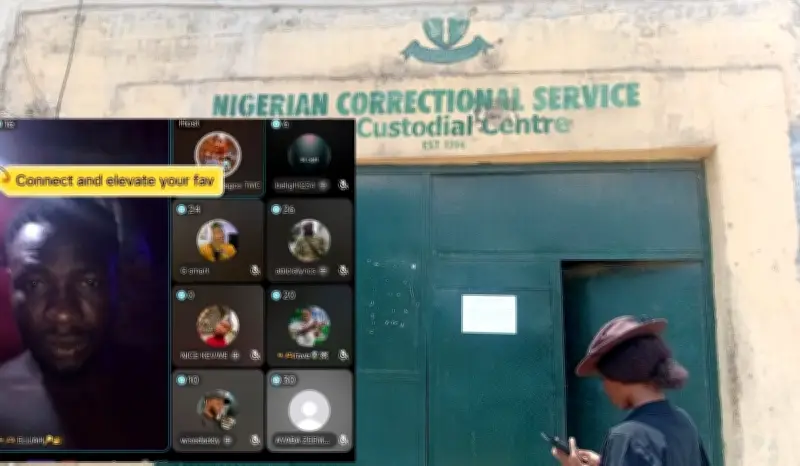
Elijah Oyebode, a man sentenced to death for murder, has been running active TikTok accounts from inside the walls of Ibara Prison in Abeokuta, Ogun State. On an evening in early 2026, he opened the app, tapped the live button, and began broadcasting to thousands of viewers. His presence on social media was not a secret; he appeared under his own identity, accumulated followers, received monetary gifts, and even won an ₦85,000 sports bet while serving time on death row.
Convicted killer's digital shadow
Oyebode's conviction dates back to the murder of Rofiat Adebisi, a final-year student of Osun State University's Ipetu Ijesha campus. According to a Certified True Copy of court proceedings at the Osun State High Court (Suit No. HIK/6C/2017), he conspired to kill the student for rituals after picking her up by the roadside on 22 December 2016. The court heard conflicting accounts he gave to investigators: first, a sexual agreement for ₦2,000 that ended with her death; later, a claim that a herbalist supplied a charm to hypnotise her. The court rejected his denial and medical evidence showed she died from cardiac arrest caused by strangulation. Justice S. O. Falola sentenced Oyebode to death by hanging in 2019.
Despite his sentence, he became a fixture on TikTok. His primary account, @ayola.oluwafu, reached Level 20 gifting status — a milestone requiring substantial financial activity, suggesting spending and transactions running into millions of naira. He also ran a secondary account that impersonated Omolola Awoyele, a prominent TikTok Live host and activist. Awoyele told Saturday Tribune, "Elijah created an account using my name and uploaded my picture, which meant he could potentially use it to scam people online." After she confronted him, he admitted the cloning, apologised, and changed the account name.
Prison economy and officer complicity
In an April 2026 livestream monitored by Saturday Tribune, Oyebode exposed an internal economy at Ibara prison. "The warders are not the ones selling phones to us," he explained. "They only get them for us at the tarmac and smuggle them in for us." He described how warders seize phones and demand payments for their release. "Even if it is the warder that brought it in for you, if another warder sees it, he will seize it and demand a certain amount from you before you get it back."
He also claimed that the same channels are used to smuggle drugs. "Warders smuggle drugs in for inmates," he said. "The inmate might buy the drugs for about ₦500,000, and the warder who smuggled them in might collect ₦100,000. So, after repackaging and reselling, the inmates can make ₦2 million from the drugs." In addition, he alleged that some death-row inmates are escorted by warders to supervise personal hotel projects outside the prison. "The warders take them to their various houses and hotels and bring them back." His blunt assessment: "It is no longer a correctional centre. It is corrupting people more."
Legal sanctions on paper
The Nigerian Correctional Service Act 2019 provides clear penalties for such activities. Section 29(1)(c) makes it an offence for any officer to procure or facilitate the use of communication devices by inmates, punishable by a fine of up to ₦3,000,000, up to three years in prison, or both. Section 29(1)(a) similarly penalises smuggling drugs into the facility. The removal of condemned inmates for private purposes contravenes Section 12(1), and Section 31(2) states that culpable officers commit a felony if an inmate escapes. Under Section 32(4)(b), supervising officers can also be sanctioned for negligence.
Official response amid 'bad eggs'
The Nigerian Correctional Service (NCS) acknowledged the problem. National spokesperson Jane Osuji said, "I cannot sit down here and tell you that it is true or it's not true because where there are so many individuals, there will be one or two bad eggs in them." She warned of national security implications: "When they are able to organise their criminal activities from behind the walls of the correctional service, then you and I are in for it." The NCS noted that over 1,400 officers have faced disciplinary action for misconduct, including dismissals and demotions. The comptroller-general maintains a zero-tolerance policy, and the service plans to deploy CCTV surveillance and conduct unannounced searches.
Tech countermeasure proposal
Cybersecurity expert Professor Tunde Olabiyisi recommends using signal jammers inside prison perimeters. "The first thing is to disable any non-approved device within the prison perimeter," he said. "If you smuggle any phone that is not approved, you will not be able to use it. It will be rendered useless." He explained that the technology can be configured to avoid affecting nearby civilian infrastructure, including the adjacent Central Bank facility.
TikTok's blind spot
While Nigerian authorities failed to secure the physical perimeter, TikTok's digital infrastructure processed payments from these illicit streams. The platform's transparency reports show that over 7.5 million videos were removed in Sub-Saharan Africa in Q3 2024, rising to over 8 million in Q4. Yet none of its automated systems detected a convicted murderer broadcasting from death row under his own identity. A moderator at TikTok's Kenya hub told Global Voices that moderators often assess content in languages they do not understand, making context and identity verification difficult.
In March 2025, a Senate bill seeking to compel major social media companies to establish physical offices in Nigeria passed its second reading. The bill's sponsor, Ned Nwoko, argued that the absence of local offices disconnects platforms from Nigerian users. TikTok's head of communications for Sub-Saharan Africa, Keagile Makgoba, requested the account handles and time for an internal review when presented with findings — despite the accounts being active for months.
Aftermath: A purge that missed the main target
As the investigation neared publication, TikTok announced a sweeping cleanup. On 9 June, it reported removing 4.02 million videos in Nigeria and disrupting over 86,000 LIVE sessions for breaching guidelines. The company touted its automated detection technologies. Yet weeks later, Oyebode's primary account, @ayola.oluwafu, remains live — now operating behind a private lock with the display name "lesson of God locate me" and a profile picture of individuals in military uniform holding firearms. He continues to evade detection, shifting identities and changing profile names periodically.
This article was published under the Tech Justice and Platform Accountability Project of the Centre for Journalism Innovation and Development (CJID), with support from Luminate, and co-published with Nigerian Tribune.