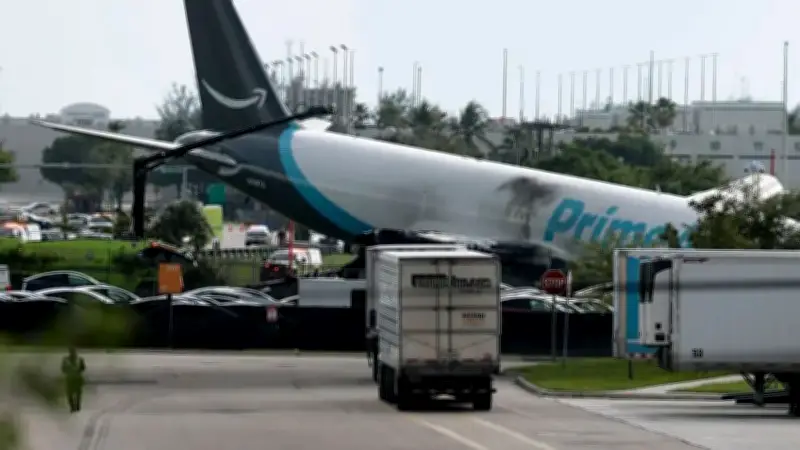
A Boeing 767-300 cargo aircraft operating for Amazon Air crashed at Miami International Airport on Sunday, killing at least five people and injuring five others. The plane overshot the runway while attempting to land and struck multiple vehicles before catching fire.
Crash Details and Immediate Response
The aircraft arrived from Luis Muñoz Marín International Airport in San Juan, Puerto Rico, and crashed shortly before 2 p.m. local time on Sunday. Miami-Dade County Mayor Daniella Levine Cava confirmed the death toll during a news conference on Sunday evening, stating, "At least five people have lost their lives, and five others are injured." She added that emergency crews reached the crash site within "seconds" of the incident and said, "Right now, our focus is on the families, those who were injured, and the ongoing response."
Miami Fire Chief Raied Jadallah reported that three of the five injured individuals were in critical condition. All five were transported to hospitals, though the mayor initially described the extent of their injuries as unknown. Several victims were trapped inside or underneath vehicles struck during the crash and had to be extricated by fire and rescue crews, Jadallah said.

Firefighting Efforts and Airport Disruption
More than 200 firefighters responded to the scene, where they encountered heavy flames and smoke. Miami-Dade Fire Rescue stated that personnel "arrived to find an airplane that had caught on fire as a result of this crash, with heavy flames and smoke showing." The fire was eventually extinguished, though Jadallah noted a fuel leak remained at the crash site.
The Federal Aviation Administration ordered flights grounded as emergency crews worked, leading to cancellations and delays during the Labor Day holiday weekend, one of the busiest travel periods in the United States. Miami International Airport confirmed the plane "overran Miami International Airport's diagonal runway and is disabled at the northwest end of the airport."
Aircraft Operator and Investigation
The aircraft was operating an Amazon cargo flight for 21 Air, a charter airline based in North Carolina. The cause of the crash was not immediately known. The National Transportation Safety Board is expected to investigate and plans to hold a news conference on Monday, September 7.
Amazon expressed condolences in a statement from Kelly Nantel, Director of Corporate Global Media Relations, who said, "We're heartbroken to learn that five people lost their lives in today's incident at Miami International Airport. Our deepest sympathies go out to the families, loved ones, and all those affected by this devastating loss." Nantel added, "The airplane, which was operated by 21 Air, was attempting to land when this incident occurred. We're working closely with local authorities and officials to learn more and will cooperate fully with any investigation." 21 Air had not responded to a request for comment at the time of the original report.
Flight Data and Travel Impact
Flight-tracking data from Flightradar24 showed the aircraft was travelling at 112 knots, or about 129 mph, as it exited the usable portion of the runway. The tracking service said the aircraft came to rest near a parking lot serving an Amazon warehouse and other businesses. It also reported light thunderstorms and gusting winds in Miami around the time of the crash.
Officials had not determined whether weather conditions or any other factor contributed to the accident. The crash caused significant disruption at Miami International Airport, with passengers reporting cancellations, delays, and long queues at airline counters as travellers attempted to rearrange their journeys. The disruption occurred during the Labor Day travel period, when the Transportation Security Administration projected that about 17 million travellers would pass through US airports in the week leading up to the holiday, including an estimated 2.3 million passengers on Sunday, September 6. Miami International Airport is one of the busiest airports in the United States and a major hub for international passenger and cargo traffic, particularly between the US, Latin America, and the Caribbean.