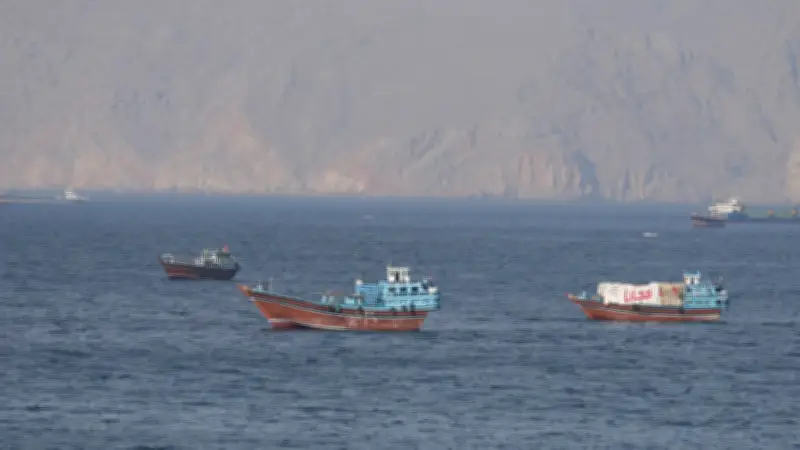
Iran has reportedly closed the Strait of Hormuz once more, pointing to the continued presence of United States forces in the region and Israel's refusal to withdraw troops from southern Lebanon as reasons for the action.
IRGC Statement on Strait Closure
According to a New York Post report, the Islamic Revolutionary Guard Corps (IRGC) stated that the US was in violation of the memorandum of understanding (MOU) signed between Washington and Tehran by President Trump and Iranian President Masoud Pezeshkian on Wednesday, June 17.
“Since Israel’s withdrawal from Lebanon, the complete lifting of the naval blockade, and the withdrawal of American terrorist forces from the Persian Gulf and the region are among the main conditions of the agreement between Iran and the United States, the Strait of Hormuz will remain closed until these conditions are met,” the IRGC said. “All ships are requested, for the sake of their security and safety, not to approach the Strait of Hormuz. Any vessel that defies this directive will be targeted.”
US Response and Ceasefire Claims
US Central Command announced on Thursday that it had formally lifted its two-month blockade on Iranian ports. However, it was not immediately clear what the IRGC meant by the embargo removal not being “complete.”
Shortly after the IRGC announcement, a US official claimed that Israel and Hezbollah had reached a cease-fire agreement, despite Israeli Prime Minister Benjamin Netanyahu stating on Thursday that the Jewish state’s forces would continue hunting terrorists.
“We will restore security and prosperity to northern towns,” Netanyahu said. “That requires maintaining the security zone in southern Lebanon.”
The Israel Defense Forces also published a new map showing an expanded zone of occupation, deploying troops more than 6 miles across the Lebanese border, including north of the Litani River.
MOU Terms and Analysis
The MOU signed on Wednesday promised that the US and Iran, “along with their allies,” would respect Lebanon’s territory and sovereignty and end all hostilities there.
Simcha Brodsky, president of the open source intelligence organization OSINT613, told The Post that Iran is taking advantage of the way the MOU was designed and the time it takes for the US to remove a blockade.
“What we’re seeing is a direct result of the wording in the US-Iran MoU. The deal lifts the US blockade in phases (‘fully within 30 days’), so the US is mid-process by design,” he said. “Iran is using that gap: It says the strait stays closed until the blockade is ‘completely lifted,’ so it can claim the lift isn’t done and call this a re-closure.”
“Iran has now bolted the Israel-Lebanon fighting onto that pretext to hard-stop the whole deal, roping Israel into an agreement it never approved or negotiated,” Brodsky added.