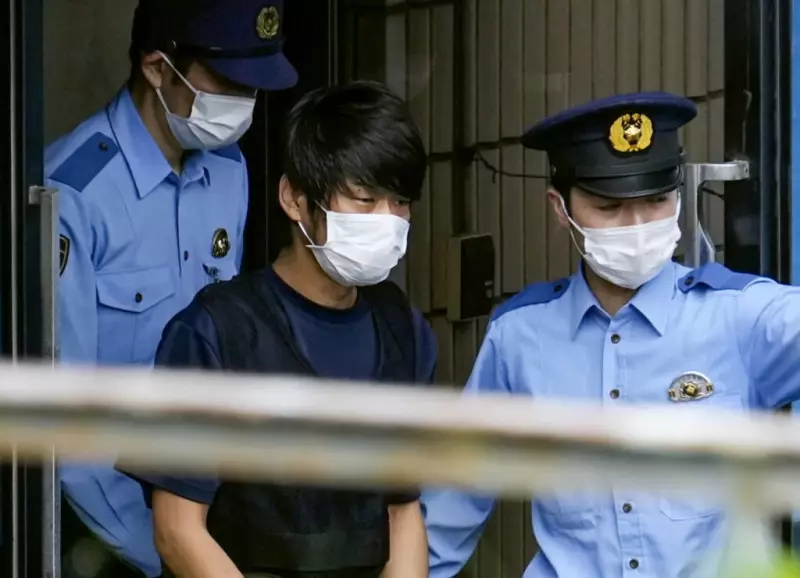
Life Imprisonment for Gunman Who Killed Former Japanese Prime Minister Shinzo Abe
The individual responsible for the fatal shooting of former Japanese Prime Minister Shinzo Abe has been convicted and sentenced to life imprisonment, with the presiding judge denouncing the daylight assassination as "despicable and extremely malicious". This verdict was delivered on Wednesday at the Nara District Court, marking a significant legal conclusion more than three years after the incident shocked a nation largely unfamiliar with gun violence and sparked intense scrutiny of the Unification Church's connections to prominent conservative politicians.
Judge Condemns Premeditated Attack
Judge Shinichi Tanaka stated that 45-year-old Tetsuya Yamagami was "determined" to assassinate Abe, Japan's longest-serving leader. He detailed how Yamagami "shot him from behind and did so when (Abe) was least expecting it", actions that underscored the "despicable and extremely malicious" nature of the crime. Yamagami utilized a handmade firearm to carry out the attack during a campaign speech in July 2022, highlighting the premeditated aspect of the assassination.
Intense Public Interest and Legal Proceedings
Public fascination with the trial remained high, with individuals queuing early on Wednesday morning to secure courtroom tickets. Yamagami appeared subdued and displayed minimal emotion as he received his sentence for murder and firearms violations. His defense team, which acknowledged his guilt when the proceedings commenced in October, indicated that they have not yet decided whether to appeal the verdict, a step that must be taken within two weeks under Japanese legal statutes.
Motivation Linked to Unification Church
Prosecutors argued that Yamagami's motive stemmed from a desire to damage the reputation of the Unification Church. The trial extensively examined how his mother's substantial donations to the church, totaling approximately 100 million yen, led to the family's financial ruin and shaped his belief that "influential politicians" were aiding the sect's growth. Abe had previously spoken at events organized by groups associated with the church, further fueling Yamagami's resentment.
Judge Tanaka acknowledged that "it is undeniable that the defendant's upbringing influenced the formation of his personality and his mindset... and that it even played a distant role" in the assassination. However, he emphasized that "each criminal action he took was based on nothing but his own decision-making, the process of which deserves strong condemnation".
Public Reaction and Broader Implications
Members of the public who observed the verdict echoed the judge's sentiments. Katsuya Nakatani, a 60-year-old spectator, remarked that "even if there was room for extenuating circumstances... opening fire with so many people around is, after all, something that cannot be forgiven". Outside the court, another individual held a banner urging the judge to consider Yamagami's challenging life circumstances.
During the opening arguments, prosecutors informed the court that Yamagami "thought if he killed someone as influential as former prime minister Abe, he could draw public attention to the Church and fuel public criticism of it". In response, Yamagami's lawyers described an upbringing marred by "religious abuse", citing his mother's extreme devotion, the family's financial collapse, his father's suicide, his aborted higher education, and his brother's subsequent suicide. This despair culminated in a suicide attempt in 2005.
Revelations and Security Lapses
Revelations following the assassination exposed longstanding ties between the Unification Church, founded in South Korea in 1954 and whose followers are often referred to as "Moonies", and Japan's ruling Liberal Democratic Party, leading to the resignations of four ministers. Prosecutors noted that Yamagami began constructing the firearm in 2020 and test-fired it in remote areas, underscoring the premeditated nature of the attack.
The killing also served as a reckoning for Japan, where stringent gun control laws make shootings exceptionally rare. Police later admitted to security lapses, acknowledging that some officials failed to recognize the initial gunshot and responded too slowly.
Prosecutors Seek Severe Punishment
Prosecutors, describing the killing as "unprecedented in our post-war history", sought life imprisonment due to its "extremely serious consequences" for society. Under Japan's legal framework, a life sentence technically permits parole, although experts indicate that most inmates remain incarcerated for the remainder of their lives.