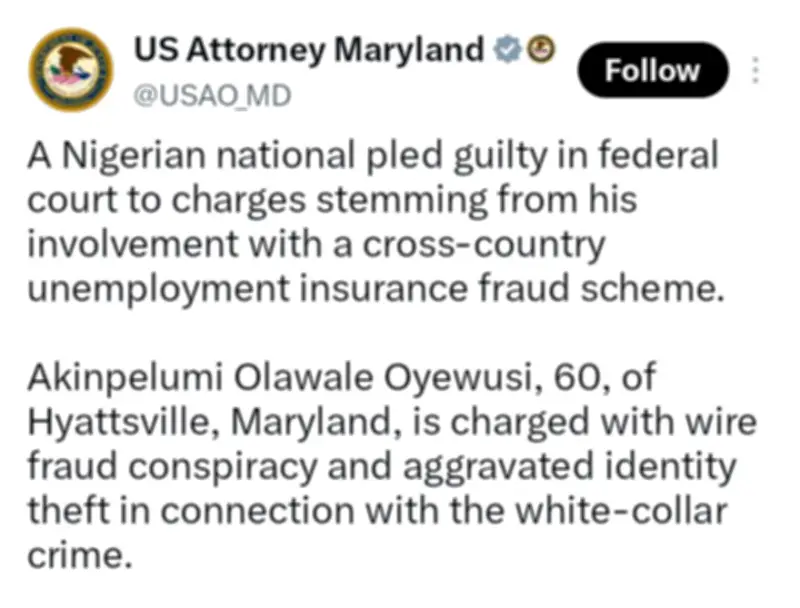
A Nigerian national has pleaded guilty in a United States federal court to orchestrating a cross-country unemployment insurance fraud scheme that siphoned more than $1.5 million from pandemic-era relief programs, according to court documents and the U.S. Department of Justice.
Details of the Fraud Scheme
The defendant, identified as 38-year-old Chukwudi Michael Okafor, a Nigerian citizen residing in the U.S., entered a guilty plea on August 12, 2026, before U.S. District Judge John D. Bates in Washington, D.C. Okafor admitted to one count of conspiracy to commit wire fraud and one count of aggravated identity theft, the Department of Justice announced in a press release.
Court records show that between March 2020 and July 2022, Okafor and his co-conspirators used stolen personal identifying information of U.S. citizens to file fraudulent unemployment insurance claims with state workforce agencies in at least 12 states, including California, Texas, Florida, New York, and Illinois. The scheme targeted pandemic unemployment assistance programs established under the CARES Act, which provided expanded benefits during the COVID-19 emergency.
How the Scheme Operated
Prosecutors detailed that Okafor recruited individuals to open bank accounts and receive debit cards under false names, then directed the fraudulent funds to be withdrawn and transferred to accounts in Nigeria and the United States. The conspiracy involved purchasing stolen identities from dark web marketplaces, creating fake employment histories, and submitting claims using VPNs and proxy servers to mask their locations.
According to the plea agreement, Okafor personally received approximately $450,000 in fraudulent proceeds, which he used to purchase luxury vehicles, electronics, and real estate in the Washington, D.C., metropolitan area. The total intended loss from the scheme exceeded $1.5 million, with actual losses to state unemployment insurance programs and the federal government amounting to $1.2 million.
Investigation and Legal Consequences
The investigation was conducted by the U.S. Department of Labor Office of Inspector General, the U.S. Secret Service, and the Federal Bureau of Investigation, with assistance from multiple state workforce agencies. Special Agent in Charge Kevin M. Smith of the Department of Labor OIG said in a statement that "this defendant exploited a national crisis to line his pockets at the expense of American taxpayers and legitimate job seekers."
Okafor faces a maximum sentence of 20 years in prison for the wire fraud conspiracy charge and a mandatory minimum sentence of two years for aggravated identity theft, which must run consecutively to any other sentence. Sentencing is scheduled for November 15, 2026. As part of the plea agreement, Okafor has agreed to forfeit $450,000 in proceeds and assets purchased with the stolen funds, including a 2022 Mercedes-Benz GLE 350 and a condominium in Silver Spring, Maryland.
Impact on Pandemic Relief Programs
The case highlights ongoing efforts by U.S. law enforcement to combat fraud targeting pandemic unemployment assistance programs, which the Government Accountability Office has estimated lost at least $60 billion to fraudulent claims nationwide. The Department of Justice has charged over 3,000 defendants with pandemic-related fraud since 2020, including more than 200 cases involving Nigerian nationals or transnational fraud rings.
U.S. Attorney Matthew M. Graves for the District of Columbia stated that "this prosecution demonstrates our commitment to holding accountable those who stole from programs designed to help Americans during an unprecedented public health and economic crisis." The court has ordered Okafor to remain in custody pending sentencing, and his cooperation with investigators may be considered in the final sentence.