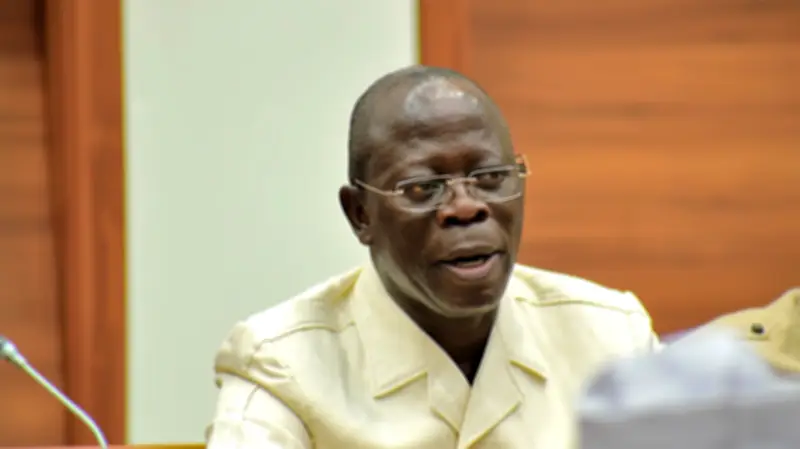
Senator Adams Oshiomhole, representing Edo North Senatorial District and former governor of Edo State, has warned that persistent rivalry among security agencies is severely undermining intelligence sharing and stalling the fight against terrorism and banditry across Nigeria.
Oshiomhole's Warning at Book Launch
Oshiomhole gave the warning at the public presentation and launch of the book, ‘Nigeria’s Security Dilemma: Rivalries and Implications’, written by the Commandant of the Federal Capital Territory (FCT) Command of the Nigeria Security and Civil Defence Corps (NSCDC), Dr Olusola Odumosu, held weekend in Abuja.
The lawmaker lamented that despite regular security council meetings, deep-seated friction between the military, police, and the Department of State Services (DSS) limits collaborative success. Reflecting on his tenure as Edo State Governor, he recounted an encounter where a military brigade commander openly accused another security arm of corrupting his personnel.
“We talk about interagency collaboration and sharing of intelligence in common sentences, but it is actually difficult to grasp. I keep lamenting it no matter what occurs in a security council meeting,” Oshiomhole stated.
Political Will and Implementation Gaps
Dismissing claims that Nigeria lacks the political will to end insecurity, Oshiomhole maintained that the Commander in Chief and the National Assembly have consistently provided orders and funded budgetary resources, noting that the breakdown often occurs between presidential directives and field implementation.
The former governor also advocated for a structural review of the NSCDC to match the firepower of modern criminals. “If you deal with dangerous criminals who destroy oil infrastructure with sophisticated weapons, your weapons should not be less sophisticated. We need to look at these contradictions,” he added.
Security as Foundation for Development
Speaking on the central place of security for national development, the Commandant General of the NSCDC, Professor Ahmed Audi, said no meaningful development can take place in the country without a secured environment. Represented by the Deputy Commandant General in charge of Intelligence and ICT, Zakari Ningi, Audi called for collective action to combat crime.
“Insecurity has become a global phenomenon. The primary responsibility of any government is to ensure the security and well-being of our citizens. No meaningful international development can take place without security,” Audi stated.
Cost of Rivalry: Lives Lost
The book reviewer, Professor Tyoor Terhemba, stated that persistent rivalry and a lack of intelligence sharing are costing Nigerian lives and fuelling asymmetric threats. He questioned the human cost of institutional friction, urging agencies to modernise operations and unify commands as contained in the book.
“How many lives have we lost because agencies refuse to share intelligence? Synergy among security agencies is not optional. There is a need to forget rivalries, forget distrust, and urgently come together to fight our common enemy, else we may become extinct,” Terhemba asked.
Author's Call for Unity
The author, Dr Odumosu, explained that unhealthy rivalry gives room for criminality to thrive, adding that no single institution possesses a monopoly on strategy. According to Odumosu, “We are having what is called unhealthy, inter-agency rivalry which has been a bane to coordinated national responses to our security challenges. Every security agency in this country must come together and have a united front and a common goal. When we continue to fight each other, when we continue to see each other as competitors rather than collaborators, we still have a lot of work to do.”
Corroborating his view, the Minister of Defence, General Christopher Musa, represented by Rear Admiral Olusanya Bankole (rtd), disclosed that measures are being implemented to foster institutional synergy, adding: “The stability of Nigeria is more important than the ego of any agency.”