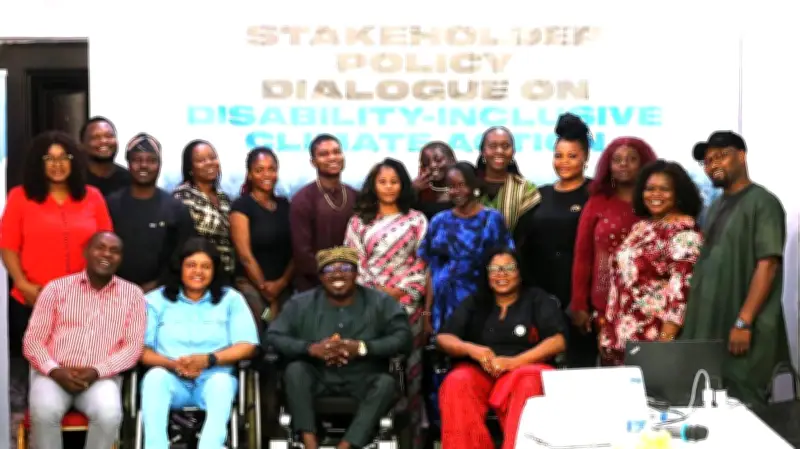
Stakeholders have raised concerns over the continued exclusion of persons with disabilities (PWDs), particularly women and girls, from Nigeria’s climate change policies and emergency response systems. They warn that millions remain vulnerable to the growing impacts of climate-induced disasters.
Policy Dialogue on Disability-Inclusive Climate Action
The concerns were raised on Wednesday in Abuja at a Stakeholders’ Policy Dialogue on Disability-Inclusive Climate Action organised by the Inclusive Friends Association (IFA) with support from Rise Up Together.
Speaking at the event, Executive Director of IFA, Grace Jerry, said climate change has become a present reality affecting communities across the country, but persons with disabilities remain largely overlooked in climate planning and interventions.
“From flooding and displacement to heatwaves and environmental stress, these impacts continue to shape the lives and well-being of millions of people. Yet persons with disabilities, particularly women and girls with disabilities, remain among those most affected and too often insufficiently represented,” she said.
Jerry noted that climate change is not a new challenge for persons with disabilities but one that has gained prominence due to increased awareness and advocacy. “Climate change has affected everybody right from the beginning. The reason it is now on the front burner is that persons with disabilities have become more aware and advocacy efforts have deepened,” she said.
She cited the example of wheelchair users trapped during floods, blind persons losing mobility aids during emergencies, and persons with albinism facing heightened risks from extreme heat. According to her, inclusive early warning systems and disability-disaggregated data are critical to effective climate responses.
“When you categorise persons with disabilities under vulnerable groups, interventions do not get to them. They become invisible under that umbrella,” she added.
Project Overview and Gaps
Program Manager IFA and Rise Up Leader, Stephen Oloche Idoko, while providing an overview of the initiative, said the Disability-Inclusive Climate Action Project was designed to address the disproportionate risks faced by persons with disabilities during climate-related emergencies.
“Although existing national climate frameworks acknowledge gender and vulnerable populations, practical guidance for disability inclusion remains limited,” he said.
According to Idoko, the project seeks to strengthen disability-inclusive climate governance, identify policy gaps and contribute to the development of a Disability-Inclusive Climate Action Guideline for Nigeria.
Deaf Community Experience
Sharing her experience, a participant from the Deaf Women Aloud Initiative (DWAI), Kauna Gabriel, recounted how deaf persons in flood-affected communities in Niger State were excluded from government relief interventions because information was not communicated in accessible formats.
“When the government came to share palliatives, deaf people in the community did not get the information. There was no interpreter to explain what was happening,” she said.
Gabriel disclosed that many affected deaf persons lost homes and property, but were unable to access support because they received information too late. “Without communication, deaf people will be left behind. With communication, the deaf can be involved,” she stressed, calling for the deployment of sign language interpreters during emergencies and disaster response efforts.
Call for Inclusive Implementation
Also speaking, Climate Justice Advisor at ActionAid International, Friday Onminyi Ogezi, observed that while Nigeria has robust climate policy frameworks, implementation, financing and inclusion remain weak.
“We recognise that Nigeria and climate actors have policies that state clearly the vulnerabilities and inclusion, but they do not state clearly the pathways and intersectionality—how climate change affects different categories of persons with disabilities,” he said.
Ogezi urged policymakers to move beyond consultation and ensure persons with disabilities actively participate in policy development, planning, implementation and monitoring. “We want to see this group take the lead in the solutions and address their issues. Beyond participation, they should be involved in decision-making processes,” he said.
Participants called for stronger implementation of existing laws, inclusive communication systems, disability-disaggregated data and greater representation of persons with disabilities in climate governance, insisting that climate action cannot be effective or equitable if millions of Nigerians are left behind.