Defence Chief Urges Borno, Yobe Residents to Expose Terror Perpetrators
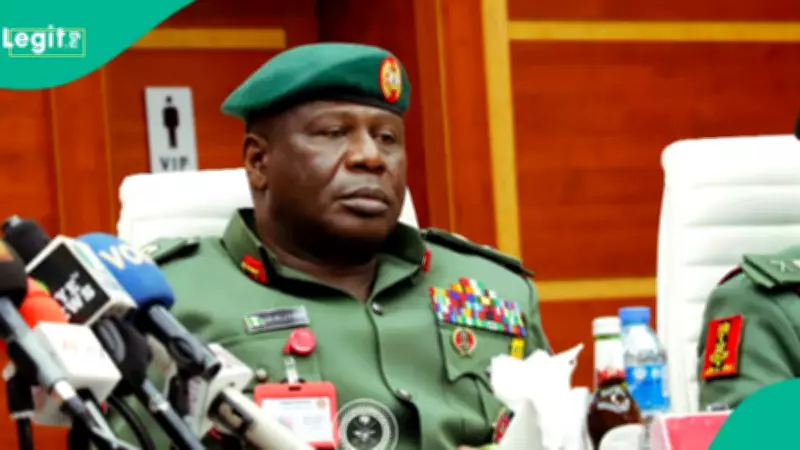
The Chief of Defence Staff, General Olufemi Oluyede, has made a powerful appeal to residents of Borno and Yobe states, asserting that they possess crucial information about the individuals carrying out terrorist activities within their communities. Speaking during a security briefing in Maiduguri, General Oluyede emphasized that lasting security in the Northeast cannot be achieved without active community participation and ownership of the ongoing crisis.
Presidential Directive Follows Deadly Attacks
General Oluyede's remarks came shortly after he relocated to the Borno state capital alongside the Chief of Army Staff, General Waidi Shaibu. This move followed a direct order from President Bola Tinubu, who instructed top military commanders to establish their operational base in Maiduguri following multiple explosions that rocked parts of Borno state. The attacks resulted in numerous casualties and heightened security concerns across the region.
The presidential directive underscores the renewed intensity of assaults targeting both civilian populations and military installations. Security analysts note that these developments represent a significant escalation in the long-running conflict that has plagued Nigeria's Northeast for over a decade.
Community Knowledge as Critical Security Asset
During his address to residents, General Oluyede delivered a pointed message about community responsibility in combating terrorism. "I want to put it clearly this afternoon that for us to end this act of terrorism, the people of Borno State and Yobe must take ownership of this problem," he declared.
The defence chief revealed that many of those involved in attacks are not strangers to the affected communities. "Bulk of people perpetrating this heinous act are from these states, they are our brothers, sisters, cousins and we know them," he stated, highlighting the intimate nature of the security challenge.
Evidence of Local Complicity in Attacks
General Oluyede cited specific examples to illustrate his point about insider involvement in terrorist operations. He referenced the recent attack on Kukawa, where subsequent investigations revealed that two individuals who participated in the assault were actually residents of the village itself.
"For example, when Kukawa was attacked, and we were conducting cordon and search afterward, we realised that two of the people that came to attack Kukawa were those inside that village. That means they are accomplices," the defence chief explained, providing concrete evidence of local collaboration with terrorist elements.
Military Adapts to Evolving Terror Tactics
Addressing the growing sophistication of insurgent operations, General Oluyede acknowledged that terrorist groups have increasingly incorporated advanced technology into their attacks. He specifically mentioned the expanding use of drones by Boko Haram and Islamic State West Africa Province (ISWAP) fighters.
"It's something that is evolving, and we are responding with germans drones and we are getting more of the drones," he revealed, indicating that the military is actively deploying countermeasures to match the technological advancements of terrorist organizations.
Governor Zulum Calls for Coordinated Offensive
The defence chief's appeal follows similar calls from Borno State Governor Babagana Zulum, who recently urged military commanders to launch a fully coordinated offensive across the Lake Chad region. Governor Zulum emphasized that current security gains would remain fragile unless the armed forces confront entrenched terrorist cells operating from islands in the Lake Chad basin.
During a meeting with the new Chief of the Air Staff, Air Marshal Sunday Kelvin Aneke, Governor Zulum identified three specific terrorist hideouts that require immediate military attention. His intervention highlights the multi-faceted approach needed to address the complex security situation in the region.
The Path Forward: Community-Military Partnership
General Oluyede concluded his remarks with a clear message about the necessity of collaboration between security forces and local communities. "We must take ownership of this crisis. That is my message to the people of Yobe and Borno," he reiterated, framing the conflict as a shared responsibility rather than solely a military challenge.
The defence chief's statements represent a significant shift in counterterrorism strategy, moving beyond purely military solutions to emphasize intelligence gathering through community engagement. As Boko Haram and ISWAP continue to adapt their tactics, Nigerian security forces appear increasingly focused on leveraging local knowledge to dismantle terrorist networks from within.