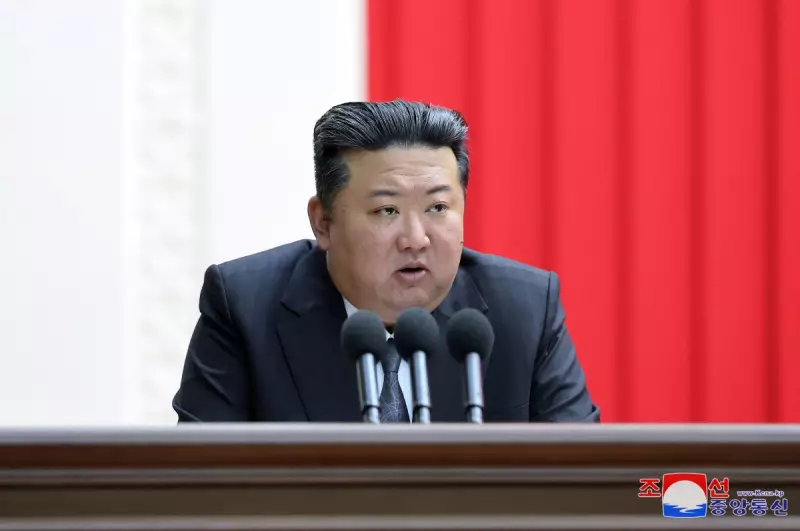
North Korean leader Kim Jong Un has issued a direct order for a significant ramp-up in the country's missile production capabilities. During a recent visit to munitions factories, Kim instructed officials to expand production capacity and construct new plants to meet the growing demands of Pyongyang's armed forces.
Factory Expansion and Military Ambitions
The directive, reported by the state-run Korean Central News Agency (KCNA) on Friday, December 26, 2025, underscores Pyongyang's commitment to strengthening its military arsenal. Kim Jong Un stated that the missile and shell production sector is "of paramount importance in bolstering up the war deterrent." He emphasized the need to prepare for a busy year ahead, ordering the building of new munitions plants to keep pace with the military's requirements.
This announcement follows a period of intense missile testing by North Korea. Analysts believe these tests aim to improve precision strike capabilities, challenge the United States and South Korea, and refine weapons potentially destined for export.
Deepening Alliance with Russia
A key driver behind this production push appears to be North Korea's deepening military partnership with Russia. Since Moscow's invasion of Ukraine nearly four years ago, the two nations have drawn closer. Pyongyang has sent troops, artillery shells, missiles, and long-range rocket systems to aid Russia's war effort.
In return, analysts say Russia is providing North Korea with crucial financial aid, military technology, and supplies of food and energy. Washington has pointed to evidence that this support includes advanced space and satellite technology, which shares underlying systems with intercontinental ballistic missiles (ICBMs).
Researcher Ahn Chan-il, originally from North Korea, noted that with its core ICBM objectives likely achieved, Pyongyang may now shift focus. The country is expected to accelerate development and production of medium- and intermediate-range missiles, potentially for export to Russia.
Broader Military Modernisation Drive
Kim's factory visit was reported just a day after state media said he toured a nuclear submarine factory. There, he vowed to counter the "threat" of South Korea developing its own nuclear-powered submarines with US backing. KCNA also reported Kim was briefed on research into "new underwater secret weapons."
Analyst Ahn further suggested that North Korea will likely seek advanced military technologies from Russia, including nuclear-powered submarine capabilities and fighter jets, to address weaknesses in its air force.
This flurry of activity included Kim overseeing a test launch of new-type high-altitude long-range anti-air missiles over the Sea of Japan on Thursday. He promised that "new modernisation and production plans" would be unveiled at the Korean Workers Party's first congress in half a decade, expected in early 2026.
These developments signal a determined push by North Korea to advance its military capabilities on multiple fronts, from missile production to naval and air force technology, solidifying its stance amid renewed geopolitical tensions.