A promised meeting about a career advancement turned into a trap for Colonel Mohammed Ma'aji, the Nigerian Army officer accused of spearheading a plot to overthrow President Bola Tinubu's administration. Instead of discussing his elevation to brigadier general, Ma'aji found himself in the hands of military intelligence, facing interrogation over a coup attempt that had allegedly been in the works since 2023.
A Career Stalled, a Plot Born
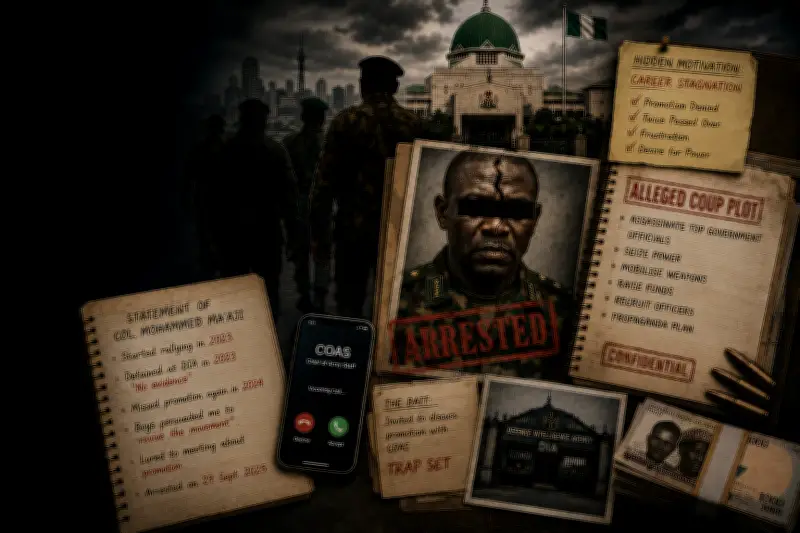
Ma'aji, a 50-year-old officer from Niger State, had been chasing promotion to the rank of brigadier general since 2023. After being overlooked twice, he reportedly reasoned that if the military would not give him his due place, he would take the entire country. Investigators were told that Ma'aji began rallying officers for a coup towards the end of Muhammadu Buhari's presidency, citing widespread insecurity and the deplorable living conditions of serving and retired military personnel as motivating factors. He claimed the military hierarchy had ignored these grievances.
His frustration was not new to security agencies. In 2023, Ma'aji was invited to the Defence Intelligence Agency (DIA) and detained overnight on suspicion that politicians wanted to use him to disrupt the general elections. His phone was seized for forensic analysis, but no evidence was found. He later wrote: "I was released with a verbal apology because there was no evidence."
Revival After Second Snub
When promotion eluded him again in 2024, Ma'aji decided to revive the dormant plot. He told investigators that younger officers, whom he called "the boys," persuaded him to act. Ma'aji was quoted as saying: "When I missed my second attempt at promotion to brigadier general in 2024, some of the boys started disturbing and calling on me that we needed to revive the movement again. They were afraid that I might be retired prematurely and that all of us will regret it."
The Trap: A Fake Meeting
Ma'aji was arrested on 29 September after military authorities used his burning desire for promotion as bait. He said he received a call from the Chief of Staff to the Chief of Army Staff (COAS), asking him to report to House 12 at Niger Barracks. Moments later, the COAS himself called, urging him to hurry because they needed to discuss his promotion. The army chief also asked whether Ma'aji had been in touch with retired Major General A. Mohammed, popularly known as "Bandect," further convincing the colonel that his career was finally being addressed.
"I drove immediately to Niger Barracks House 12 with very high morale because I was excited that my promotion issue was finally receiving attention," Ma'aji recounted. At that point, the alleged coup plan had already moved into high gear, with operational strategies for fundraising, weapons mobilisation, and logistics all mapped out.
From Promotion Talk to Interrogation
During the meeting, the COAS asked why his promotion had been delayed, inquired about his service record and course grades, and assured him he would be promoted before the year ended. But the mood shifted when Lieutenant General Emmanuel Undiandeye, the Chief of Defence Intelligence, walked in. Undiandeye asked if Ma'aji was the colonel and instructed him to follow to his office to collect a message for retired Major General Bandect. The COAS then handed Ma'aji $1,000 as welfare support before sending him off with the intelligence chief.
Believing he was running an errand, Ma'aji drove to DIA headquarters. Instead of delivering a message, he was directed to the office of Brigadier General Nicholas Ashinze, the DIA's director of operations. There, the interrogation began. "It was there he started asking me about the plot involving myself, Lt. Felix, Lt. Col. Bappah and others," Ma'aji stated. He initially denied involvement but was told that Lieutenant S.S Felix had already been arrested and that Lieutenant Colonel Shamsuddeen Bappah was on the run. "That was how the investigation commenced on 29 September 2025 till today," he added.
Pleas for Mercy and a Grim Picture
In his signed statement, Ma'aji appealed for leniency for the other suspects, insisting they had come to realise their mistakes during the investigation. He described their actions as driven by "patriotism, love of country and a genuine desire to have positive change," not personal ambition. He urged the military authority to improve the welfare of soldiers, painting a bleak picture of officers grappling with economic hardship, poor housing, and declining morale. He also called for safe internal channels where personnel could voice grievances without fear of victimisation.
How the Plot Came to Light
PREMIUM TIMES first reported the alleged coup plot in October 2025, days after Sahara Reporters disclosed that 16 senior military officers had been arrested and detained. Independent investigations by this newspaper later expanded the list to 40 suspects, including civilians and a police officer. A domestic worker in the Presidential Villa was also accused of aiding a suspect in conducting reconnaissance of the heavily fortified building.
Initially, the Defence Headquarters neither confirmed nor denied the existence of a coup plot, describing the arrests as part of a routine internal process to maintain discipline. But the fallout was swift: the government cancelled the 1 October Independence Day parade and reshuffled the military high command, removing Chief of Defence Staff Christopher Musa. He was replaced by Oluyede, who later moved to the Ministry of Defence.
Legal Proceedings and Charges
Months later, the Defence Headquarters acknowledged the alleged plot and announced that serving officers would face military judicial panels. In April, the federal government filed 13 charges before the Federal High Court in Abuja against six civilians, including two retired military officers. The defendants are Mohammed Ibrahim Gana (retired major-general), Erasmus Ochegobia Victor (retired navy captain), Ahmed Ibrahim (police inspector), Zekeri Umoru (electrician at the Presidential Villa), Bukar Kashim Goni, and Abdulkadir Sani, a Zaria-based Islamic cleric. While the civilians and retired officers are being prosecuted in civil court, the serving officers are awaiting trial by court martial.