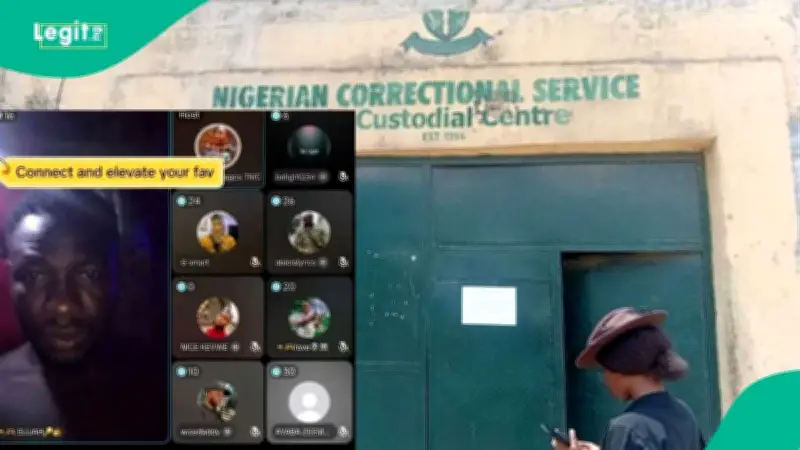
At the Ibara Maximum Security Custodial Centre in Abeokuta, Ogun State, a convicted murderer is serving a death sentence while maintaining a surprisingly active digital life from his cell. Elijah Oyebode, condemned to hang for a 2016 ritual killing, has operated multiple TikTok accounts, earned money through live viewer gifts, and placed online sports bets — all from inside one of Nigeria’s most closely watched correctional facilities.
Conviction for the Murder of a University Student
Oyebode’s legal troubles date back to the brutal kidnapping and killing of Rofiat Adebisi, a final-year student at Osun State University. She was abducted at a roadside in 2016 and killed for ritual purposes. In 2019, Justice S. O. Falola of the Osun State High Court found Oyebode guilty of murder and sentenced him to death by hanging.
Despite that sentence, Oyebode appears to have accessed smartphones and mobile data inside the prison. One of his TikTok accounts, operating under the handle @ayola.oluwafu, achieved Level 20 gift status — a milestone on the platform that reflects significant financial transactions from viewers. He also told a Saturday Tribune-monitored livestream on April 16, 2026, that he earned ₦85,000 from a single sports bet the previous month.
Prison Life Broadcast to Thousands
During that livestream, Oyebode described an environment where phones are common. “An individual may have two to three phones. Facebook and TikTok are full of prisoners,” he said. His account accumulated more than 1,400 followers, and his activities remained visible for weeks after TikTok announced a major content purge.
Oyebode also created a second TikTok account impersonating Omolola Awoyele, a popular live host. Awoyele later confronted him after recognizing her own image and name on a profile she never created. Through a video call, she confirmed that Oyebode was broadcasting from inside the prison. Awoyele said she initially contacted lawyers on his behalf after he claimed he was innocent, but she withdrew all support once she obtained a certified true copy of the court proceedings and received a confession from him during a call. He then began sending her threatening messages from the prison.
Warders Accused of Smuggling Phones and Drugs
Oyebode did not stop at describing his own access. He alleged that correctional officers routinely smuggle mobile phones and drugs into the facility. He went further, saying officers who bring in phones also confiscate devices from other inmates and demand money for their return. In even more serious claims, he asserted that wealthy death-row inmates are occasionally escorted outside the prison by officers to supervise private building projects and meet contacts arranged through social media.
These allegations, while unverified, have drawn attention to the broader challenges facing Nigeria’s prison system. The Nigerian Correctional Service has acknowledged that some staff may be compromised.
Official Response: Bad Eggs and Disciplinary Action
National Spokesperson Jane Osuji told the press that the service cannot rule out misconduct among its ranks. “Where there are so many individuals, there will be one or two bad eggs,” she said. She confirmed that over 1,400 officers have faced disciplinary action so far. Osuji also warned the public against sending money to inmates online, saying such support “may leave correctional facilities worse than when they entered.”
She did not directly address Oyebode’s specific claims, saying the service needed evidence to act on particular allegations of digital misconduct by inmates.
Experts Suggest Signal Jammers to Curb Illegal Phone Use
Cybersecurity expert Professor Tunde Olabiyisi has proposed a practical solution: install signal jammers configured to a defined perimeter around prisons. These jammers would render smuggled, unapproved devices unusable inside prison grounds without interfering with civilian communications in surrounding areas. Such technology is already in use in several countries and could close the loophole that allows inmates to livestream, bet, and scam from their cells.
TikTok Enforcement and a Still-Active Account
Oyebode’s online presence persists even as TikTok ramps up enforcement. Weeks before the reports surfaced, the platform announced a sweep that removed 4.02 million Nigerian videos and disrupted over 86,000 live sessions. Yet Oyebode’s primary account remained active, operating under a new display name and with its profile switched to private.
Education Offers a Contrast Behind Bars
In a separate but related development, the Nigerian Correctional Service has celebrated a more positive milestone from behind bars. Six inmates of the Medium Security Custodial Centre in Kuje, Abuja, recently earned university degrees from the National Open University of Nigeria (NOUN). The certificates were presented at a ceremony in Abuja, highlighting the role of education in rehabilitation. The contrast between the disciplined pursuit of degrees and the illicit use of social media within prisons underscores the complex reality of Nigeria’s correctional system.