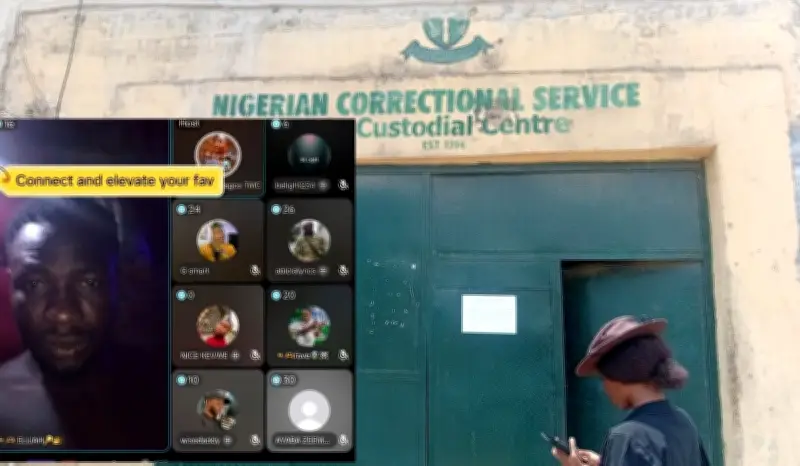
Elijah Oyebode, a death row inmate at the Ibara Correctional Centre in Abeokuta, Ogun State, has allegedly been running multiple TikTok accounts, hosting livestreams, receiving monetary gifts, and communicating with outsiders, according to an investigation that has exposed fresh security lapses in Nigeria's correctional system.
Oyebode's activities contradict the assumption that high-security death row inmates are cut off from the outside world. Investigators say he maintained a social media presence that allowed him to earn money and even impersonate prominent creators, raising concerns about the effectiveness of prison oversight and the integrity of officers tasked with enforcing contraband rules.
From Murder Conviction to Death Row
Oyebode was sentenced to death by hanging in 2019. An Osun State High Court found him guilty of murdering Rofiat Adebisi, a final-year student at Osun State University. According to court records, Oyebode offered conflicting accounts of the incident before denying involvement at trial. The court relied on medical and other evidence to convict him.
His case took a different turn when activist and TikTok creator Omolola Awoyele became involved. Awoyele said she first came across Oyebode online and believed his claims of innocence. After helping him seek legal support, she confirmed via video call that he was in prison. However, she later obtained his court records and confronted him.
TikTok Livestreams and Impersonation
Investigators linked Oyebode to at least two TikTok accounts. One reportedly reached Level 20 gifting status, which enables recipients to collect monetary gifts from viewers. The second account was allegedly created to impersonate Awoyele by using her name and picture. "Elijah created an account using my name and uploaded my picture, which meant he could potentially use it to scam people online," Awoyele said.
She described her initial interactions: "At first, I did not believe him. I asked if he had WhatsApp because I wanted to confirm his claims through a video call. Through the video call, I confirmed that he was indeed in prison." Awoyele added that Oyebode later admitted his guilt, prompting the lawyer handling his appeal to withdraw from the case.
Inmate Exposes Prison Corruption
During a TikTok live session in April 2026, Oyebode allegedly detailed how inmates get phones and internet access. "An individual may be in possession of two to three phones," he said. "Facebook and TikTok are full of prisoners. They will not disclose their location to anyone. If they do video calls and people see a nice background, they will not know where they are."
He also revealed his earnings: "I get a lot of people sending money to me from the internet; only a few are my family. The bet I won last month was ₦85,000." He claimed that warders were complicit in smuggling. "The warders are not the ones selling phones to us. They only get them for us at the tarmac and smuggle them in for us." He further explained that even when another warder seizes a phone, the inmate must pay a bribe to retrieve it.
On drug smuggling, Oyebode said: "Warders smuggle drugs in for inmates. The inmate might buy the drugs for about ₦500,000, and the warder who smuggled them in might collect ₦100,000 from them. So, after repackaging and reselling, the inmates can make ₦2 million from the drugs."
He also made alarming claims about inmates running businesses outside prison: "There are some inmates here who are building hotels outside the prison and always go there for supervision with the aid of the warders while facing the death penalty. The warders take them to their various houses and hotels and bring them back. Some will meet people, especially women, on social media and settle the warders to meet with them."
Summarising his view of the system, Oyebode said: "I will not deceive you; it is no longer a correctional centre. It is corrupting people more."
Prison Service Responds
Nigerian Correctional Service spokesperson Jane Osuji acknowledged that misconduct by some officers is a challenge but denied that corruption is systemic. "I cannot sit down here and tell you that it is true or it's not true because where there are so many individuals, there will be one or two bad eggs in them," she said. "We want a situation where we can work together so that we can have evidence of this, track it, and get both the inmates and the officers that are enabling this."
Osuji warned about the dangers of inmate internet access. "If they can join a live social media platform for fun or monetary value, they can as well do anything from the comfort of their cells. When they are able to organise their criminal activities from behind the walls of the correctional service, then you and I are in for it," she stated.
She noted that contraband smuggling is a worldwide problem: "It is important to state clearly that the smuggling of unauthorised gadgets into prisons is a challenge faced by correctional administrations globally." The service said it has disciplined more than 1,400 officers for misconduct and maintains zero tolerance. "The comptroller-general maintains a zero tolerance for every form of misconduct or corruption involving staff or inmates," Osuji said. She appealed to the public to report such cases, warning that otherwise inmates could leave prison worse than they entered.
TikTok's Moderation Questioned
The investigation also scrutinised TikTok's content moderation. Despite the platform's enforcement efforts, Oyebode's account allegedly remained active. TikTok later requested details of the accounts for an internal review and subsequently announced the removal of millions of videos and thousands of livestreams in Nigeria. However, investigators said Oyebode's primary account was still online after the reported sweep.
The case underscores the difficulty of detecting organised criminal activity from within prison walls and raises urgent questions about the adequacy of digital surveillance in correctional facilities. With inmates allegedly able to earn thousands of naira, coordinate with outsiders, and even direct business ventures, the line between custody and liberty appears dangerously blurred in Nigeria's prison system.