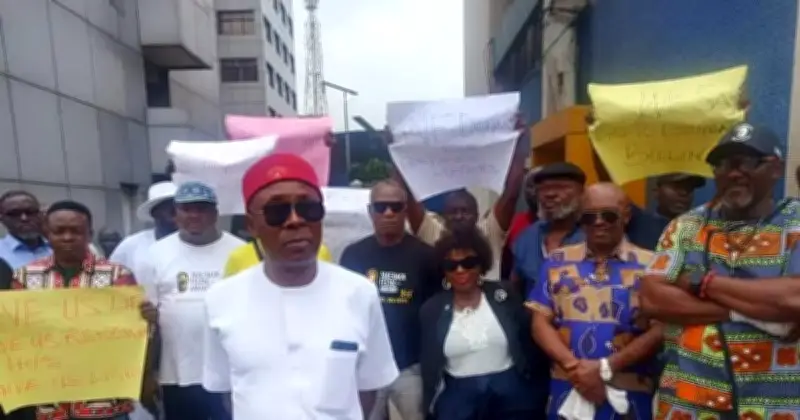
Residents of FESTAC Town in Lagos marched to the headquarters of the Eko Electricity Distribution Company (EKEDC) in Marina on Tuesday, issuing a 48-hour ultimatum for the restoration of power supply or face mass action. The protest, organized under the group Take Back FESTAC, followed over eight months of near-total blackout, crippling estimated billing, and a collapse of economic activity across the estate.
Protesters demand immediate action after months of darkness
Convener of Take Back FESTAC and General Secretary of Take Back Nigeria, Comrade Valentine Uduebor, said the demonstration was a last resort after repeated engagements with EKEDC produced no results. He noted that EKEDC had earlier assured residents that power would improve following the completion of a transmission project. "They told us to give them five months. We agreed because we believed them. Those five months have come and gone, yet our people remain in darkness. That is why we are here today," Uduebor said.
Uduebor highlighted the severity of the situation, stating that he had not purchased electricity tokens since buying ₦40,000 worth over a year ago because there had been virtually no power to consume. He warned, "Forty-eight hours from today, if EKEDC does not restore electricity to FESTAC, members, stakeholders and residents will not be held responsible for whatever communal inconvenience may follow."
Economic and health impacts of prolonged blackout
Vice President of the group, Chief James Ibeka, said the blackout had pushed the cost of living to unsustainable levels. Families now spend as much as ₦10,000 daily on generator fuel at ₦1,300 per litre. "Sometimes we go for three good months without having up to two hours of electricity cumulatively. Healthcare, food preservation, businesses and every aspect of life have been affected. We even lost a young man," Ibeka added.
Small businesses including barber shops, salons and artisan workshops have shut down entirely, while hospitals struggle to maintain basic care for patients dependent on stable power. Dr. Dumebi Owa, a medical practitioner at the protest, described the situation as a direct threat to lives. "In hospitals, patients on life support depend on electricity. Imagine carrying out surgery and the power suddenly goes off. It is dangerous and unacceptable," she said. She also accused EKEDC of prioritizing estimated billing over actual power supply, generating revenue regardless of electricity delivery.
Residents face estimated billing despite no service
Several protesters said they are charged monthly despite receiving little or no power. Protester Michael stated he pays approximately ₦15,000 every month whether or not electricity is supplied. "To be truthful, they don't give us light. If they do, it is for about one hour or 30 minutes. The painful thing is that we are not on prepaid meters. Whether there is electricity or not, the bills keep increasing," he said.
The group's PRO, Nathaniel Ussi, called on EKEDC to accelerate the distribution of prepaid meters to end the cycle of estimated billing. About five protesters were later invited into the EKEDC office to meet with management, but no immediate resolutions were announced.
Community warns of consequences if demands unmet
The protest, which drew hundreds of residents, underscores the worsening electricity crisis in Lagos suburbs. FESTAC residents emphasized that their patience has run out, and they are prepared for mass action if EKEDC fails to restore power within 48 hours. The ultimatum marks a significant escalation in the community's fight for reliable electricity, highlighting broader frustrations with Nigeria's power distribution challenges.