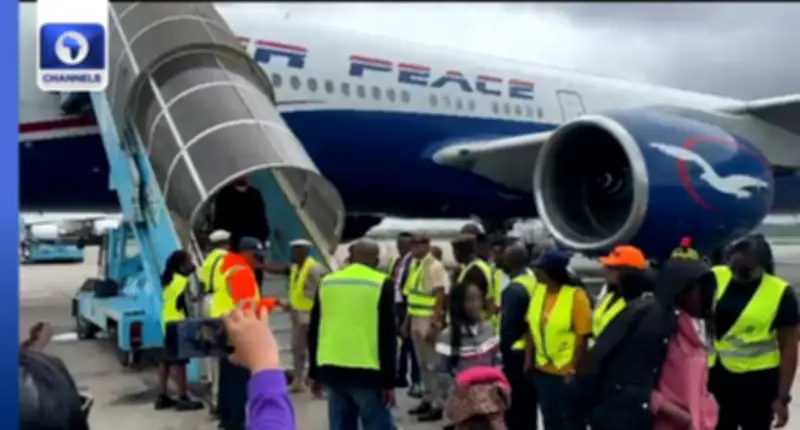
The final batch of 187 Nigerians evacuated from South Africa amid the recent xenophobic attacks arrived at the Murtala Muhammed International Airport in Lagos on Sunday, July 15, 2026. This marks the completion of a multi-phase repatriation effort that has brought home over 600 Nigerian nationals since the violence erupted in late June.
Evacuation Details and Arrival
The aircraft, operated by Air Peace, touched down at approximately 9:30 a.m. local time. The returnees were received by officials from the National Emergency Management Agency (NEMA), the Nigerians in Diaspora Commission (NiDCOM), and the Lagos State Government. According to a statement from NiDCOM, the evacuees included 112 men, 65 women, and 10 children. All passengers underwent health screenings and were provided with temporary accommodation and transportation to their various states of origin.
This final batch follows two earlier evacuations: the first on July 8 brought 315 Nigerians, and the second on July 12 brought 110. The total number of evacuees now stands at 612. The evacuation was coordinated by the Federal Government in response to widespread attacks on foreign-owned businesses and properties in South Africa, which resulted in at least 12 deaths and the destruction of numerous shops and homes owned by Nigerians.
Government Response and Condemnation
The Nigerian government condemned the attacks and demanded compensation for affected citizens. In a press briefing, the Minister of Foreign Affairs, Geoffrey Onyeama, stated, "We have made it clear to the South African government that the safety of Nigerians and their property is non-negotiable. We are pursuing diplomatic channels to ensure that those responsible are held accountable and that victims receive restitution." He also confirmed that the South African government had deployed additional police to protect Nigerian businesses.
President Muhammadu Buhari had earlier directed the evacuation exercise, emphasizing that the government would not tolerate any form of xenophobia against Nigerians abroad. The evacuation was conducted in collaboration with the South African authorities and the International Organization for Migration (IOM).
Challenges and Concerns
Many evacuees reported losing their livelihoods and belongings. One returnee, Chidi Okonkwo, a businessman who had lived in Johannesburg for 15 years, said, "I lost my shop and all my inventory. I have to start from scratch. The Nigerian government has promised support, but we need more than promises." NiDCOM Chairperson Abike Dabiri-Erewa assured that the government would provide skills training and small business loans to help returnees reintegrate into the Nigerian economy.
The attacks have strained diplomatic relations between Nigeria and South Africa. The Nigerian government temporarily recalled its ambassador to South Africa for consultations. However, both nations have expressed commitment to resolving the issue through dialogue and strengthening bilateral ties.
Broader Impact and Future Measures
The xenophobic violence has sparked widespread condemnation across Africa. The African Union (AU) called for an end to the attacks and urged member states to protect foreign nationals. In Nigeria, the incident has led to calls for stronger protections for Nigerian citizens abroad, including the establishment of a diaspora emergency response fund.
As the evacuees settle in, the focus shifts to long-term solutions. The government is working with South African authorities to improve early warning systems and crisis response mechanisms. Additionally, the Nigerian embassy in Pretoria has set up a hotline for citizens in distress. The evacuation underscores the vulnerability of diaspora communities and the need for robust consular services.