Key Takeaways
Paramilitary forces collectively play a vital role in securing Nigeria’s internal stability and public safety. Key challenges faced by these forces include funding shortages, inadequate personnel welfare, lack of modern equipment, and overlapping mandates. Some paramilitary services in Nigeria include the Nigeria Customs Service (NCS), Nigeria Immigration Service (NIS), Nigeria Correctional Service, Federal Fire Service (FFS), Nigeria Security and Civil Defence Corps (NSCDC), Federal Road Safety Corps (FRSC), and National Drug Law Enforcement Agency (NDLEA).
List of Paramilitary Forces in Nigeria
1. The Nigerian Police Force (NPF)
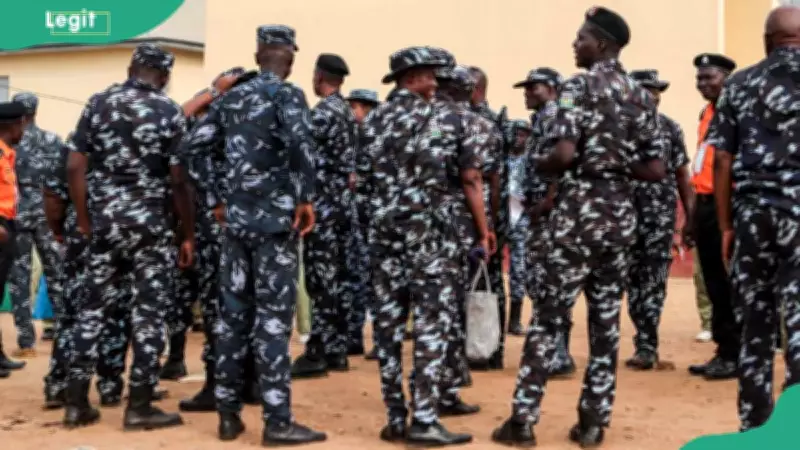
The Nigerian Police Force is the primary security and law enforcement agency. Its functions include crime prevention, protection of lives and property, order preservation, arrest of offenders, and crime detection.
2. The Nigerian Security and Civil Defence Corps (NSCDC)
The NSCDC maintains peace and order during emergencies, provides emergency medical services, inspects private security companies, and assists in decontamination and distribution of emergency supplies.
3. The Nigerian Immigration Service (NIS)
The NIS controls entry and exit of persons, issues travel documents such as passports, and grants residence permits to foreigners.
4. The Nigerian Customs Service (NCS)
The NCS intercepts contraband, checks travelers and cargo, assesses customs duties, enforces import/export restrictions, and collects trade data.
5. The Nigerian Correctional Service (NCOS)
The NCOS takes custody of legally interned persons, provides humane care, conducts risk assessments, offers rehabilitation programs, and empowers inmates through education and vocational training.
6. The National Drug Law Enforcement Agency (NDLEA)
The NDLEA eradicates illegal drug trafficking and usage, suppresses demand, recovers losses from drug trade, and rehabilitates drug users.
7. The Federal Fire Service (FFS)
The FFS provides fire prevention, rescue, mitigation, paramedical services, and firefighting.
8. The Federal Road Safety Corps (FRSC)
The FRSC educates drivers, designs driver’s licenses and number plates, enforces speed limits, and regulates the use of sirens and flashers.
9. The Economic and Financial Crimes Commission (EFCC)
The EFCC enforces economic and financial crime laws, investigates fraud and corruption, collaborates with other bodies, and recovers losses.
How Do Paramilitary Forces Differ from the Military?
According to Miriam Adah, a Doctoral Researcher in Defence and Strategic Studies at the Nigerian Defence Academy Kaduna, paramilitary forces are structured like the military but have a civilian-oriented mandate. The military focuses on territorial integrity and suppressing insurrection, while paramilitary forces support internal security and law enforcement.
Key Challenges Faced by Paramilitary Forces in Nigeria
Challenges include funding shortages, inadequate personnel welfare, outdated equipment, and overlapping mandates that can lead to rivalry rather than collaboration.
Nigeria’s Paramilitary Structure Compared to Other Countries
Miriam Adah notes that Nigeria’s structure is similar to India’s, with multiple agencies addressing different security needs. Unlike Ethiopia, where regional security bodies draw authority from regional governments, Nigeria’s paramilitary agencies are centralized.
Is Man O' War a Paramilitary in Nigeria?
Yes, it is a voluntary paramilitary organization founded in 1951, established by the Federal Government through the Citizenship and Leadership Training Centre Act.
Is the Police a Paramilitary in Nigeria?
The Nigerian Mobile Police (MOPOL) is the paramilitary arm of the Nigeria Police Force, operating under federal orders.
Which is the Highest-Paid Paramilitary in Nigeria?
According to Nigerian Waves, the Nigerian Police Force is the highest-paid paramilitary, with salaries ranging from N108,233 to N8,537,976 annually.