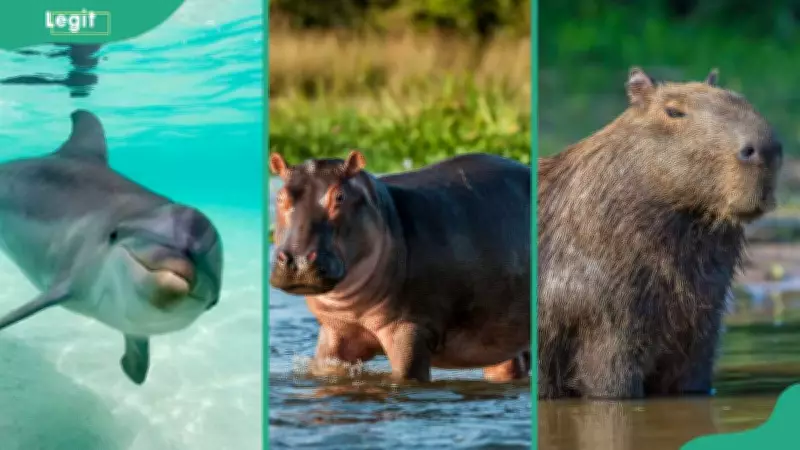
Water covers over 70% of the Earth's surface, creating diverse habitats for an incredible variety of creatures. From deep oceans to rivers and lakes, aquatic animals have developed fascinating adaptations to survive and thrive. Some are fully aquatic, while others are semi-aquatic, spending part of their lives in water. This article explores nine remarkable animals that live in water, highlighting their unique features and behaviors.
Key Takeaways
- Aquatic animals inhabit diverse environments such as oceans, rivers, lakes, ponds, and wetlands, each supporting species adapted to those conditions.
- They possess specialized adaptations including gills for breathing underwater, fins for swimming, streamlined bodies, or the ability to hold their breath for extended periods.
- Aquatic life ranges from tiny plankton and fish to large mammals like whales and dolphins, showcasing immense biodiversity.
Top 9 Animals That Live in Water
9. Hippo
Scientific name: Hippopotamus amphibius
Class: Mammalia
Family: Hippopotamidae
Hippos are massive mammals that spend up to 16 hours a day in lakes, ponds, and rivers to keep their huge bodies cool. Only their heads peek out of the water. Although they can hold their breath for about 30 minutes, they usually do not dive deep, leaving just the tops of their heads at the surface. At night, hippos leave the water to forage on land. If they stay too long on dry land on a hot day, they quickly dehydrate. While not ocean dwellers, hippos are well adapted to freshwater environments.
8. Manatee
Scientific name: Trichechus
Class: Mammalia
Family: Trichechidae
Manatees, also known as sea cows, are slow-moving herbivores that inhabit shallow, warm coastal waters and rivers, such as Florida's Crystal River. Weighing up to 1,300 pounds (600 kg), they are born underwater and remain there throughout their lives, though they must surface every few minutes to breathe. They feed on seagrasses, weeds, and algae. Different manatee species live along the Atlantic coast of North and South America, the west coast of Africa, and the Amazon River.
7. The Muskrat
Scientific name: Ondatra zibethicus
Class: Mammalia
Family: Cricetidae
The muskrat is a frequent inhabitant of wetlands, swamps, and ponds, where it digs tunnels in swampy banks. This large rodent has a body length of 30 cm and a flat tail almost as long as its body. Muskrats are well adapted to water and begin swimming 10 days after birth. They are known for their developed communication skills, using distinctive odors to exchange information and frighten predators.
6. Baikal Seals
Scientific name: Pusa sibirica
Class: Mammalia
Family: Phocidae
The Baikal seal is the only true freshwater seal species, endemic to Lake Baikal in Russia, the world's deepest lake. Although new generations are born each year, the species faces threats from poaching and pollution from nearby paper and cellulose industries.
5. The Amazonian Dolphin
Scientific name: Inia geoffrensis
Class: Mammalia
Family: Iniidae
This charismatic dolphin uses echolocation to find small fish and crustaceans in the turbid waters of the Amazon River. During annual migrations, they swim through flooded forests and hunt among trees. Their bright pink or pale coloration and natural curiosity make them easy targets for poachers who illegally use them as bait for catfish. Their population has declined significantly. Local inhabitants consider these dolphins supernatural beings capable of taking human form.
4. Capybara
Scientific name: Hydrochoerus hydrochaeris
Class: Mammalia
Family: Caviidae
The capybara is the world's largest rodent, growing up to 4 feet (130 cm) long and weighing about 145 pounds (66 kg). These moisture-loving mammals eat grass and aquatic plants. They have webbed paws that help them swim well and stay underwater for 5 minutes or more. Capybaras live in Central and South America, inhabiting lakes, rivers, and wetlands from Panama to Brazil. Their eyes, ears, and nostrils are located high on the head, staying above water when submerged. They live in social groups with an alpha male, protecting their territory and food together. People hunt capybaras for their skin and meat, which is especially popular during Lent, as Catholics in South America consider it an acceptable alternative to beef or pork.
3. Beaver
Scientific name: Castor
Class: Mammalia
Family: Castoridae
Beavers are environmental engineers, second only to humans in altering landscapes. Using powerful jaws and teeth, they cut down trees and build dams of wood and mud, ranging from 2 to 10 feet (1–3 meters) in height and over 100 feet (30 meters) in length. They are a prime example of aquatic animals that depend on water for survival and habitat creation.
2. River Otter
Scientific name: Lontra canadensis
Class: Mammalia
Family: Mustelidae
River otters are playful, hygrophilous mammals that willingly submerge underwater. They move gracefully thanks to webbed paws and a paddle-like tail. Their ears and nostrils close underwater, and their fur is water-repellent. Young otters begin swimming at 2 months old. They live in burrows along rivers or lakes, near the fish they feed on.
1. Platypus
Scientific name: Ornithorhynchus anatinus
Class: Mammalia
Family: Ornithorhynchidae
The platypus is an incredible mixture of animals: a fluffy trunk like an otter, a beak like a duck, and webbed paws and a paddle-like tail like a beaver. It swims well and spends most of its life underwater. Unlike otters and beavers, platypuses lay eggs. Males have poisonous stings on their hind legs. They build holes at the water's edge and feed on underwater worms, molluscs, and insects.
Frequently Asked Questions
What are animals that live in water called?
Animals that live in water are called aquatic animals. They include species in oceans, rivers, lakes, and ponds, such as fish, whales, and crabs.
What are animals that live in water and on land called?
Animals that live both in water and on land are called amphibians or semi-aquatic animals. Examples include frogs, crocodiles, and turtles, which adapt to both environments.
What are plants and animals that live in water called?
Plants and animals that live in water are collectively known as aquatic organisms. This group includes algae, seaweed, fish, and other water-based life forms.
Can fish see at night?
Yes, many fish can see at night due to special adaptations in their eyes. Some species also rely on other senses, like detecting vibrations, to move and find food in low light.
Which animal can survive in water?
Many animals can survive in water, including fish, dolphins, and whales. Even some mammals like seals and hippos spend most of their time in water.
How many animals can live in water?
There is no exact number, but thousands of animal species live in water worldwide. Scientists estimate that aquatic life makes up a large portion of Earth's biodiversity.
Beneath the surface, a completely different world thrives, filled with unique flora and fauna in remarkable diversity. Despite years of research, scientists have only uncovered a fraction of the secrets of aquatic animals, and with advancing technology, new species continue to be discovered each year.