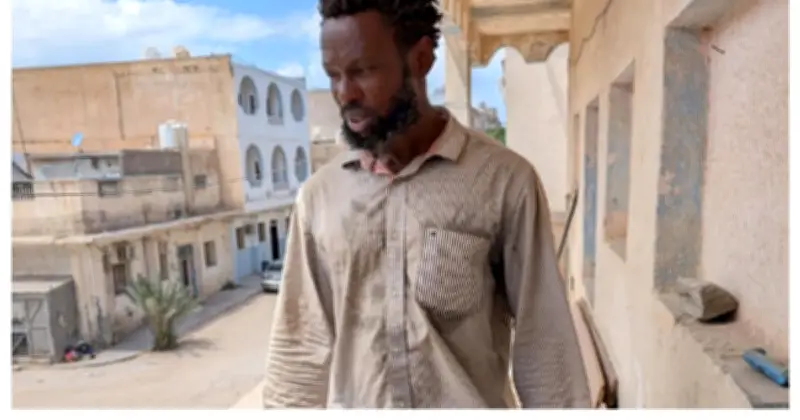
Investigative journalist Fisayo Soyombo has issued a stark warning to Nigerians considering irregular migration to Libya, revealing that the hardship, robbery, exploitation, and dangerous desert conditions are far worse than many imagine. His warning is based on a 47-day undercover investigation from Kano through Niger Republic to Tripoli, during which he documented the grim realities faced by undocumented migrants.
Undercover Journey Reveals Harsh Realities
Soyombo, founder of the Foundation for Investigative Journalism (FIJ), shared his findings during an interview on ARISE News on Sunday. He explained that many Nigerians leave home hoping to escape economic hardship, only to find themselves trapped in even worse conditions in Libya. He noted that many migrants believe any destination outside Nigeria automatically offers a better life, but that assumption can be costly.
“You know, when you are trying to escape economic deprivation, you think that any other option is good. The options in Libya are worse,” Soyombo said. He recounted that many migrants arrive in Libya only to discover they cannot continue their journey to Europe. With no money left and no legal status, they end up taking whatever jobs they can find just to survive.
“What happens a lot of time is, they get to Libya, they realise they can’t cross. They are stuck. They run out of funds. Then they have to go into many jobs to at least be able to eat. Then they start saving to cross,” he added.
Robbery and Exploitation of Migrants
Soyombo highlighted the vulnerability of undocumented migrants in Libya, particularly their inability to access basic financial services. Because Libya criminalises irregular migration, migrants cannot open bank accounts, forcing them to carry cash and making them easy targets for criminals.
“But don’t forget, you’ve gone into Libya illegally because Libya already criminalised irregular migration. You can’t open a bank account. So you keep cash. Anyone can rob you,” he said.
He also described the harsh working conditions migrants face, especially in farming. Temperatures in Libya’s desert regularly exceed 40 degrees Celsius, making farm work extremely dangerous. Soyombo compared it to the hottest Nigerian state he has visited, Yobe, noting that the desert heat is far more intense.
“The Nigerians who are in Libya are farming. Do you know the temperatures in Libya? It’s a desert. The hottest Nigerian state I’ve been to is probably Yobe. The Agadir that was the start of the desert was like 20 degrees centigrade to 32 degrees centigrade. In the desert, you are talking temperatures of 40 and more as you go to farm,” he explained.
Forced Labour and Robbery Incidents
Soyombo shared a disturbing incident from his undercover mission where he narrowly escaped being forced to work on a farm. He spotted an Arab man approaching and fled, but others were not so lucky. “We were stopped at a village. One Arab man came. And you know, again, because I was on a mission, my eyes were everywhere. Once I saw him approaching, I took to my feet,” he said.
Those who could not escape were conscripted to work under the scorching sun without pay. “The guys that were not fast, he conscripted them to the farm. They worked for like three hours in this scorching sun. And he didn’t pay them a dime,” Soyombo recounted. The following day, the same man allegedly robbed the migrants before forcing them back to work. “Robbed them, took their cash, took them to the farm and he didn’t pay them a dime. Who were they going to complain to? He robbed them and then he enslaved them,” he said.
Understanding the Risks Before Leaving
Despite the painful experiences he witnessed, Soyombo said he does not judge Nigerians who take the risky journey. He believes many simply lacked accurate information before leaving home. “I don’t blame them, I will never sit anywhere and blame anyone who has gone to Libya. Because on that trip, a lot of migrants told me, oh, if I knew I would suffer this much, I wouldn’t come,” he said.
Soyombo stressed that the journey is unpredictable and far more dangerous than many expect. He spent six months planning the operation and was advised to budget 30 days, but the mission lasted 47 days. “So for instance, the first thing is that you can never predict that journey. I spent six months preparing for this project. I was told to budget 30 days. I ended up spending 47 days,” he said.
He concluded that documenting the experience through photos and videos was the most practical way to warn others. “And for me, the most straightforward way to help them is to say, this journey you’re about to go through, I went through it and have documented it. These are photos, these are videos,” Soyombo said. His investigation aims to provide firsthand evidence of the dangers along the migration route, helping Nigerians make informed decisions before considering irregular migration.