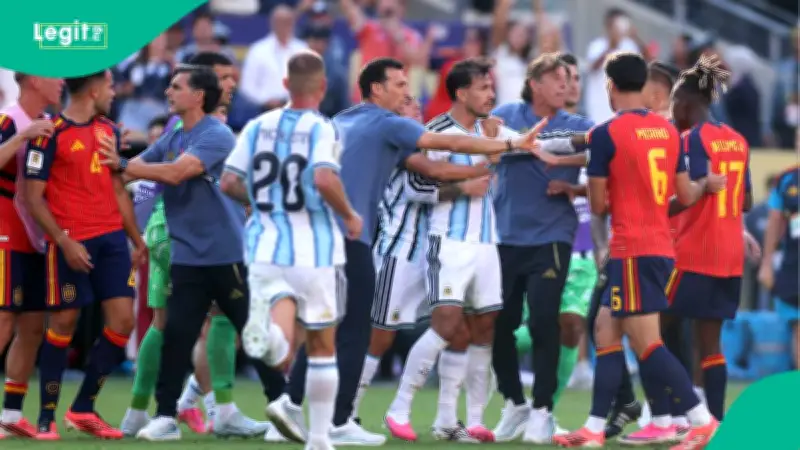
FIFA has confirmed that its independent Disciplinary Committee is reviewing the official match reports and all relevant circumstances following Argentina's dramatic World Cup final defeat to Spain. The reigning world champions now face the possibility of further disciplinary action over the chaotic scenes that unfolded after the final whistle.
Post-Match Altercation Under Scrutiny
According to Sky Sports, FIFA is examining whether additional action is warranted under its disciplinary regulations after tensions boiled over between players from both sides. The confrontation began moments after the final whistle when Spain's players celebrated their victory near Argentina's squad.
Leandro Paredes, who was shown a red card after the match, allegedly became involved in clashes with Spain defenders Eric Garcia and Gavi during the heated exchanges. Separate footage also appeared to show Nahuel Molina attempting to strike Spain captain Rodri as emotions spilt over following Argentina's 1-0 extra-time defeat at the New York New Jersey Stadium.
Potential Punishments for Argentina
Under FIFA's disciplinary regulations, players sent off during a match automatically serve a one-match suspension in their country's next official fixture. This means Enzo Fernandez, who was dismissed during extra time after receiving a second yellow card, will automatically miss Argentina's next competitive international.
Paredes' post-match red card also carries an automatic suspension. However, FIFA has the authority to increase those sanctions if it concludes that the incidents amounted to violent conduct or serious unsporting behaviour. Molina, who was not shown a card during the confrontation, could also face retrospective disciplinary action if the Disciplinary Committee determines that his actions warrant punishment based on video evidence.
The Argentina Football Association (AFA) could also face sanctions if FIFA concludes that the team's overall conduct breached its disciplinary code. FIFA regulations allow action against a national association where multiple players or officials engage in misconduct during the same match. The governing body may also consider whether the incidents brought football or FIFA into disrepute, another provision that allows for disciplinary measures where appropriate.
Semi-Final Celebrations Also Under Review
Argentina's conduct after the semi-final victory over England is also among matters being assessed, according to the BBC. Following the win, several Argentina players displayed a banner reading "Las Malvinas son Argentinas", referring to the Falkland Islands dispute.
At the time, a FIFA spokesperson reportedly said: "As is standard procedure, FIFA's independent Disciplinary Committee is assessing the match reports and considering the relevant circumstances before deciding on potential further steps based on the FIFA Disciplinary Code."
That review remains ongoing, meaning Argentina could potentially face disciplinary decisions relating to both the semi-final celebrations and the post-match incidents following the final. The issue attracted political attention after UK officials criticised the banner, while United States officials defended the players' right to express themselves, further increasing the spotlight on FIFA's eventual decision.
Previous World Cup Disciplinary Cases
FIFA has previously imposed additional sanctions following incidents at major tournaments. One of the most famous examples came at the 2006 FIFA World Cup when France captain Zinedine Zidane received a three-match suspension after headbutting Italy defender Marco Materazzi in the final. Materazzi also received a two-match ban for provoking the French legend.
More recently, UEFA suspended Spain internationals Rodri and Alvaro Morata for one match following chants during Euro 2024 celebrations. Whether Argentina's players receive similar punishments will depend entirely on FIFA's findings once its disciplinary review is completed.