
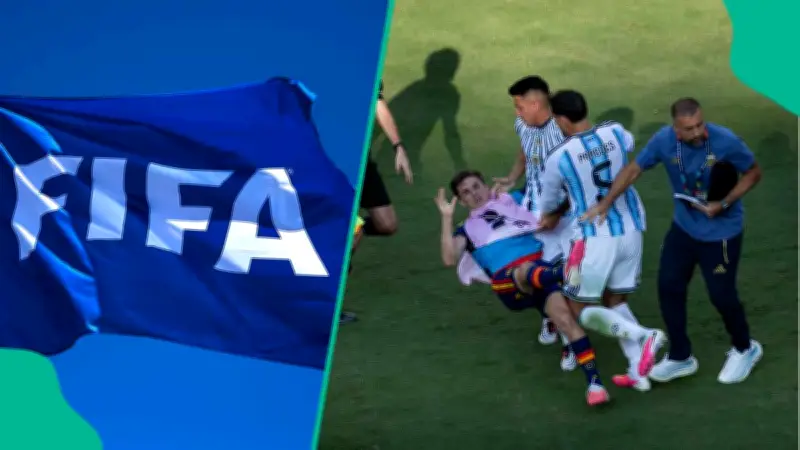
FIFA has officially opened disciplinary proceedings against the football associations of Argentina and Spain after chaotic and violent scenes marred the conclusion of the 2026 World Cup final. The governing body's action follows a post-match confrontation involving players from both teams at the New York New Jersey Stadium, where Spain defeated Argentina 1-0 with an extra-time goal from Ferran Torres.
FIFA Opens Investigation into Post-Match Violence
According to Reuters, FIFA's primary focus is on Argentina, whose players were involved in disorder immediately after the final whistle. Argentina stars Leandro Paredes and Manuel Molina were caught up in the violent incidents, while Spain's Gavi was also drawn into the altercations. The exact nature of the confrontation has not been fully disclosed, but witnesses reported pushing, shoving, and heated exchanges among players and staff.
The disciplinary case is being examined under multiple articles of the FIFA Disciplinary Code. Sky News reports that FIFA is investigating potential breaches of article 13 paragraph 2c, article 14 paragraph 5, article 15, and article 17, which relates to order and security at matches. These provisions cover offensive behavior, fair play, and ensuring safety during games.
Political Banners Add to Argentina’s Woes
Beyond the post-final violence, the Argentine Football Association (AFA) faces a separate investigation. Some Argentina players displayed political banners on the pitch after their 2-1 semi-final victory over England. FIFA considers this a potential violation of its regulations, which prohibit political statements at official events. The banners reportedly contained messages related to the Falkland Islands sovereignty dispute, a long-standing issue between Argentina and the United Kingdom.
The AFA has not yet commented on the investigation, but the association has previously defended players' rights to express themselves. Legal experts suggest that FIFA could impose fines, point deductions, or even suspensions if the banners are deemed a serious breach of rules.
Spain’s World Cup Victory Marred by Incidents
Spain's victory in the 2026 final gave the country its second World Cup title, denying Lionel Messi and Argentina a fourth crown. Ferran Torres scored the decisive goal in extra time, sparking celebrations that quickly turned sour as tensions escalated between players. Spanish officials have cooperated with FIFA's investigation, but the involvement of Gavi in the altercations could result in individual sanctions.
FIFA's disciplinary process will determine what sanctions, if any, are handed to the individuals and associations involved. Possible penalties range from fines and suspensions to match bans for players and stadium closures for national teams.
Argentina FA Threatens Legal Action
In a related development, the Argentine Football Association has threatened legal action against several media outlets over the reporting of its financial case. The AFA claimed that its president, Claudio Fabian Tapia, was not invited to testify before a US House Committee regarding alleged financial irregularities. The association stated that certain reports were false and damaging to its reputation, and it reserved the right to sue for defamation.
This separate legal threat adds to the turmoil surrounding Argentine football, coming just days after the World Cup final incidents. FIFA has not commented on the AFA's legal stance, focusing instead on the disciplinary proceedings.
The full scope of FIFA's investigation is expected to take several weeks, with hearings and evidence review scheduled. Both associations have been given deadlines to submit their defenses. The football world now awaits FIFA's ruling, which could set a precedent for handling on-field and off-field misconduct at major tournaments.