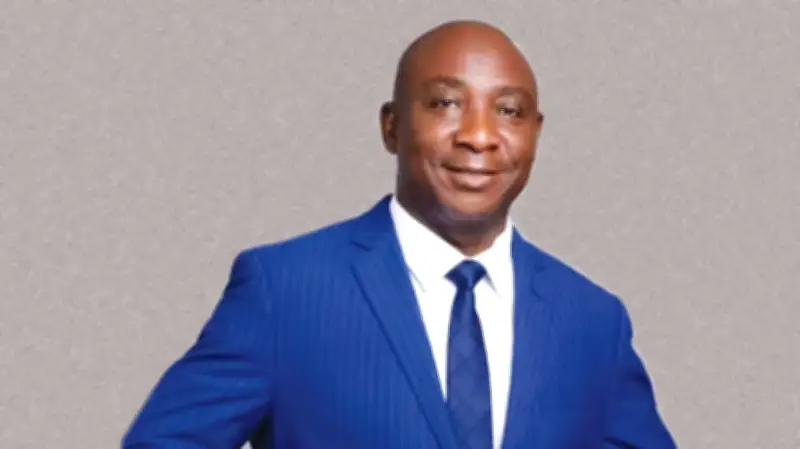
President of the Nigeria Football Federation (NFF), Ibrahim Gusau, is among those reflecting on the impact of Folarin Balogun's decision to represent the United States at the ongoing FIFA World Cup. Former Green Eagles and Flying Eagles star, United States-based Paul Okoku, has described striker Folarin Balogun's decision to represent America as Nigeria's loss.
Balogun Shines on World Stage
Balogun was named Player of the Match in their opening group game against Paraguay, where he scored two goals with sharp movement and clinical finishing. "Balogun plays with confidence under pressure," Okoku said. "For years, observers of American football have asked whether the United States could produce or attract the kind of striker capable of deciding major World Cup matches. Against Paraguay, Balogun answered."
A Nigerian Story
Okoku noted that Balogun's story is also a Nigerian story. "He was born in the United States to Nigerian parents and raised in England. He represents the modern football world: multiple identities, multiple football cultures, multiple possible national teams, and one final choice. He chose the United States. That choice is America's gain. And, respectfully, it is also Nigeria's loss," he stated.
Okoku added: "Not because Balogun did anything wrong. He did not. Every player has the right to choose the country he feels best represents his identity, opportunity, and future. But when a player of Nigerian heritage scores twice for the United States in a World Cup opener, Nigerians are allowed to notice. We are allowed to reflect. We are allowed to ask why so much Nigerian football talent continues to shine under other flags. This is not bitterness. It is reality."
Quoting Bob Marley, Okoku said: "Every man got a right to decide his own destiny, and in this judgment there is no partiality."
Challenge for Nigeria
Okoku, a member of the 1983 Flying Eagles squad, said that "the challenge is not whether Nigeria has talent but whether it has built the systems, trust, planning, and continuity needed to keep more of that talent committed to the green and white."
"The evidence is visible throughout the 2026 FIFA World Cup. With the Super Eagles absent from the tournament, at least 15 players of Nigerian heritage are representing other nations on football's biggest stage. Think about that for a moment."
He added: "Nigeria may be absent on the fixture list, but Nigeria is not absent from the World Cup. That reality should be a source of pride. But it should also be a source of reflection. Because if Nigerian heritage can be found throughout this tournament, then Nigerian football must continue asking an important question: 'How do we ensure that more of that talent chooses Nigeria when the moment of decision arrives?'"
America's Football Journey
Reflecting on America's football history, Okoku said: "From nearly empty college bleachers decades ago to packed World Cup Stadiums in 2026, America's football journey has become personal."
"Football's growth in America was never a question of possibility. It was only a question of time," he said. "Permit me, respectfully, to call it football. Most of the world knows the game by that name, while many Americans continue to call it soccer. Even the debate over whether the game should be called football or soccer occasionally finds its way into public discourse. Yet regardless of the terminology, the sport's growth in America has become impossible to ignore."
"Fortunately, the game itself is bigger than the label. Whether one says football or soccer, the passion, skill, drama, and beauty of the game remain universal. The ball is still round, the goals remain the same, and the emotions it evokes transcend language, borders, and cultures."
He said that when he first experienced collegiate football in America, the contrast was striking. "Some of my earliest road trips during my first year in America took me to Kentucky and Ohio for university football matches. I remember looking around and seeing only a handful of spectators—students, parents, friends, perhaps twenty people in total, maybe fewer."
"For someone coming from a football culture where the game could fill stadiums, dominate conversations, and unite communities, it was surprising. I remember thinking: Football still has a long journey ahead in this country. That memory returned to me as I watched the United States defeat Paraguay 4-1 in its opening World Cup match, led by a young striker of Nigerian heritage, Folarin Balogun."
"The contrast could not have been more powerful. There was a time when many football nations did not take the United States seriously. America was respected in American football, basketball, baseball, track and field, swimming, and Olympic sports. But in the world's football, the United States was often viewed as an outsider."
"That perception has changed. The 1994 FIFA World Cup gave America a platform. Major League Soccer gave the game a professional home. The women's game gave America global credibility. Corporate investment, youth academies, immigrant communities, college pathways, and soccer-specific stadiums helped deepen the foundation."
"Then came global names such as David Beckham, Thierry Henry, Kaká, Wayne Rooney, Zlatan Ibrahimović, and later Lionel Messi. Each helped expand the visibility of the game in America. Messi, in particular, brought a level of global attention that few players in history could generate. But the real story is not only about famous names, it is that America kept building," Okoku stated.