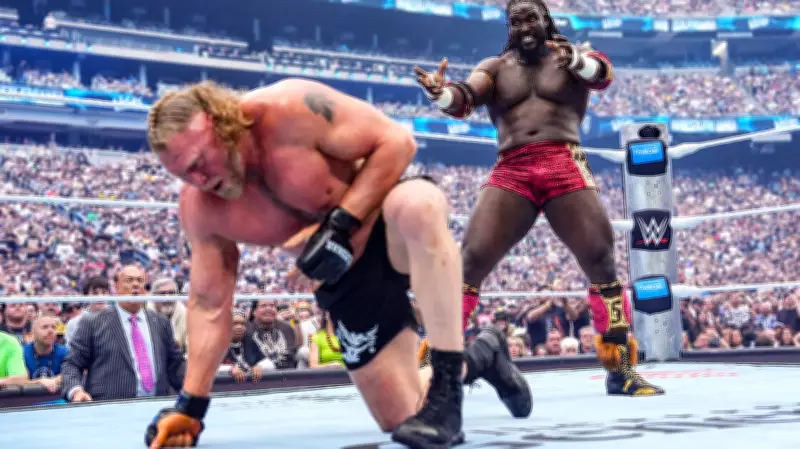
Nigerian wrestler Oba Femi recently made history by defeating Brock Lesnar in his debut at WrestleMania Raw, marking what observers call a new era in entertainment wrestling. The loss forced Lesnar to announce his retirement from the sport.
For many Nigerians, Femi's achievement reignites interest in professional wrestling, often dismissed as staged performance rather than sport. Christian Okpara reports.
WrestleMania 42: A Spectacular Display
On April 19, 2026, World Wrestling Entertainment (WWE) fans witnessed a spectacular display of grit and perseverance as Nigeria's Oba Femi defeated the world-renowned Brock Lesnar. Lesnar entered the ring with a reputation as one of the most dangerous fighters on earth.
The event, WrestleMania 42, captured global attention, drawing billions of viewers to the Allegiant Stadium in Las Vegas, USA. It set a new digital record for WWE, generating over 1.3 billion views across all social media platforms. The high viewership is attributed to Femi's rising star status and Lesnar's established star power.
Nostalgia for Nigerian Wrestling Fans
The fight took older Nigerian wrestling fans back to the days of Power Mike, Mike Bamidele, Mighty Igor, Argentina Apollo, and Dick the Bulldog Brawler. Wrestling, popular in Nigeria from the 1970s to early 1990s, had declined due to perceptions of pre-rehearsed performances.
While Hulk Hogan, the Ultimate Warrior, and the Undertaker still attracted attention, they did not generate the same interest among Nigerians as the Femi-Lesnar battle. Femi, along with Omos (Tolulope Omogbehin) and Uar Bernard (drafted into the Philadelphia Eagles), represents a new generation of Nigerian superstars.
Africa's Growing Presence in WWE
Before these stars, Africa's biggest export to WWE was Ghanaian Kofi Kingston. To succeed in WWE, a wrestler must be big, strong, athletic, believable, and skilled in verbal promos. Oba Femi fits this mold perfectly.
Joining WWE in 2021, Femi rose to the main event of WrestleMania 42 within five years—an unprecedented achievement. According to experts, his emergence allows Lesnar to retire peacefully, while inspiring young Nigerians to pursue excellence.
Daniel Igali's Perspective
Olympic wrestling gold medallist Daniel Igali called Femi's feat positive for Nigeria, bringing global attention. He acknowledged professional wrestling as make-believe but noted that participants must possess athleticism and undergo tutelage before entering the limelight.
Igali said, "They've been using them as bodyguards; that's how they introduce them. Some friends who did well in conventional wrestling and won Olympic medals have joined professional wrestling. They give you a role; you play different characters until they put you in the limelight. It's a good thing for Nigeria."
He added that many inquiries about wrestling come from people unaware of the difference between Olympic and professional wrestling. "We have a lot of interest from young people who want to join wrestling, but when you explain what you do, they become disappointed. Still, it's good for Nigeria's image."
Marketing Impact: A New Era
Bamidele Johnson, Chief Operating Officer of Strategic Communications, noted that 1.3 billion views signal the dominance of virility over traditional promotion. He said, "A shocking upset involving a global figure like Brock Lesnar would travel far beyond wrestling audiences, feeding social media cycles, memes, and mainstream conversations. It becomes a cultural event, expanding reach and pulling in new viewers."
Johnson added that Femi's victory positions Africa as a serious growth market. "Brands and promoters would see value in targeting Nigerian and wider African audiences through sponsorships, localised content, and potential live events. Femi's victory can rekindle interest among Nigerians, but not as before. The era of Power Mike thrived on belief in wrestling as a real contest. Today's audience is more sceptical, so renewed interest comes from nostalgia and national pride."
Job Creation Opportunities
Former UPE World Heavyweight Wrestling Champion Osita Offor, known as De Ultimate Commander, sees job-creating potential. He urged the Federal Government to capitalise on the euphoria to draw youths into wrestling and similar events that harness natural power.
Offor stated, "The country is blessed with energetic young men and women. Energy can be channelled into wrestling or boxing. Not all youths can go beyond secondary school, and not everyone can play football. A deliberate scouting effort for strong young people can help raise talented wrestlers for WWE or MMA recruiters."
Drawing from his experience, Offor highlighted the need for support systems. "I traveled to America, Europe, and other countries to wrestle because I had support from the Bauchi State government and former Abia State Governor Theodore Orji. Not many youths can achieve the same success through that route today."
Brands and the Future
Dr. Ejike Ndiulo, MD/CEO of HenryJValeens, emphasised the massive significance of Femi's victory. "With WWE integrated with Netflix and YouTube, and Oba Femi bridging Gen Z and Millennial demographics, the Nigerian market opportunity is huge. Nigerian brands now have a direct line to a global audience by associating with him early."
He advised brands to launch a 180-day or 365-day showcase campaign, perhaps a docu-series of Femi's journey from Lagos to WrestleMania. "Given that Femi is regarded as the 'Ruler,' depicting royalty and strength, brands should situate this within Nigeria's cultural context. CSR and talent pipelines, such as promoting local wrestling clinics, can position brands as 'Builders of Future Rulers.'"
Canada-based sports analyst Lucky Nana stressed the importance of aggressive marketing. "People lose interest quickly. Even in Canada, ice hockey requires aggressive marketing. The issue is not that Nigerians don't want to watch sports; it's weak and inconsistent marketing. Stadium attendance depends on how aggressively the event is promoted."