Former Captain Sunday Oliseh Blames Osimhen's Conduct for Nigeria's AFCON Failure
Former Super Eagles captain Sunday Oliseh has attributed Nigeria's inability to secure the 2025 Africa Cup of Nations title to what he describes as "indiscipline" displayed by star striker Victor Osimhen. In a detailed analysis on his YouTube channel, Oliseh argued that individual excesses critically undermined team unity during the crucial stages of the tournament held in Morocco.
The Costly Confrontation That Broke Team Chemistry
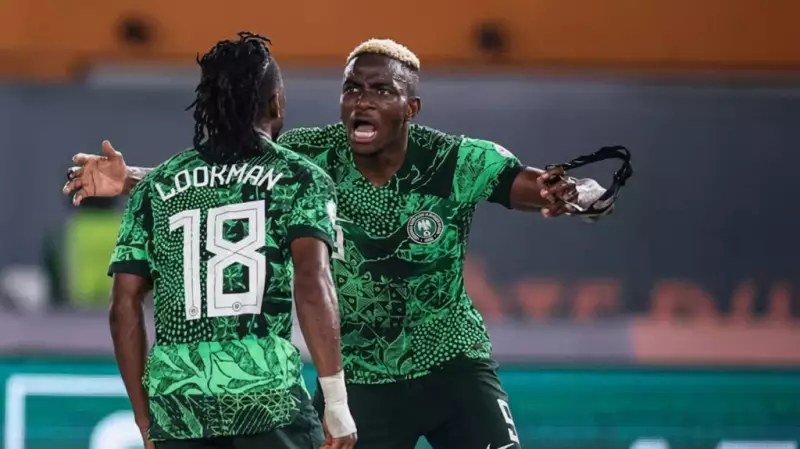
Oliseh pinpointed a specific incident during Nigeria's commanding 4–0 Round of 16 victory over Mozambique as the turning point. He highlighted Osimhen's public confrontation with teammate Ademola Lookman, where the Napoli striker appeared to rebuke Lookman for not releasing the ball during an attacking move. This moment, according to Oliseh, created significant disruption within the squad's dynamics.
"Let's look at the toxicity that might have cost us the AFCON title," Oliseh stated emphatically. "We are confusing talent with licence. Victor Osimhen is world-class, but talent is not a license to destroy team chemistry."
The Ripple Effect on Team Performance
The former midfielder presented a compelling case about the consequences extending far beyond that single match. He insisted that Lookman's form noticeably declined following the public altercation, directly impacting Nigeria's attacking effectiveness in subsequent games, particularly the semifinal.
"Look at the evidence," Oliseh elaborated. "Since that public outburst against Ademola Lookman, one of our brightest lights, he became a shadow of himself, and we lost our bite. When you publicly diminish your teammates, you break their spirit."
Oliseh further argued that Lookman had been "the most dangerous player in the tournament until that public verbal abuse broke his focus," suggesting Nigeria consequently lost "the psychological edge needed to win" against a disciplined Moroccan side in the semifinal.
Broader Concerns About Football Culture and Administration
Oliseh's critique extended beyond the pitch incident to encompass what he perceives as a troubling shift in fan culture. "What's worse, and frankly, what's most dangerous for our football is the fan culture that now tolerates this," he warned, expressing concern about normalizing such behavior.
He also referenced Osimhen's previous public criticism of former Super Eagles coach Finidi George, using it to emphasize a larger principle. While acknowledging Osimhen's immense value to the team, Oliseh stressed that no player is bigger than the national team.
"Scoring goals for Nigeria doesn't give you a licence to disrespect certified legends like Finidi George or Victor Ikpeba," he asserted. "It doesn't give you the right to disrespect your coaches or teammates. If goals alone justified arrogance, what should the legends who put Nigeria at the pinnacle of world football, like Amokachi, Amunike, Okocha, Babangida and myself, do? Walk on people's heads?"
A Warning About the Future and Critique of Celebrating Mediocrity
Oliseh issued a stark warning about the potential long-term damage if these issues remain unaddressed. "If we don't fix the discipline and the administration, there won't be a Super Eagles left to support," he cautioned, linking on-field behavior to broader structural problems.
He also expressed disappointment with the team's reaction to finishing third, when Nigeria defeated Egypt on penalties. "There was a time the Super Eagles shed tears at second place, because to us anything but the trophy was a failure; celebrating third place built a culture of mediocrity," Oliseh lamented, contrasting past standards with current attitudes.
Oliseh's comprehensive analysis presents a sobering perspective on how individual actions, team culture, and administrative standards collectively contributed to Nigeria's failure to lift the AFCON trophy in 2025.