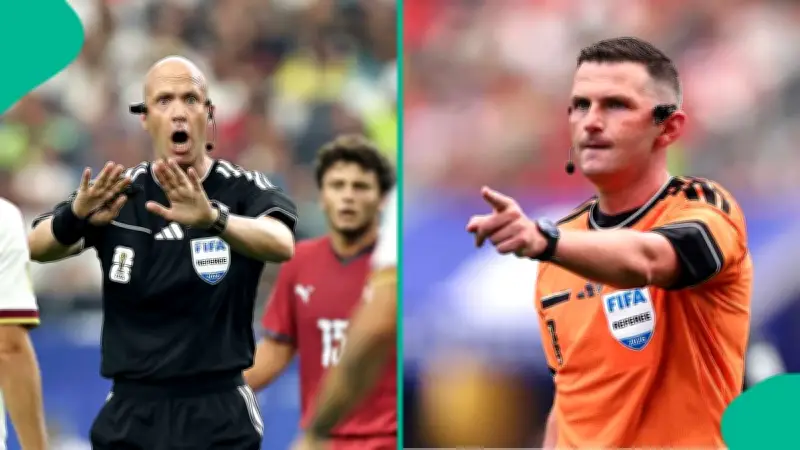
English referees Anthony Taylor and Michael Oliver may be blocked from handling the 2026 World Cup final due to a long-standing FIFA policy tied to the 1982 Falklands War. Michael Oliver has been appointed to officiate the quarterfinal between Spain and Belgium, but his hopes of refereeing the final could be dashed if Argentina or England progress deep into the tournament.
FIFA Policy Rooted in the Falklands War
According to FIFA regulations, English referees are not permitted to officiate matches involving Argentina, a restriction that dates back to the Falklands War when Britain and Argentina fought over the disputed South Atlantic islands. The policy is reciprocal, meaning Argentine referees are also barred from taking charge of England matches at FIFA competitions.
This regulation has become increasingly relevant during the knockout stages of the 2026 World Cup. Argentina is set to face Switzerland in the quarterfinals, while England will take on Norway for a place in the last four. If both nations win and meet in the semifinals, Michael Oliver and any other English referee would automatically be ruled out of officiating the match, as reported by The Mirror.
Impact on World Cup Final Appointment
Likewise, should Argentina progress to the World Cup final, an English referee would be ineligible to take charge because of FIFA's long-standing neutrality policy. If England reach the final instead, English officials would also be excluded, as FIFA does not appoint referees to matches involving their own national teams. As a result, Oliver's chances of officiating the World Cup final will largely depend on how the knockout stage unfolds.
Background on the Falklands War
The Falklands War occurred in 1982 between Argentina and the United Kingdom over the Falkland Islands, South Georgia, and the South Sandwich Islands. The conflict lasted 10 weeks and resulted in the deaths of 649 Argentine and 255 British soldiers. Since then, FIFA has maintained a policy that prevents referees from countries with historical or political conflicts from officiating matches involving the other nation.
This policy is not unique to England and Argentina; FIFA has similar restrictions for other politically sensitive matchups, such as matches between Iran and the United States, or between Russia and Ukraine. The aim is to ensure neutrality and avoid any perception of bias or political tension affecting the game.
Michael Oliver's Career and Prospects
Michael Oliver, 41, is one of England's most experienced referees, having officiated in the Premier League since 2010 and in FIFA tournaments since 2012. He has refereed major matches including the 2018 Champions League final and the 2022 World Cup semifinal between France and Morocco. His appointment to the Spain vs. Belgium quarterfinal indicates FIFA's trust in his abilities, but the political restriction could prevent him from reaching the final.
If Argentina and England both reach the semifinals, Oliver would be ineligible to officiate that match. Even if only one of them reaches the final, Oliver could still be excluded if the other finalist is Argentina, due to the Falklands policy. The only scenario where Oliver could referee the final is if neither England nor Argentina reaches it, and the final does not involve a team that would trigger a conflict of interest.
Other English Referees Affected
Anthony Taylor, another English referee, is also affected by this policy. Taylor has officiated in the Premier League and FIFA tournaments, including the 2023 Europa League final. Both Taylor and Oliver are considered top candidates for the World Cup final, but the Falklands restriction limits their availability.
FIFA has not publicly commented on the policy during the 2026 World Cup, but it remains in effect as per the governing body's regulations. The policy has been in place since 1982 and has been applied consistently in all FIFA competitions, including the men's and women's World Cups.
Reactions and Implications
The restriction has drawn mixed reactions from fans and commentators. Some argue that it is outdated and should be reconsidered, given the passage of time and improved diplomatic relations between the UK and Argentina. Others support the policy as a necessary measure to prevent political tensions from spilling onto the football pitch.
For England and Argentina, the policy means that if they face each other, the referees must come from a neutral country. This could affect the dynamics of the match, as referees from different countries may have different styles of officiating. However, FIFA has a pool of referees from around the world, so there are always neutral officials available.
The 2026 World Cup is being co-hosted by the United States, Canada, and Mexico, and the knockout stage matches are scheduled to take place in various cities across the three countries. The final is set for July 19, 2026, at MetLife Stadium in New Jersey.