
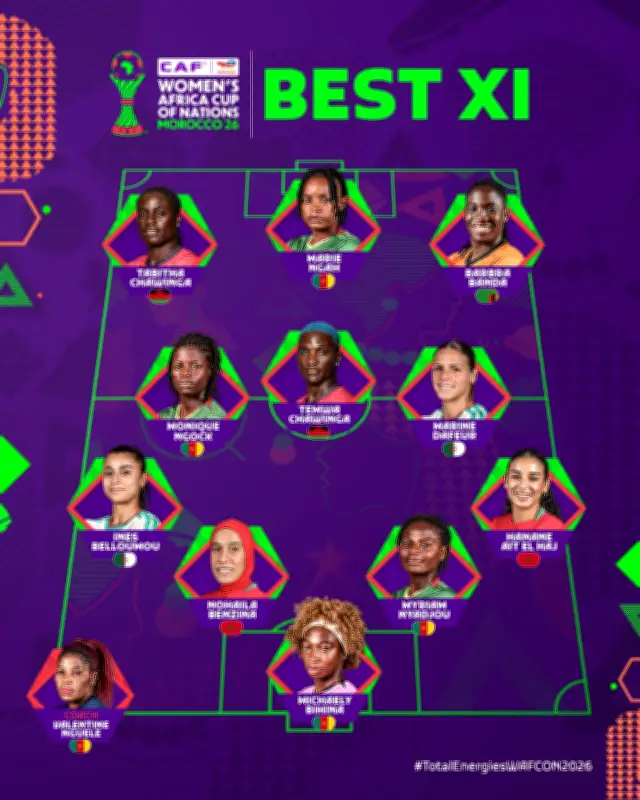
The Confederation of African Football (CAF) has released the Best XI of the 2026 Women’s Africa Cup of Nations, and notably, no Super Falcons player made the cut. The exclusion underscores Nigeria’s disappointing run at the tournament, where the team was eliminated in the quarter-finals.
Nigeria’s Early Exit and Historic Low
Nigeria, the record 10-time African champions, suffered a 1-0 defeat to eventual champions Cameroon in the quarter-final stage. This marked the first time in the nation’s history that the Super Falcons failed to reach the semi-finals of the continental championship, a significant setback for a team accustomed to dominating the competition.
The early exit not only ended their title hopes but also meant that none of the squad’s players were considered among the tournament’s standout performers by CAF’s selection panel.
Cameroon Leads the Best XI with Four Selections
Cameroon, who clinched the title with an impressive campaign, dominated the Best XI with four players. Goalkeeper Michaely Bihina, along with Myrian Myadjou, Monique Ngock, and Marie Ngah, were all included in the selection, reflecting their pivotal roles in the Indomitable Lionesses’ success.
Runners-up Malawi had two representatives in the team, with sisters Tabitha Chawinga and Temwa Chawinga earning their places. The Chawinga siblings were instrumental in Malawi’s historic run to the final.
Other Nations Represented in the Line-Up
Hosts Morocco and Algeria each contributed two players to the Best XI. Mohaila Benzina and Hanane Ait El Haj were Morocco’s representatives, while Ines Belloumou and Marine Dafeur earned spots for Algeria. Zambia’s striker Barbara Banda completed the star-studded line-up, adding further firepower to the selection.
In addition to the team, Cameroon’s Valentine Nguele was named Coach of the Tournament, capping a remarkable achievement for the champions.
Implications for the Super Falcons
The Best XI announcement further highlighted the Super Falcons’ underwhelming campaign in the 2026 WAFCON. With no players recognized among the continent’s elite, questions will likely arise about the team’s performance and future direction as they look to regroup after this early exit.
The tournament’s conclusion leaves Nigeria reflecting on a rare failure to reach the latter stages, while Cameroon’s triumph and the recognition of their players signal a shift in the balance of power in African women’s football.