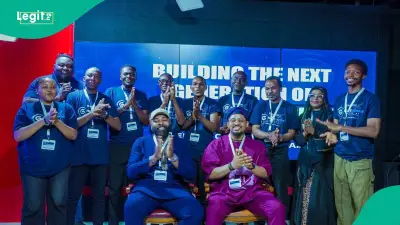
Professor Abiodun Adeniyi, Vice-Chancellor and Professor of Communication and Media Epistemology at Baze University, Abuja, delivered the 7th Inaugural Lecture of the university on June 9, exploring the concept of how one's ancestral village follows them in the digital age. The lecture, titled "How the Village Is Following You: Belonging, Memory, and the Portable Home in the Age of Digital Mobility," argues that technology has transformed the village from a physical place into a portable, persistent, and emotionally charged network that migrants carry with them wherever they go.
Redefining the Village
Professor Adeniyi distinguished his use of the term "village" from the common Nigerian superstitious interpretation that refers to sorcery and witchcraft. Instead, he defined the village as a place of emotional connection, real or imagined association, and a location of belonging where longing persists. This metaphorical village, he explained, is a practical or non-practical beginning point—practical for those with ongoing relationships, and non-practical for second or third generation migrants with inherited but distant ties. The village, he emphasized, is not defined by geography, location, or size, but by the emotional ties that bind individuals to their origins.
Technology and the Collapse of Distance
The lecture highlighted how modern communication technologies have collapsed geographical boundaries, enabling migrants to maintain constant contact with their villages through platforms like WhatsApp, Facebook, Instagram, and X. According to Professor Adeniyi, these digital tools allow migrants to form groups, chat round the clock, and participate in village development decisions, effectively replacing the physical village square. Voice notes, text messages, and image exchanges sustain connections, while memories are revived and belonging is fostered on the go. The media, he noted, has become a springboard for sharing meanings across distanciated territories, steadying emotional well-being.
The professor pointed out that in the past, leaving home often meant social disappearance, with migrants incommunicado until their next physical appearance. Reliance on word of mouth from returning migrants, surface mail that took weeks or months, and scarce, unaffordable telephone services made maintaining ties difficult. Today, however, mobile telephony and digital platforms have dissolved those barriers, making it possible for people to move but never fully leave.
Migration as Life Circulation
Professor Adeniyi reframed migration not as a crisis or anomaly, but as a normal, continuous, and necessary social process. He argued that migration is akin to the circulation of blood, water, and air in the human body—essential for sustaining life and equilibrium. Rejecting the dominant narrative that portrays migrants as unwanted outsiders or security threats, he posited that migrants are essential contributors to social and economic balance. They provide labor, innovation, demographic balance, and renewal to receiving societies, while also benefiting origin countries through remittances, knowledge transfer, and development links.
The lecture emphasized that halting migration is like halting blood circulation, as both sending and receiving countries need it for survival. Professor Adeniyi called for a more balanced positioning of the migration narrative, recognizing it as a structural condition rather than an anomaly, and a driver of adaptation, resilience, and social reproduction.
Digital Shadows and Algorithmic Belonging
Professor Adeniyi introduced the concept of "digital shadows"—the voice notes, photos, rituals, and memories stored in devices that ensure objects are not left behind but move with people in their pockets and bags. He argued that forgetting has become a matter of choice, as past information is not lost but only changes position. Devices, he said, have become extensions of the human body, carrying the voices and emotions of loved ones, and enabling digital séances where villagers commune with the dead.
The lecture illustrated this with the story of Madam Adeshola, a retired government worker in Abuja whose mother in the village called her daily. When Madam Adeshola became unreachable, her mother alerted her son, who traveled to Abuja and found her dead on the floor. This example, Professor Adeniyi said, demonstrates how technology has reversed proximity, with distant people noticing issues before nearby ones.
However, the professor also warned of the risks of misinformation and disinformation, as emotional ties to narrators can lead migrants to accept single narratives without verification, reinforcing biases and spreading ignorance. He called for critical thinking and sustained public campaigns to raise awareness.
The Portable Village and the End of Departure
The lecture concluded that the village is no longer a place but a presence—performative, reconstructed, redistributed, and patently portable. Departure, Professor Adeniyi argued, has ended because links can continue even in absence. The village provides follow-up care through advice and support, as well as surveillance, monitoring the progress and behavior of migrants at a distance. Memory has become an infrastructure for organizing identity, with digital platforms serving as new village squares—WhatsApp for meetings, Facebook for lineage archives, and TikTok for performative belonging.
Professor Adeniyi noted that the digital village is real in Africa, with WhatsApp groups becoming cultural archives, arenas for discipline, and spaces for governance. He called for community-based digital governance, stronger data protection laws, and the inclusion of migrants in national policy architecture. He also highlighted the need for digital identity literacy, memory awareness studies, and the normalization of selective disconnection to combat emotional exhaustion.
Looking to the future, the professor predicted that artificial intelligence will predict belonging, curate identity, and reconstruct the past, making forgetting almost impossible. He urged the development of inclusive governance with migrant and diasporic communities as active participants, and the regulation of algorithmic nostalgia. "Before now, we left the village behind. Now, however, the village is with us," he said. "Distance has died, but belonging is now heavier."