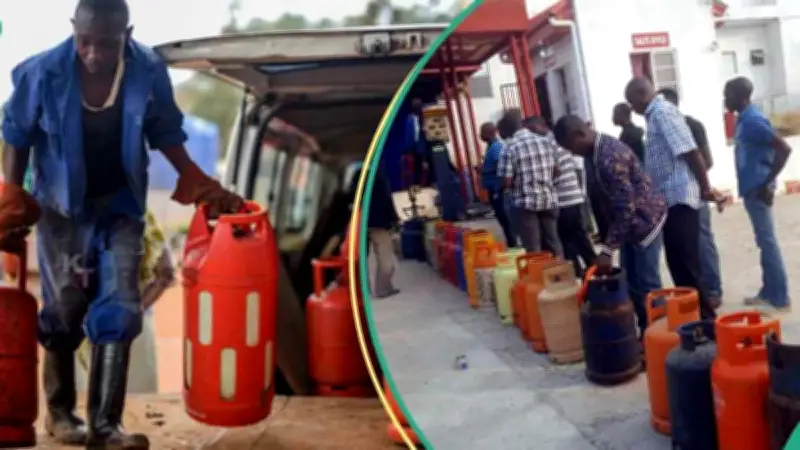
The cost of refilling a standard 12.5kg cooking gas cylinder now ranges from about ₦15,000 to over ₦20,000 across Nigeria, according to recent market checks reported by Legit.ng. Households in parts of Lagos, Abuja (FCT), and Rivers State are paying among the highest prices, with some retail outlets charging up to ₦1,650 per kilogramme, while consumers in Ogun and some Lagos locations can refill for as low as ₦15,000.
For example, a consumer buying gas at ₦1,200 per kilogramme would spend about ₦15,000 to fill a 12.5kg cylinder, while someone purchasing at ₦1,650 per kilogramme would need about ₦20,625. The national average retail price for a 12.5kg refill reached approximately ₦17,616.94 in September 2026, according to LPG market data cited by Legit.ng.
State-by-State Breakdown of 12.5kg Refill Costs
Recent market data provides a snapshot of what consumers are paying for LPG in different locations across Nigeria. The following table details the approximate price per kilogramme and the total cost of a 12.5kg refill in several states and regions:
- Lagos (some retail outlets): ₦1,600 per kg, ₦20,000 for 12.5kg
- Abuja/FCT (high-end locations): ₦1,650 per kg, ₦20,625 for 12.5kg
- Abuja/FCT (lower-end locations): ₦1,250 per kg, ₦15,625 for 12.5kg
- Iriebe, Rivers: ₦1,600 per kg, ₦20,000 for 12.5kg
- Ogun (Shagamu): ₦1,200 per kg, ₦15,000 for 12.5kg
- Biu, Borno: ₦1,650 per kg, ₦20,625 for 12.5kg
- Osun: ₦1,500 per kg, ₦18,750 for 12.5kg
- Lagos (Badagry): ₦1,200 per kg, ₦15,000 for 12.5kg
- Oyo: ₦1,300 per kg, ₦16,250 for 12.5kg
- Eleme, Rivers: ₦1,600 per kg, ₦20,000 for 12.5kg
The figures illustrate how much consumers can save or spend depending on where they buy their gas. A household in Shagamu or Badagry paying ₦1,200 per kilogramme would spend about ₦15,000 for a full refill, while a consumer in Abuja's high-end locations or Biu, Borno, paying ₦1,650 per kilogramme, would need about ₦20,625.
Lagos, Abuja Among Locations with Higher Prices
Lagos remains one of the markets where consumers are experiencing significant price differences. A recent check found LPG selling for about ₦1,600 per kilogramme at some Lagos retail outlets, taking the cost of a 12.5kg refill to roughly ₦20,000. Osun recorded around ₦1,500 per kilogramme, while Oyo was about ₦1,300.
The Federal Capital Territory has also recorded wide price differences. Recent checks in Abuja showed cooking gas prices ranging from approximately ₦1,250 to ₦1,650 per kilogramme, depending on the location and retailer. At the upper end, that translates to about ₦20,625 for a 12.5kg cylinder. The disparity means two households buying the same quantity of gas can pay thousands of naira more simply because they live in different locations.
Why Cooking Gas Prices Differ Across Nigeria
The price paid by consumers is influenced by more than the amount charged at the depot. According to recent market checks, LPG was selling at plants for around ₦1,350 per kilogramme in Lagos, ₦1,300 in Osun, ₦1,400 in Ogun and ₦1,200 in Oyo. Retail prices were higher in several of these locations after transportation, distribution and other operating costs were added.
Depot prices also vary. Recent data showed selected depot prices of around ₦990 per kilogramme at Dangote, ₦1,100 at Matrix, ₦1,125 at Navgas and ₦1,150 at A.Y.M Shafa and NIPCO. Marketers have also linked recent price movements to supply conditions, international energy-market volatility and logistics costs. Vanguard reported that LPG rose to about ₦1,300 per kilogramme in Lagos in September, while some smaller gas plants charged between ₦1,350 and ₦1,400.
For Nigerian households, the implication is clear: consumers should not assume that the price paid in one state or neighbourhood will be the same elsewhere. At current rates, a family using a 12.5kg cylinder may need between ₦15,000 and more than ₦20,000 for a full refill, depending on location. As LPG prices continue to fluctuate, checking several nearby retailers before refilling could help households identify the cheapest available option.