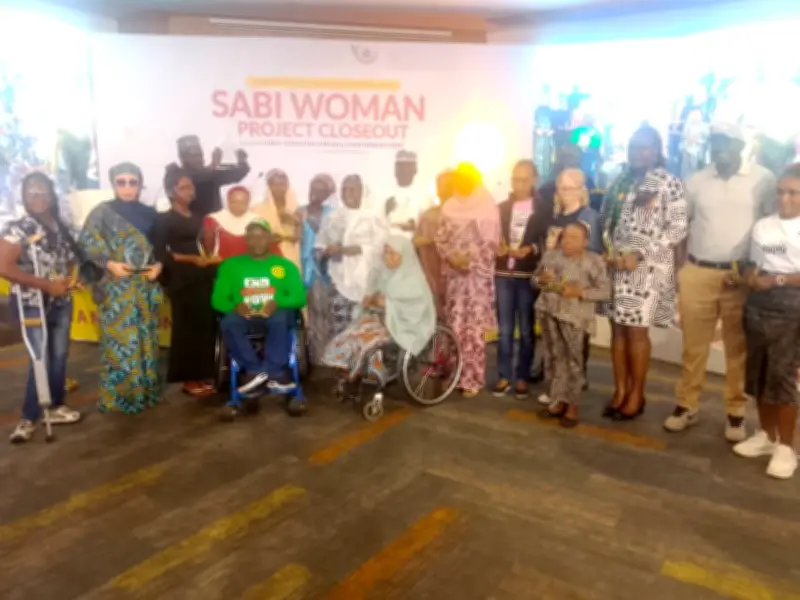
The Federal Government has commended Sightsavers Nigeria for implementing the Sabi Woman Project, an initiative aimed at empowering women with disabilities through education, entrepreneurship, and economic inclusion.
Government Endorsement and Call for Sustained Inclusion
Speaking at the closeout ceremony of the project in Abuja on Tuesday, the Senior Special Assistant to the President on Special Needs and Equal Opportunities, Mohammed Abba Isa, described the initiative as a practical model for inclusive development. He urged stakeholders to sustain efforts toward expanding opportunities for women and girls with disabilities. Isa noted that women with disabilities continue to face multiple challenges, including limited access to quality education, exclusion from economic opportunities, social stigma, and systemic barriers that hinder their full participation in society. He emphasized that the project had demonstrated that women and girls with disabilities could excel when provided with the necessary support and enabling environment.
“Today’s event is not merely about celebrating the end of a project. It is an opportunity to reflect on lives transformed, barriers dismantled and the brighter future being created for girls and young women with disabilities in Nigeria,” Isa said. The Presidential aide called for stronger collaboration among government institutions, development partners, civil society organisations, and the private sector to ensure wider access to opportunities for women and girls with disabilities across the country.
Project Achievements and Partnerships
In her remarks, the Country Director of Sightsavers Nigeria, Prof. Joy Shu’aibu, explained that the Girls’ Education and Skills Partnership (GESP), popularly known as the Sabi Woman Project, combined educational support for adolescent girls with disabilities with entrepreneurship development for young women. According to her, life coaches were engaged to mentor girls with disabilities, helping them build confidence and pursue their aspirations, while young women entrepreneurs received training in business management, bookkeeping, costing, and financial literacy. The project partnered with companies, including Unilever, to provide beneficiaries with products on credit, enabling them to establish and expand their businesses.
“We wanted to ensure that adolescent girls and women with disabilities have access to education, sustainable livelihoods and opportunities to become everything they can possibly be,” Shu’aibu said. She identified stigma as one of the major challenges confronting persons with disabilities and urged the media to promote positive narratives that showcase their abilities and contributions to society.
Concrete Statistics and Impact
Highlighting the achievements of the project, Shu’aibu disclosed that 1,512 young women with disabilities received entrepreneurship training, while 1,366 adolescent girls benefited from life-skills and career guidance programmes. She further revealed that 1,647 employers, business advisers, trainers, and enterprise associations were trained on disability-inclusive practices to improve opportunities for women with disabilities in workplaces and businesses. The project also collaborated with the Industrial Training Fund (ITF) to develop an inclusive entrepreneurship training guide and strengthen the capacity of facilitators to effectively train persons with disabilities. Shu’aibu urged governments, development partners, and private sector organisations to continue investing in disability inclusion, stressing that such efforts were essential for achieving equitable and sustainable national development.
Beneficiary Testimonies and Call for Action
One of the beneficiaries, Aisha Oguntola, a visually impaired student of the University of Lagos, described the programme as life-changing. She said the initiative helped her build confidence and prepare for future employment opportunities through training in career planning, curriculum vitae writing, and job readiness. “The platform was an eye-opener. It helped me understand that disability does not define my ability. I can do everything others can do when given the opportunity,” she said. Oguntola, however, decried the persistent discrimination and social exclusion faced by persons with disabilities, including within educational institutions.
Another beneficiary, Aisha Muhammed from Kano State, said the programme equipped her with valuable skills and financial independence, enabling her to manage her finances while pursuing vocational opportunities. The event brought together government officials, development partners, disability rights advocates, and beneficiaries to review the gains recorded by the project over the last two years and discuss strategies for sustaining its impact. Stakeholders underscored the importance of investing in skills development and economic opportunities for persons with disabilities, noting that empowerment requires deliberate efforts to eliminate barriers to inclusion. Participants agreed that the success of the Sabi Woman Project provides a strong foundation for scaling similar initiatives across Nigeria to ensure that women and girls with disabilities have access to quality education, skills development, and economic opportunities.