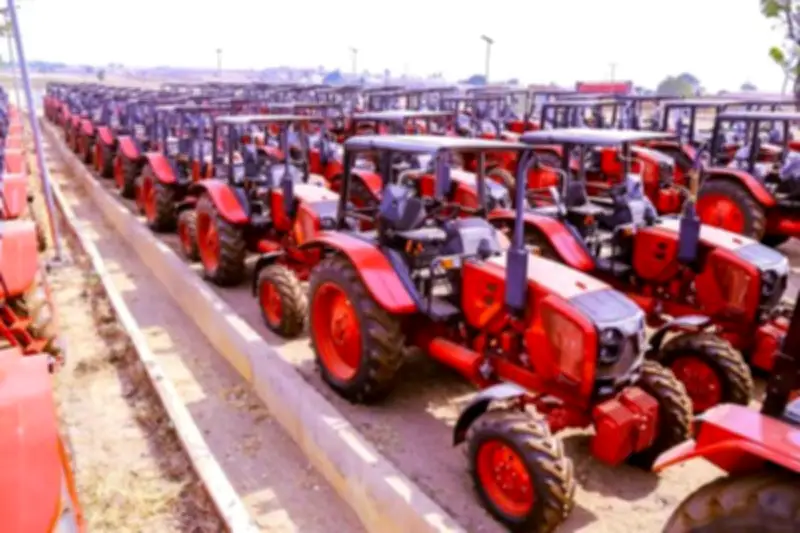
President Bola Ahmed Tinubu has assured Nigerians that the planned deployment of 10,000 tractors by the National Agricultural Development Fund (NADF) across the country will significantly boost job creation and accelerate food production. The President made this known in his Democracy Day message, revealing that NADF would deploy the 10,000 tractors over a five-year period.
Agriculture as a cornerstone of economic recovery
According to Tinubu, agriculture remains central to his administration’s economic recovery and growth strategy. He noted that ongoing investments in infrastructure and mechanisation are helping to connect producers to markets and create opportunities across the agricultural value chain. The President highlighted that key economic reforms and interventions in the sector are aimed at stimulating growth, improving livelihoods, and strengthening Nigeria’s productive sectors.
He assured the public of the government’s commitment to reducing inflation, expanding food production, creating jobs, and improving living standards despite the prevailing economic challenges facing many Nigerians. The President’s remarks come amid ongoing efforts by NADF to implement one of the Federal Government’s flagship agricultural mechanisation programmes designed to bridge Nigeria’s mechanisation gap and increase agricultural productivity.
Procurement contract signed for 2,000 tractors
Recall that NADF signed a procurement contract worth about $70 million with AGCOMS International Trading Limited for the supply of 2,000 John Deere tractors to farmers nationwide as part of the initiative. This agreement forms the first phase of a broader presidential directive mandating NADF to spearhead the deployment of 10,000 John Deere tractors over the next five years.
Speaking during the contract signing ceremony, the Executive Secretary and Chief Executive Officer of NADF, Mohammed Abu Ibrahim, said the programme is one of the Federal Government’s strategic interventions to modernise agriculture and improve farm output. He explained that the project covers not only tractors but also complementary equipment such as ridgers, harrowers, and combine harvesters needed to support large-scale agricultural production.
According to Ibrahim, the agency secured approval from the Federal Executive Council (FEC) and subsequently engaged in extensive negotiations with John Deere and other stakeholders to ensure the success of the programme. “We got the conveyance of the Federal Executive Council in October and we have taken three months to go on a very robust and intensive negotiation with John Deere. We have also had stakeholders’ engagements,” he said.
Local assembly plant and job creation
Ibrahim disclosed that arrangements had been concluded with the Nigerian Ports Authority to provide space for an assembly plant that would facilitate local assembly and distribution of the tractors across the country. He noted that beyond improving access to modern farm machinery, the programme is expected to stimulate local industrial activities, develop technical skills, and generate employment opportunities.
The Country Director of AGCOMS International Trading Limited, Chijioke Okoli, said the project was designed as a comprehensive mechanisation initiative rather than a simple equipment procurement exercise. According to him, the company will establish local assembly operations, train Nigerian youths and technicians, and provide long-term product support to ensure sustainability.
“We will not just procure and assemble the tractors; we will also give our youth the opportunity to understand the technology behind what we are trying to assemble. The assembling plant plays a crucial role because the people involved will have first-hand experience of what it takes to put the tractors together,” Okoli said.
He revealed that part of the sustainability strategy includes training and certifying local technicians who will be equipped to operate, maintain and service John Deere equipment across the country.
Potential impact on agriculture and economy
It is believed that the 10,000-tractor programme could mark a turning point for Nigeria’s agricultural sector by reducing dependence on manual farming, expanding cultivated land, and enhancing productivity. The initiative is also expected to support the Federal Government’s broader objectives of increasing food production, creating jobs, boosting rural incomes, and strengthening the contribution of agriculture to national economic growth under the Renewed Hope Agenda.