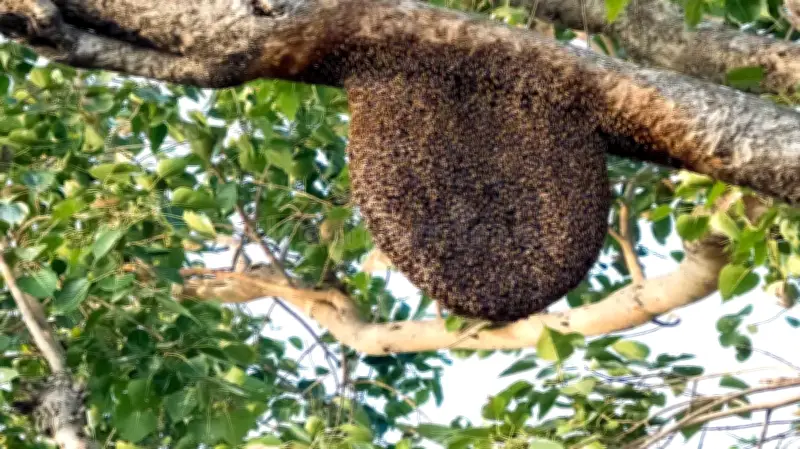
A young beekeeper, Folorunso Dosu, set out at dawn to harvest honey from a familiar tree line he had visited for months. It was supposed to be a routine visit, but on that day, something different happened: The usual humming that signaled an active hive was faint. When he climbed closer, the colony that filled the hollow trunk had almost collapsed. Dead bees littered the bark. The honey he eventually recovered was smaller in quantity and unusually dark, with a bitter smell. He said the shift had become frequent across nearby bushes, where farmers had recently intensified spraying of chemicals ahead of planting season. “I have been doing this for years. Before, you couldn’t even stand near some trees because of bees but now most are empty,” Dosu said.
Beekeepers Report Severe Losses
Ambrosia Honey Farms CEO, Habeeb Issa, said he has witnessed both growth and setbacks in his 11 years of beekeeping, with some of the most severe losses linked to pesticide use, environmental stress, and poor farm management practices. Issa recalled one of his most difficult experiences about four to five years ago when vandals invaded his apiary and deliberately used pesticides to kill bees at hive entrances before stealing honey. He said the incident led to the death of thousands of bees and a significant collapse of colonies on the farm. “I first noticed reduced activity during routine inspection, when I moved closer, I saw thousands of dead bees. It was a saddening sight,” he said.
According to him, even surviving colonies suffered reduced productivity after exposure to chemicals. Issa also said the challenges have not been limited to vandalism, noting that environmental conditions and farm management issues continue to affect production across seasons. He cited the 2025–2026 season, where honey production dropped significantly owing to a shortened harmattan period, which he described as critical for nectar storage and honey formation. “We had a very short harmattan season, which is very crucial for bees. The shortness affected their activity and nectar storage, so, honey production dropped by about 40 per cent compared to the previous season,” he said.
He added that pest infestations such as ants and termites have also contributed to colony decline, especially where vegetation is poorly managed. In some cases, colonies absconded after hives were overrun due to poor maintenance and delayed inspection. Issa also pointed to pesticide use on nearby farms, particularly cocoa plantations, where chemical spraying affected bees over time. “There were colonies on cocoa farms where pesticides used to treat the trees affected the bees in the long run,” he said. He explained that forage availability remains another major challenge, especially when bees relocated for security reasons end up in areas with limited flowering plants. Issa said disturbances around apiaries, including livestock movement and environmental noise, also affect bee behaviour, causing colonies to reduce their activities.
He further noted that poor inspection routines and inadequate hive management have contributed to avoidable losses. “In some cases, we lost colonies because we were unable to inspect the hives as regularly as needed,” he said. He added that weed overgrowth around apiaries has allowed ants, including weaver ants, to invade and destroy colonies.
From Pesticides to Poor Harvesting Practices
Another beekeeper, Habeebat Bamidele, told The Guardian that she first noticed something was wrong when hives that were once active and productive began to go quiet in areas where pesticide use was heavy. Bamidele, who is also the Managing Director of Bambee Farms, said the change was gradual, as bees became less active across farms, some colonies disappeared completely and honey yields dropped. “Bees are highly sensitive to chemicals. Excessive pesticide application pollutes their environment, weakens colonies, and in many cases leads to colony collapse or hive absconding. “I have experienced situations where bees abandoned their hives on farms with heavy pesticide use, and honey production dropped as a result because the bees became stressed and unable to forage effectively.” She said the change was gradual and consistent enough to raise concern as bees became less active and colonies disappeared over time.
Bamidele said the experience exposed poor awareness among farmers about the role of bees in agriculture. According to her, many farmers still view bees mainly as honey producers, without recognising their role in crop pollination and food production. “Bees contribute to the pollination of over 70 per cent of food crops. However, many farmers still see bees only as honey producers.” She said this gap in awareness has led to harmful practices, including the destruction of bee colonies and pesticide use to eliminate bees, reducing pollination services and affecting food supply. She added that while pesticides remain part of modern farming, misuse is responsible for most damage to bee populations.
The beekeeper advocated integrated pest management practices, organic alternatives, and the maintenance of flowering plants around farms to reduce harm to pollinators. She noted that modern beekeeping systems such as Langstroth, Flow Hive and Kenyan Top Bar hives help reduce disturbance to colonies. Proper handling techniques, including protective gear, smokers, and hygienic extraction, also improve honey quality and colony health. Bamidele warned that continued neglect of pesticide misuse and low awareness among farmers could worsen bee decline, increasing adulterated honey in markets and dependence on imports. “If nothing changes, we may face a future with declining bee populations, reduced honey production, and lower food productivity,” she said. She called for stronger farmer education, responsible pesticide use, and wider adoption of sustainable agricultural practices.
The Guardian learnt that chemical spraying has become more aggressive, often carried out without guidance on timing or pollinator safety. Some farmers, however, insisted chemicals are necessary to protect crops from pests and diseases. The tension between crop protection and pollinator survival is becoming increasingly visible across rural areas.
Issa said several practices by farmers, honey hunters, and even beekeepers themselves continue to worsen the decline in bee populations and honey quality across different environments. He identified pesticide use as the most damaging factor, explaining that bees are highly exposed when they forage on treated crops. “When bees go out to pollinate and feed on nectar, they pick up pesticides, this can kill them directly or transfer into the hive and affect the entire colony.” He also pointed to deforestation as another major driver of colony loss, noting that clearing land for cultivation removes trees and flowering plants that support bee survival. According to him, reduced vegetation limits nectar and pollen sources, making it difficult for colonies to sustain themselves over time.
Issa further criticised some honey-harvesting practices, particularly among honey hunters who destroy entire colonies during extraction. He said some use fire and other destructive methods at night, which not only kills bees but also destroys comb structures and forces surviving colonies to rebuild under stress. He added that in some cases, brood (bee larvae) is harvested alongside honey, leading to poor-quality products and contamination during processing. Issa said beekeepers also contribute to losses through poor management practices, including irregular hive inspections and inadequate pest control. He explained that neglected hives are often invaded by ants and other pests, which can destroy colonies if not detected early. He also noted that some beekeepers operate without proper equipment, exposing bees to unnecessary stress. “Some people open hives without smokers or protective gear, and this makes the bees aggressive,” he said.
According to him, improved knowledge remains the most important step in strengthening beekeeping practices in the country. Issa said modern hives with movable frames make inspection and harvesting easier, while reducing stress on colonies. He also stressed the importance of proper equipment such as bee suits, gloves, and smokers, which help calm bees and reduce colony losses during handling. On honey processing, he said hygiene remains critical to ensuring quality and safety. Issa explained that only fully capped honey should be harvested, with moisture content below 20 per cent, while stainless steel equipment should be used during extraction and storage. He warned against open-air processing, noting that exposure can lead to contamination and reduced product quality. He also called for improved packaging standards, saying clean glass or food-grade plastic containers should be used to preserve purity.
Beyond technical practices, Issa said stronger public awareness is needed on the importance of bees to food security. He called for the inclusion of bee conservation in school curricula to build early understanding of pollination and environmental protection. Issa also urged government support through policies that protect bees, reduce deforestation, and provide financial assistance to beekeepers in the form of grants or low-interest loans. He further called for improved rural security, noting that many beekeeping operations are located in remote areas where insecurity limits access to farms adding that better protection and support systems would encourage more farmers and beekeepers to expand production safely and sustainably.
Government Inaction and Advocacy
President of Beekeepers’ Welfare Association, Zaria, Idris Muhammad Barau, said the continued use of chemical pesticides and poor awareness among farmers are contributing significantly to the decline in bee populations. Barau expressed concern over what he described as inadequate government commitment to addressing the dangers posed by chemical pesticides to bees, emphasizing that advocacy for organic alternatives should be intensified. “We have to be very sincere. The government is not ready to do anything, so you just talk and they do nothing. The earlier we begin advocating for organic pesticides for farmers, the better chance we have of having the lives of bees.” He maintained that many farmers remain unaware of the crucial role bees play in pollination, often mistaking them for pests that damage crops. “Most farmers don’t even know what crop pollination is. They see bees as agents destroying their crops. For example, when farmers see bees on watermelon plants, they spray them because they think the bees are damaging the crop, not knowing that the bees are actually pollinating it.”
Barau emphasised the need for sustained awareness campaigns to educate farmers on the ecological and agricultural importance of bees. He also raised concerns about unsafe practices among local honey hunters and beekeepers, noting that some use pesticides to kill bees in a bid to harvest small quantities of honey because they are not aware of using protective gears. Barau noted that while smaller organisations have continued to push awareness around bee conservation and organic pesticide use, the scale of the challenge requires broader intervention. He, however, disclosed that the association recently secured 20,000 grants from the Czech Republic Embassy to support bee conservation efforts and promote pollination awareness. Barau added that the initiative would focus on promoting sustainable beekeeping practices and educate farmers on the benefits of pollination and environmentally friendly pest control methods.
Entomologist Warns of Food Production Threat
Entomologist, Aminu Abubakar Ibrahim, warned that the decline in honeybees and other pollinators poses a major threat to the country’s food production, agricultural economy and food security, citing habitat destruction and widespread pesticide use as key drivers of the crisis. Ibrahim explained that pollinators, particularly honeybees and indigenous insects, play a critical role in the yield and quality of crops that sustain the nation’s food systems and agricultural exports. He noted that pollinators significantly improve productivity of staple and cash crops, including sesame, cotton, cocoa, cashew, fruits, vegetables, legumes, and nuts, stressing that their contribution to agricultural output is often underestimated. Studies, he said, show pollination can increase sesame yields by as much as 59 per cent and cotton by 37 per cent, while crops such as cocoa and cashew, alongside plants such as shea and locust beans, also depend heavily on pollinators for regeneration and productivity. He added that even economically valuable wild plants such as shea and locust beans depend on pollinators for regeneration, while a survey conducted in Kwara State identified honeybees as major pollinators of crops such as beans and groundnuts.
Ibrahim, however, warned that habitat loss and the widespread use of harmful pesticides are causing a steady decline in pollinator populations, with implications for crop yields, farmer incomes, and food affordability, particularly in rural communities. “Pollinator loss directly contributes to declining crop yields among farmers, with significant economic and nutritional consequences,” he said, noting that inadequate pollination has been linked globally to annual losses in fruit, vegetable, and nut production. He added that the consequences may be more severe in Nigeria, where studies indicate that crop production losses caused by insufficient pollination could range between three and 19 per cent, resulting in substantial economic losses to farmers.
Beyond economic concerns, Ibrahim said the disappearance of pollinators threatens access to nutritious foods, particularly fruits, vegetables, nuts, and legumes, which could worsen dietary deficiencies and health outcomes. He described the impact of pesticide use on pollinators as severe, stressing that many chemicals considered hazardous and banned in Europe remain widely available in Nigeria because of weak regulation and poor enforcement. “The threat from pesticides is severe and widespread. These chemicals kill bees and other pollinators directly and contaminate their environment,” he said, adding that agrochemicals are often sold informally and applied without proper guidance. He also highlighted habitat destruction as a major contributor to pollinator decline, explaining that routine land clearing and the removal of native flowering plants commonly dismissed as weeds are destroying critical nectar sources needed for pollinators to survive. According to him, urban landscaping, monoculture farming, and large-scale land clearing have reduced biodiversity in many agricultural areas, contributing to weakened bee colonies, reduced honey yields, and pollination failures.
Ibrahim acknowledged progress made by Nigeria in developing national frameworks to address the crisis, including the formulation of a National Pollinator Strategy and an Integrated Pest Management Strategy, which were finalised in 2025 and are awaiting formal adoption. Amid growing concerns over declining pollinator populations, stakeholders had earlier moved to strengthen national efforts aimed at protecting bees and other endangered pollinators critical to food production. At a two-day National Trialogue on Pollinator-Friendly Land Degradation Neutrality Country Action Plan organised by the Department of Forestry under the Federal Ministry of Environment in collaboration with the United Nations Development Programme (UNDP) Nigeria in Uyo, Akwa Ibom State, experts approved a two-year national work plan to improve pollinator protection and integrate pest management into biodiversity policies and action plans. The initiative, supported by the Biodiversity and Ecosystem Services Network (BES-Net), is expected to strengthen pollinator conservation through awareness campaigns, data collection, and eco-friendly agricultural practices.
Participants at the meeting agreed on measures including the development of a national pollinator strategy, integrated pest management approaches, and a Pollinator Information Management System (PIMS) to improve awareness, monitoring, and advocacy around pollinator species. They also adopted plans for community-based conservation methods and agroecological practices to strengthen pollinator ecosystems, while pilot interventions in states such as Benue and Kano have already trained farmers on environmentally friendly farming methods. Ibrahim noted that pilot interventions in states such as Benue and Kano have trained farmers on environmentally friendly farming practices, while awareness campaigns and school-based programmes have helped improve understanding of bee conservation. He also referenced regulatory actions by the National Agency for Food and Drug Administration and Control (NAFDAC), including bans on hazardous chemicals such as paraquat and atrazine, noting that implementation remains weak, saying enforcement failures continue to undermine progress as banned pesticides remain readily available in markets. “The core problem is that pesticide bans exist on paper but not in practice,” he said, attributing the situation to poor funding, porous borders, weak monitoring systems, and the unregulated sale of agrochemicals. He further criticised what he described as an overemphasis on honeybees at the expense of other indigenous pollinators such as butterflies, warning that the absence of a national monitoring system limits understanding of the ecosystem decline. Ibrahim maintained that the nation possesses the blueprint for protecting pollinators, but it has not yet built the enforcement infrastructure or cultivated the broad ecological awareness needed to make those plans a reality.