As cities grow denser and tap water becomes a resource we can no longer take for granted, a quiet revolution is taking root on windowsills and balconies across the world.
Urbanisation Is Eating Our Green Spaces
Walk through Lagos, Mumbai, Nairobi, or any rapidly expanding city today, and the story is the same: concrete is winning. Parks shrink. Trees are felled to make way for roads. The green corridors that once gave city neighbourhoods their character are absorbed by development, one building permit at a time.
The numbers are sobering. The United Nations estimates that by 2050, nearly 70% of the world's population will live in urban areas, up from 57% today. Africa alone is urbanising faster than any other region, with cities like Lagos projected to become one of the largest on earth within two decades. All of this growth concentrates people in environments that are architecturally designed for efficiency, not ecology.
For city dwellers, this creates a slow but deeply felt loss. The restorative effect of greenery, the calm that comes from sitting near a plant, from tending something living, is well documented. Yet the average urban apartment offers a balcony at best, a windowsill at worst. Green space, for millions of people, has been reduced to whatever they can grow indoors.
Indoor Gardening Has Stopped Being a Hobby and Started Being a Movement
Something shifted during and after the pandemic years. Stuck indoors, people turned to plants. What started as a lockdown distraction became, for many, a lasting practice. Google searches for "indoor plants," "how to care for houseplants," and "plant care for beginners" reached historic peaks and have remained elevated. Plant shops reported surges in sales. Social media communities built around indoor gardening, particularly around cacti and succulents, grew into some of the most engaged communities on Instagram, TikTok, and YouTube.
But the trend runs deeper than novelty. A growing body of research supports what most plant owners already suspect intuitively: living with plants reduces stress, improves air quality in enclosed spaces, boosts mood, and increases productivity. The World Health Organisation has linked access to green spaces to improved mental health outcomes, and for people who don't have access to parks or gardens, a well-kept collection of houseplants becomes a meaningful substitute.
The challenge, for busy urban professionals, is maintenance. Most people don't have the time, the knowledge, or the water access to maintain a collection of thirsty tropical plants. Which is exactly why water-efficient varieties have moved to the centre of the conversation.
Water Conservation Is No Longer Optional
Water scarcity is no longer a problem confined to arid regions. Across sub-Saharan Africa, the Middle East, South Asia, and increasingly parts of Europe, freshwater availability is tightening. Climate change is disrupting rainfall patterns, groundwater tables are dropping, and ageing urban infrastructure means that even cities with adequate rainfall often struggle to deliver reliable water supply to residents.
Against this backdrop, the traditional approach to houseplant care, daily or near-daily watering, moisture-retaining soil, and regular misting, looks increasingly unsustainable. The average tropical houseplant can consume several litres of water per week. Multiply that across a collection, and the environmental footprint becomes significant.
Water-efficient houseplants, by contrast, are adapted to thrive on minimal irrigation. Many can go weeks, even months, between waterings without visible distress. They store moisture in their tissues rather than depending on constant replenishment from the soil. For households navigating water restrictions, irregular supply, or simply a conscience about consumption, they represent a straightforward solution.
Why Succulents Are Built for Modern Life
Among all water-efficient plant categories, succulents stand apart, not just for their drought tolerance, but for how comprehensively well-suited they are to the specific constraints of urban living.
They thrive under neglect.
The greatest killer of houseplants isn't underwatering; it's overwatering by anxious owners who can't resist checking on their plants daily. Succulents invert this dynamic. Their biggest enemy is too much water, which means the instinct to leave them alone is actually the correct one. For people who travel frequently, work long hours, or simply forget, this is transformative.
They are compact by nature.
Most succulents stay small. A windowsill that couldn't support a monstera or a fiddle-leaf fig can comfortably house a collection of a dozen different succulent varieties, each with its own character, colour, and texture. This makes them ideally suited to apartments where horizontal space is the scarcest resource.
They don't need specialist lights.
While all plants need some light, succulents are among the most adaptable. Many varieties of Haworthias and certain Gasterias in particular are genuinely low-light tolerant, capable of thriving in the indirect light of a north-facing room. Others will happily grow on a bright windowsill without any supplemental lighting.
They propagate easily and cheaply.
A single leaf or stem cutting from a mature succulent can, with minimal intervention, become a new plant. This means a small starting collection can multiply over time, and that the cost of maintaining a diverse collection can be almost nothing once you're established.
They are aesthetically versatile.
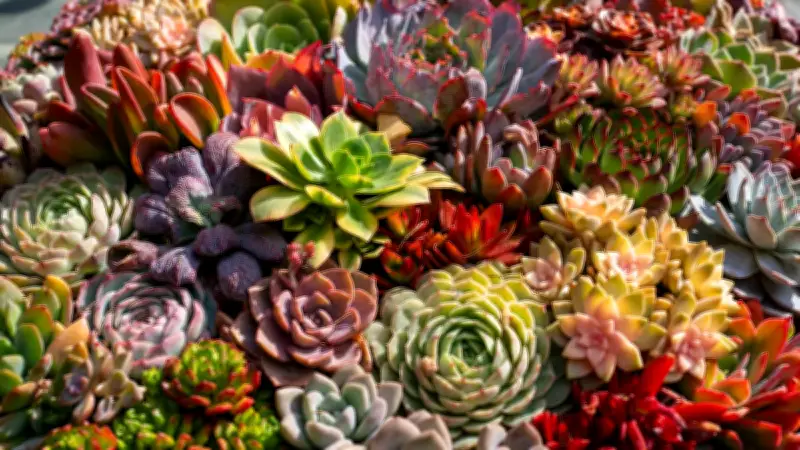
The visual range within succulents is extraordinary: geometric rosettes of Echeveria, architectural spines of Cactus, trailing stems of String of Pearls, the otherworldly forms of Lithops. A thoughtfully curated succulent collection can be as visually compelling as any other form of interior design.
Where to Start: Beginner Recommendations
For anyone considering building their first collection of water-efficient houseplants, starting simple is the right instinct. A few well-chosen plants that you learn to care for properly will always outperform a large collection you're uncertain about.
Aloe Vera is arguably the most forgiving plant on earth. It tolerates neglect, irregular watering, and a wide range of light conditions. It also has practical value; the gel from a broken leaf has real soothing properties for minor burns and skin irritation. Place it on a sunny windowsill, water it once a fortnight, and it will reward you with very little drama.
Jade Plant (Crassula ovata) is a classic for a reason. Slow-growing, long-lived, and structurally elegant, a mature Jade Plant looks genuinely impressive. It handles low light better than many succulents and is nearly impossible to kill through underwatering.
Haworthia is the indoor succulent par excellence. Unlike most of its relatives, it genuinely prefers lower light, which makes it ideal for rooms without direct sun. Its architectural, striped leaves add textural interest to any shelf or desk.
Echeveria varieties are among the most visually arresting plants you can grow indoors. Their tight rosette form, available in greens, blues, purples, and pinks, photographs beautifully and looks equally good in ceramic pots or terracotta. They do need good light, so a bright windowsill is ideal.
Small Cactus, particularly compact varieties like Mammillaria or Gymnocalycium, are excellent for desks and shelves where space is truly limited. They require almost no watering and can go months without attention.
Choosing the right growing medium matters just as much as watering frequency. Standard potting soil retains far too much moisture for succulents and can cause root rot within weeks. A well-draining soil mix, either commercial or homemade, is essential.
For those drawn to flowering varieties, flowering succulents like Kalanchoe, Crown of Thorns, and Christmas Cactus add seasonal colour without the water demands of traditional flowering houseplants.
The Future of Home Greenery Is Sustainable by Design
The trajectory here is clear. As urban populations grow, as water becomes more contested, as apartment sizes shrink and environmental awareness deepens, the plants that survive in our homes will increasingly be those that ask the least of us and of the planet.
For anyone considering building their first collection of water-efficient houseplants, succulent plants are a very good option. This isn't a compromise. The design possibilities within drought-tolerant plants are genuinely limitless; a well-assembled succulent collection, housed in thoughtfully chosen pots, is as aesthetically rich as any other form of indoor planting. The difference is that it is also responsible.
There is a broader cultural shift underway too. Younger urban consumers are increasingly making choices in food, fashion, travel, and now home decoration through the lens of sustainability. A plant that thrives on rainwater, that propagates itself for free, that can be started from seeds without specialist knowledge, fits this worldview naturally.
The future of urban greenery isn't a lush tropical forest crammed into a studio apartment. It's something quieter and smarter: a considered collection of plants that earn their place by asking very little and giving quite a lot. Water-efficient houseplants, succulents above all, are already that future. Most city dwellers just haven't caught up yet.