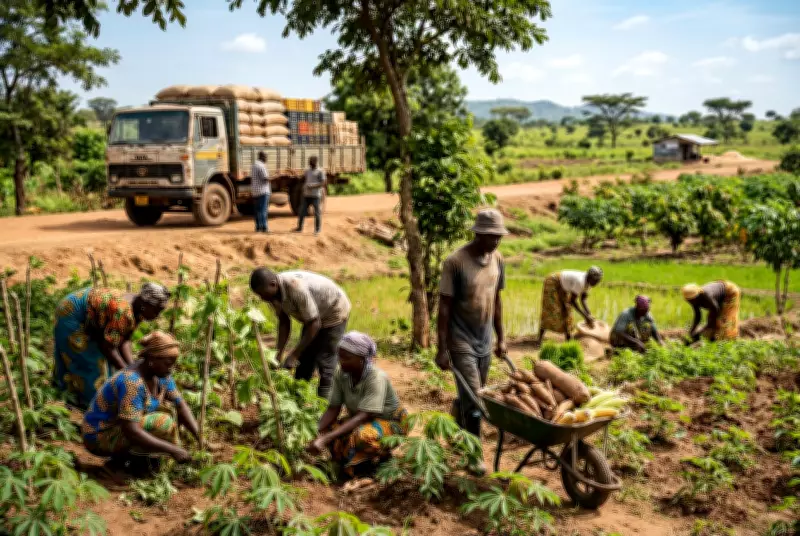
If you have ever wondered what crops Nigeria grows, this article provides a thorough answer based on extensive research and professional experience covering the country's economic and cultural landscape. Nigeria's agricultural story is one of extraordinary potential meeting significant challenges. The country sits on roughly 70.8 million hectares of agricultural land, stretching from the humid rainforests of the south to the semi-arid savannah of the north. This climatic range allows Nigeria to cultivate an unusually diverse catalogue of crops, which directly impacts national food security, household income, export revenue, and daily meals for millions of Nigerians.
What Are the Main Crops Grown in Nigeria?
Nigeria's agricultural geography divides into three ecological zones. The southern rainforest belt supports oil palm, cocoa, rubber, and plantain. The middle belt produces yam, cassava, maize, soybeans, and sorghum. The northern savannah belt is the heartland of groundnut, millet, cotton, and rice production. The Federal Ministry of Agriculture and Food Security classifies Nigerian crops into food crops and cash crops. Food staples include cassava, yam, maize, rice, sorghum, millet, cowpeas, and plantain. Cash crops include cocoa, rubber, palm oil, groundnut, cotton, sesame, and ginger. Nigeria is the world's largest producer of cassava, with over 60 million metric tonnes annually, and the crop is embedded in Nigerian food culture as garri, fufu, and tapioca.
How to Understand Nigeria's Crop Landscape
Start with climate zones: the south receives 1,500mm to 3,000mm of rain annually, while the north receives as little as 500mm. Distinguish food crops from cash crops. Know major producing states: cassava is heaviest in Benue, Kogi, Cross River, Ondo, and Ogun; cocoa is concentrated in Ondo, Ogun, Osun, and Ekiti; groundnut is centred in Kano, Katsina, and Jigawa. Understand that 80% of Nigerian farmers are smallholders cultivating less than two hectares, accounting for 90% of output. Factor in post-harvest losses of 30% to 40%, which can exceed 50% for tomatoes. Consult research institutions like the Agricultural Research Council of Nigeria. Follow government programmes such as the Anchor Borrowers Programme and NIRSAL, which influence crop planting decisions.
What Crop Is Nigeria Famous For?
Cassava defines Nigeria's agricultural identity globally, with the country being the world's largest producer for decades. Cocoa was Nigeria's most valuable export in the 1960s and 1970s, financing free primary education in the Western Region. Nigeria is the world's fourth-largest cocoa producer. Yam is another dominant crop, with Nigeria producing roughly 70% of the world's total output. Palm oil completes the quartet, as Nigeria was the world's largest exporter before independence. Today, palm oil cultivation remains essential in Rivers, Akwa Ibom, Cross River, Imo, Edo, and Delta states.
Nigeria's Key Crops: Production and Economic Data
The major crops include cassava (60+ million metric tonnes, primarily from Benue, Kogi, Cross River, Ondo), yam (45+ million metric tonnes, from Benue, Taraba, Plateau, Kogi), maize (10-12 million metric tonnes, from Kaduna, Kano, Benue, Ogun), sorghum (6-7 million metric tonnes, from Kano, Katsina, Borno, Sokoto), millet (4-5 million metric tonnes, from Kano, Jigawa, Sokoto, Borno), rice (4-5 million metric tonnes, from Kebbi, Ebonyi, Anambra, Niger), groundnut (3-4 million metric tonnes, from Kano, Katsina, Jigawa), cocoa (280,000-340,000 metric tonnes, from Ondo, Ogun, Osun, Ekiti), palm oil (1+ million metric tonnes, from Rivers, Akwa Ibom, Edo, Cross River), and cotton (200,000-400,000 metric tonnes, from Katsina, Kebbi, Zamfara, Anambra). Nigeria dominates global output in root and tuber crops but performs below potential in cash crops like cocoa and palm oil due to post-independence neglect.
What Are the Top 3 Imports of Nigeria?
Nigeria spends over $10 billion annually importing food while earning less than $400 million from agricultural exports. The top three food imports by value are wheat, rice, and sugar. Wheat is grown in very limited quantities, with domestic production covering nowhere near demand. Rice production has increased but still falls short of the roughly 7 million metric tonnes consumed annually. Sugar is primarily imported from Brazil and India, as domestic production covers only a fraction of demand. Other major imports include fish, tomato paste, wheat flour, and vegetable oils.
What Are the 10 Economic Crops in Nigeria?
Economic crops cultivated primarily for income include cocoa, palm oil and palm kernel, rubber, groundnut, sesame, cotton, ginger, cashew, shea, and tobacco. Cocoa is the most historically significant cash crop. Palm oil has deep roots in the south-south and south-east. Rubber is cultivated in Edo, Delta, Ondo, and Cross River states. Groundnut was a leading export before the oil boom. Sesame has grown remarkably, with Nigeria now among the world's top exporters. Cotton was a pre-independence giant, but its industry collapsed in the 1980s and 1990s. Ginger is an increasingly important cash crop, with Nigeria being the world's largest producer by volume. Cashew production has expanded significantly, making Nigeria Africa's leading cashew producer. Shea is harvested from wild trees across north-central and northwestern states. Tobacco has significant commercial history in Oyo, Ogun, and Plateau states.
What Crops Does Nigeria Grow Best? The Honest Conclusion
Nigeria grows a remarkable breadth of crops across its climatic zones, leading the world in cassava and yam production, ranking among the global top five in ginger, cashew, and sesame, and holding historic significance in cocoa, palm oil, and groundnut. The country has 70.8 million hectares of agricultural land and over 80 million rural residents dependent on farming. However, the challenge lies in the gap between what farmers plant and what they harvest, between harvested produce and market access, and between market supply and national needs. Post-harvest losses, poor rural roads, inadequate irrigation, high input costs, limited financing, and a weakened extension system undermine Nigeria's agricultural endowment. Closing this gap requires sustained investment, policy continuity, and support for smallholder farmers who feed most of the nation. The potential of what crops Nigeria grows is enormous, and the work of realising that potential is ongoing.
Key Takeaways
- Nigeria is the world's leading producer of cassava and yam, and a significant global producer of ginger, sesame, cashew, and cocoa.
- Despite this production, Nigeria spends over $10 billion annually importing wheat, rice, sugar, and other foods, revealing a structural gap between production potential and food self-sufficiency.
- Closing the gap requires supporting smallholder farmers with better seeds, accessible credit, functional rural roads, and post-harvest storage infrastructure.
Frequently Asked Questions
What is the number one crop grown in Nigeria?
Cassava is Nigeria's number one crop by volume, with over 60 million metric tonnes produced annually. It is the most widely consumed staple food, eaten as garri, fufu, and tapioca across all geopolitical zones.
Does Nigeria grow rice?
Yes, Nigeria grows rice in states like Kebbi, Ebonyi, Niger, and Anambra. However, domestic production falls short of the approximately 7 million metric tonnes consumed annually, necessitating imports.
What food crops does Nigeria grow in the north?
Northern states primarily grow millet, sorghum, groundnut, cowpeas, maize, and onions, with limited wheat in Borno and Plateau. Cotton, sesame, and ginger are important cash crops in north-central and northwestern regions.
Is Nigeria the largest producer of yam in the world?
Yes, Nigeria produces approximately 70% of the world's total yam supply. Benue, Taraba, Plateau, Kogi, and Nasarawa states are the primary yam-growing regions.
What cash crops does Nigeria export?
Nigeria's main agricultural exports are cocoa, sesame, cashew, palm oil, rubber, ginger, and cotton. Cocoa is the most historically significant, while sesame and cashew have grown considerably in export value.
Why does Nigeria import food despite growing so much?
Food imports are driven by post-harvest losses of up to 40%, poor rural infrastructure, production volumes falling short of demand for staples like wheat and rice, and inadequate processing capacity.
What crops grow best in southern Nigeria?
Southern Nigeria's humid climate supports oil palm, cocoa, rubber, plantain, banana, cassava, yam, and a wide range of fruits and vegetables. Cross River, Ondo, Delta, and Edo states are particularly productive.
Does Nigeria grow wheat?
Nigeria grows wheat in very small quantities, mainly in Borno, Plateau, and parts of the northwest during the cool dry season. Domestic production covers only a tiny fraction of national demand, with most wheat imported from the United States and Canada.
What is the most important cash crop in Nigeria historically?
Cocoa holds the most significant historical position, having financed free primary education in the old Western Region and representing Nigeria's leading agricultural export through the 1960s.
How many hectares of arable land does Nigeria have?
Nigeria has approximately 70.8 million hectares of agricultural land, a significant portion of which remains underutilised. The Federal Ministry of Agriculture and Food Security cites this as the foundation for achieving food self-sufficiency.
What role does the government play in Nigerian crop production?
The Federal Ministry of Agriculture and Food Security sets policy, manages input subsidy programmes, and coordinates food security initiatives. The Agricultural Research Council of Nigeria oversees a national network of crop-specific research institutes.
What is Nigeria's newest economic crop opportunity?
Sesame has emerged as one of Nigeria's fastest-growing export crops, with Benue, Nasarawa, Taraba, and Cross River states leading production. Nigeria is among the world's top sesame exporters, supplying Japan, China, and South Korea.