
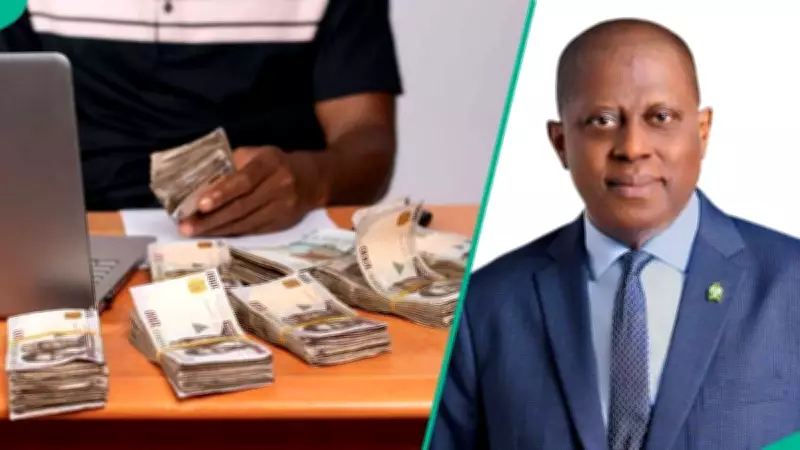
Nigerian Naira Records Best Exchange Rate Performance Since May 2024
The Nigerian currency has demonstrated remarkable strength in the official foreign exchange market, achieving its most favorable exchange rate against the United States dollar in over eight months. Central Bank of Nigeria Governor Olayemi Cardoso has expressed visible excitement about this development, highlighting how sustained monetary reforms are beginning to yield positive results.
Official Market Performance Shows Significant Improvement
Data published on the Central Bank of Nigeria's official website reveals that the naira closed at N1,354.9 per dollar in the official market on Monday, February 9. This represents a substantial improvement from the N1,384.5 per dollar recorded during the corresponding Monday of the previous week. Market analysts have confirmed that this marks the naira's strongest exchange rate performance since May 29, 2024, when it closed at N1,329.65 per dollar.
The currency's appreciation was not limited to the US dollar alone. Against the British pound sterling, the naira gained N12.03 to settle at N1,845.72 per pound, compared to the previous Friday's closing price of N1,857.75 per pound. However, the currency experienced a slight depreciation against the euro, declining by 69 kobo to quote at N1,613.19 per euro.
Parallel Market Also Shows Positive Momentum
Traders operating in the parallel market have confirmed similar positive trends, with the naira trading at its strongest levels in several months. According to Abdullahi, a Bureau de Change operator in Lagos, the exchange rates on Monday were as follows:
- The US dollar traded between N1,435 and N1,450
- The British pound traded between N1,960 and N2,000
- The euro traded between N1,670 and N1,710
This parallel market performance indicates broad-based strengthening of the Nigerian currency across different trading platforms.
CBN Governor Expresses Optimism About Future Prospects
Speaking at the National Economic Council Conference in Abuja on Monday, February 9, Governor Cardoso highlighted several encouraging developments in the foreign exchange market. He noted that the gap between official and parallel market rates has narrowed significantly, now standing at under 2%, compared to much wider disparities observed in previous months.
"When you travel now, you don't have to look for foreign exchange; you can use your naira card and pay for whatever you want," Cardoso stated, emphasizing how improved liquidity has reduced pressure on the naira and eliminated the previous scramble for foreign exchange among businesses and travelers.
The CBN governor also revealed that the apex bank is now buying foreign exchange from the market rather than selling, which represents a significant shift indicating improving confidence and market sustainability. This development suggests that Nigeria's external reserves are strengthening, moving the country toward a more market-driven foreign exchange system.
Economic Experts Weigh In on Positive Outlook
Muda Yusuf, Chief Executive Officer of the Centre for the Promotion of Private Enterprise, shared his perspective with Legit.ng, stating: "The outlook for 2026 looks promising, with expectations of stronger economic growth, lower inflation, rising investor confidence, and a shift toward more inclusive development."
Yusuf further emphasized that if current reforms continue and security challenges are adequately addressed, 2026 could usher in a period of stronger growth and noticeable improvements in people's living standards.
Naira Exits Africa's Worst-Performing Currencies List
In a related development, the naira's improved performance toward the end of 2025 helped it exit Africa's top ten worst-performing currencies list, ending nearly two years on the bottom-ten ranking. Analysis using the Forbes currency calculator shows that the naira left this undesirable list in October 2025 and had not reappeared as of December.
This positive movement has been supported by multiple factors including:
- Improving external reserves
- Consistent policy reforms by monetary authorities
- Better foreign exchange liquidity across markets
According to Forbes data, São Tomé and Príncipe's dobra was Africa's weakest currency last year, while Nigeria's naira demonstrated remarkable recovery from its previous position among the continent's poorest-performing currencies.
Long-Term Economic Implications
Governor Cardoso emphasized that strengthening external reserves and moving toward a market-driven foreign exchange system are critical components for attracting foreign direct investment. These developments support Nigeria's long-term goal of building a $1 trillion economy, as outlined in various government economic blueprints.
The Central Bank attributes the currency's recent strength to reforms focused on three key areas:
- Disinflation measures to control price levels
- Foreign exchange market normalization
- Banking sector resilience and stability
As the naira continues to demonstrate competitive strength within the West African sub-region, economic observers remain cautiously optimistic about sustained improvements in Nigeria's currency performance and broader economic indicators.




