
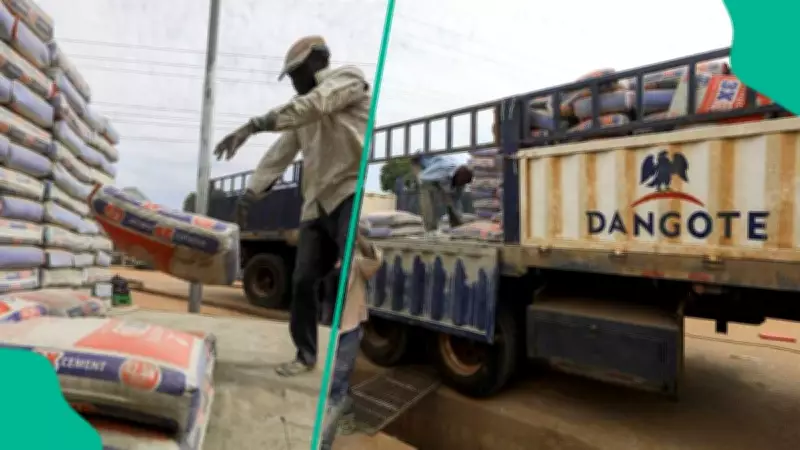
Cement Prices Surge Above N10,000 Per Bag Across Nigeria as Dangote, BUA Lead Hike
In a significant development affecting the construction sector, cement prices have risen sharply above N10,000 per 50kg bag across multiple Nigerian states. Major industry players, including Dangote Cement, BUA Cement, Lafarge Africa, and Mangal Cement, have implemented upward price adjustments, with new quotes ranging from N10,500 to as high as N11,500 in some areas. This increase marks a notable shift from earlier rates, which hovered around N9,000 to N9,700 per bag in late 2025 and early 2026.
Regional Price Variations and Market Impact
A comprehensive market survey conducted in states such as Kwara, the Federal Capital Territory (FCT), Kano, Kaduna, Jigawa, and Lagos reveals widespread price hikes. In Kwara state, particularly in Ilorin, cement that previously sold for between N9,300 and N9,700 per bag now averages N10,500 to N10,700. Dangote Cement has increased from about N9,500 to between N10,500 and N10,600, while BUA Cement now sells for roughly N10,600 to N10,700, up from N9,500–N9,600. Lafarge Africa products are within the same N10,600–N10,700 range, and Mangal Cement, once the most affordable at N9,300–N9,400, is now priced between N10,500 and N10,600.
In Abuja, retail prices have escalated further, with BUA cement reaching as high as N11,200 per bag in markets like Utako. Dangote Cement sells for around N10,800 to N11,000, though dealers note that bulk purchases of 900 bags can secure discounts to about N10,500 per bag. However, such options are often inaccessible to small-scale builders and individual consumers.
Dealer Explanations and Consumer Concerns
Industry dealers attribute the price increases to a combination of factors, including higher production costs, elevated logistics expenses, and rising statutory obligations such as taxes. In Kano, for instance, dealers report that manufacturers now supply BUA cement at about N10,500, Dangote at N10,450, and Mangal at N10,550 per bag. After adding overheads, retail prices range between N10,800 and N11,000. Similarly, in Kaduna, BUA cement is quoted at N10,900, while Dangote and Mangal sell for around N10,800. In Jigawa, some dealers confirm prices as high as N11,000 per bag.
Consumers and retailers, however, express frustration over the financial strain. In Lagos, where prices have climbed from about N9,000 in December 2025 to N10,000 in January 2026 and recently to as much as N11,500 in some areas, some retailers blame middlemen for inflating prices beyond manufacturer charges. A seller in Ojo explained that retailers often purchase from intermediaries rather than directly from producers, leading to significant markups. Another trader in Badagry argued that transportation costs alone do not justify the current retail prices, though dealers have not publicly responded to these allegations.
Cross-Border Pricing and Industry Observations
Adding to the controversy, some dealers have raised concerns about price disparities between Nigeria and neighbouring countries. A Kano-based dealer claimed that Nigerian manufacturers sell cement at lower effective prices in nearby nations. For example, a Nigerian resident in Niamey, Niger Republic, reported that BUA cement sells for about 3,000 CFA francs per bag, equivalent to roughly N7,500 depending on exchange rates. Industry observers caution that export pricing may reflect differences in taxes, logistics, exchange rates, and promotional strategies, making direct comparisons with domestic prices complex.
Impact on Construction and Housing Projects
The rising cement costs are already having a tangible impact on construction activities. Block makers in Kano have increased prices for nine-inch special blocks from N750 to N800 due to the higher cement costs. Stakeholders warn that this trend could slow down building projects nationwide. Former president of the Nigerian Institute of Builders, Kunle Awobodu, expressed concern, noting that high cement prices weaken purchasing power and discourage building activity. He called on the federal government to engage manufacturers and explore measures to ease production costs and improve affordability.
A representative from a cement manufacturer, speaking anonymously, indicated that the price adjustments are industry-wide and partly linked to imported inputs priced in dollars. He suggested that prices may moderate if the naira strengthens further. For many households, the immediate effect is higher project costs; a two-bedroom bungalow can require hundreds of bags of cement, meaning a N1,000 increase per bag could add hundreds of thousands of naira to total construction expenses.
Broader Economic Context and Policy Implications
This price surge occurs against a backdrop of broader economic challenges in Nigeria. According to a report by Agora Policy, a Nigerian policy think tank, weak competition and high market concentration are key reasons cement prices remain high despite surplus production capacity. The think tank called for competition reforms rather than reopening imports to address affordability issues. As N10,500 becomes the new baseline in many cities, with N11,000 increasingly common, stakeholders emphasize the need for strategic interventions to stabilize the market and support the construction sector, which is vital for economic growth and housing development.




