
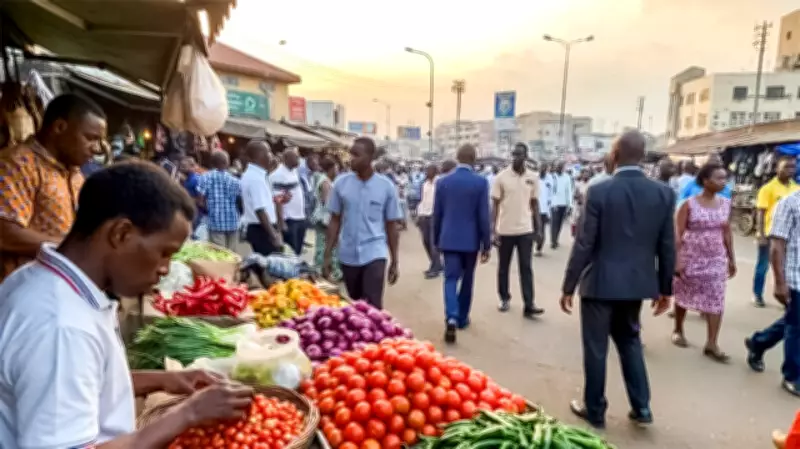
Worsening cost-of-living pressures have overshadowed this year's May Day celebrations in Nigeria, as workers grapple with rising prices despite a recent increase in the minimum wage. As the Nigeria Labour Congress and the Trade Union Congress mark Workers' Day, demands for wage increases, palliatives, and steps to address insecurity dominate proceedings.
The conflict between Iran and the United States has driven up the price of Premium Motor Spirit from around N780 to N1,400 per litre, pushing basic items beyond reach. Workers under the N70,000 minimum wage struggle with eroded purchasing power due to inflation and escalating fuel costs.
Labour Leaders Speak Out
NLC President Joe Ajaero warned that worsening economic conditions undermine workers' welfare and national productivity. He stated that insecurity and poverty have become major obstacles to decent work, with millions trapped below the poverty line. TUC President Festus Osifo called for stronger solidarity to combat poverty and insecurity, emphasizing that decent work is non-negotiable.
Economic Data Highlights Hardship
In July 2024, the N70,000 minimum wage was equivalent to $43.19 at N1,472 per dollar. By March 2026, inflation stood at 15.38 per cent year-on-year. Workers argue living conditions were better in 2019 with a N30,000 minimum wage when the exchange rate was N357 to the dollar. A bag of imported rice rose from N7,000 in 2019 to N57,000 now, while local rice surged from N12,000 to between N53,000 and N95,000.
Other food items have seen sharp increases: a big bag of melon rose 30.69 per cent to N330,000, a basket of round tomatoes increased to N65,000, and a 50kg bag of garri rose 25 per cent to N25,000. Royal Stallion rice increased 13.2 per cent to N60,000, and Honeywell semovita 5kg rose 13.85 per cent to N7,400.
World Bank and Analysts' Views
The World Bank's Nigeria Development Update noted macroeconomic improvements but stated these have yet to translate into improved living standards, highlighting high food inflation and widespread poverty. Analysts say inflation deceleration and food price declines are insufficient to ease hardship. Data shows locally produced rice fell 10.94 per cent year-on-year to N1,841.83 per kilogram, while brown beans dropped 48.65 per cent.
Nigeria's inflation rate declined from 18.85 per cent in 2023 to 15.38 per cent in March 2026. Unemployment stands at 5.3 per cent under revised methodology, but analysts say using previous metrics would approach 40 per cent.
Urgent Need for Another Wage Increase
Labour states that with rising energy costs and a minimum wage no longer sufficient, another increase is urgent. The Minimum Wage Act 2024 sets the next review for 2027, but labour leaders begin early advocacy for improved welfare. President Tinubu is expected to join labour in Abuja for the celebrations.
Dr. Toyin Olawunmi of Chrisland University warned that insecurity and poverty threaten decent work and national stability. He described burdens including insecurity tax, inflation tax, and transport tax, stating, "Nigeria cannot build decent work on frightened communities."
Rufus Olusesan of the Precision Electrical and Related Equipment Senior Staff Association accused the government of bribery and corruption, saying, "Seven litres of fuel costs N10,000; factoring it into salaries, it cannot take anybody home." Segun David of the Chemical and Non-Metallic Products Senior Staff Association noted the minimum wage cannot cover transportation, and for a worker supporting up to 10 dependents, the renewed hope agenda is fading.
CPPE Advocates Shift in Approach
Dr. Muda Yusuf of the Centre for the Promotion of Private Enterprise called for a shift from wage hikes to real income protection. In a policy brief, he argued that periodic wage increases are eroded by food inflation, energy costs, and deteriorating public services. He identified 10 priorities: cost of living and price stability, healthcare, retirement security, job security, energy costs, transportation, housing, skills development, social protection, and tax reform.
He called for investment in mass transit, agricultural productivity, affordable housing, expanded health insurance, pension compliance, and inflation-linked wage adjustments. "A comprehensive welfare framework anchored on structural reforms is imperative," he said.




